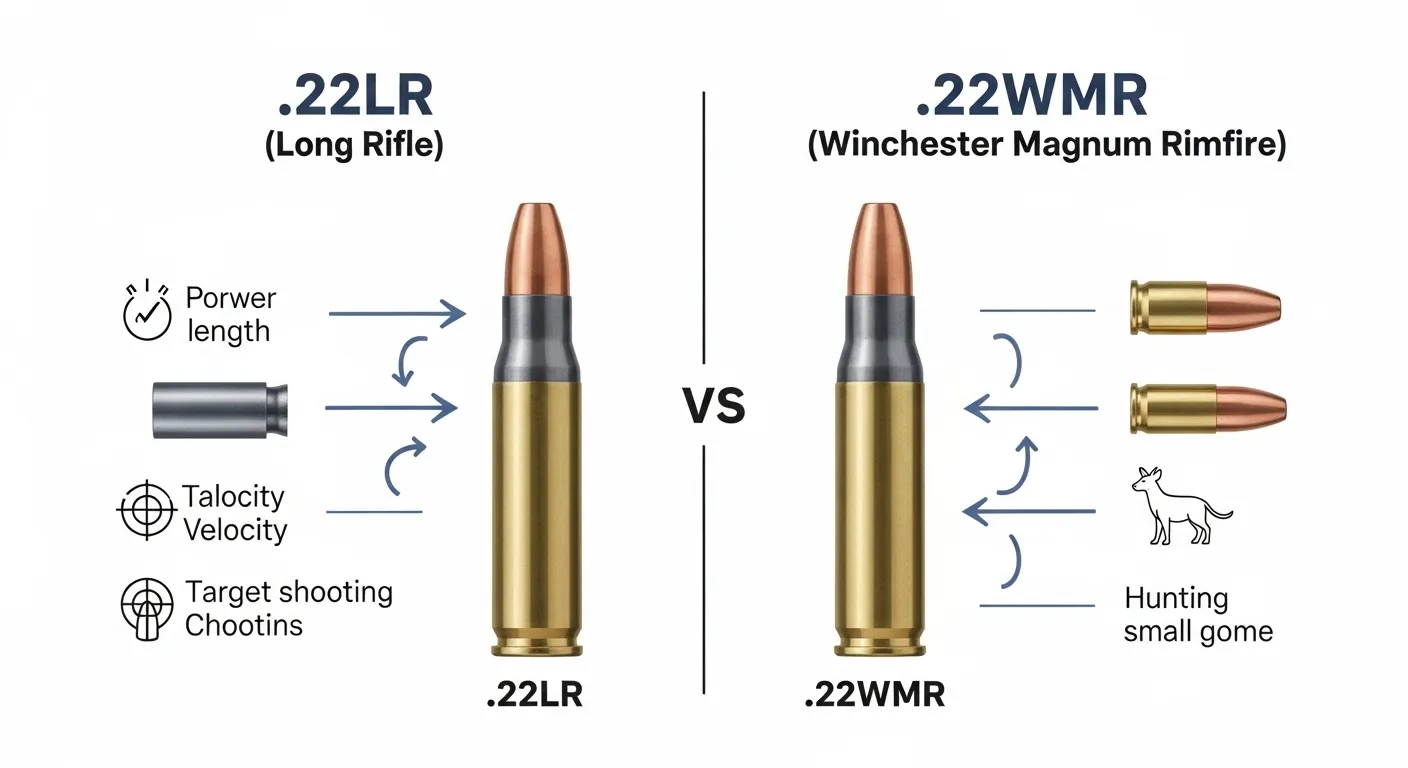
Imagine a beginner shooter visiting a shooting range for the first time. The instructor places two small cartridges on the table and says, “These are .22LR and .22WMR.” At first glance, they look similar. Both are small rimfire cartridges and both are commonly used for target shooting and small-game hunting. However, their performance, power, and purpose are quite different.
Understanding the difference between 22LR and 22WMR is important for anyone interested in shooting sports, hunting, or firearms education. Many learners search for the difference between 22LR and 22WMR because the cartridges appear nearly identical but behave differently in rifles and revolvers. The difference between 22LR and 22WMR becomes clear when we examine their size, velocity, and intended use. Knowing the difference between 22LR and 22WMR helps beginners choose the right ammunition and allows experts to make better decisions in the field.
Both cartridges belong to the rimfire family, but their design goals are different. To truly understand the topic, we must explore their characteristics in detail.
Pronunciation
| Cartridge | US Pronunciation | UK Pronunciation |
| 22LR | “twenty-two L-R” /ˌtwɛn.tiˈtuː ɛl ɑːr/ | “twenty-two L-R” /ˌtwɛn.tiˈtuː ɛl ɑː/ |
| 22WMR | “twenty-two W-M-R” /ˌtwɛn.tiˈtuː ˌdʌbəl.juː ɛm ɑːr/ | “twenty-two W-M-R” /ˌtwɛn.tiˈtuː ˌdʌbəl.juː ɛm ɑː/ |
Before diving deeper, let us explore the difference between 22LR and 22WMR in detail so readers can clearly understand their features and uses.
Difference Between 22LR and 22WMR
1. Cartridge Size
22LR:
The .22 Long Rifle cartridge is smaller and more compact.
Example 1: A beginner practicing at a shooting range often uses .22LR because it fits smaller rifles easily.
Example 2: Many training pistols are designed specifically for the smaller .22LR cartridge.
22WMR:
The .22 Winchester Magnum Rimfire cartridge is longer and thicker.
Example 1: Hunting rifles designed for more power frequently use .22WMR.
Example 2: The larger cartridge case allows more powder for stronger shots.
2. Power
22LR:
It produces moderate power.
Example 1: It is suitable for target practice.
Example 2: It works well for small pests like rats.
22WMR:
It produces much higher power.
Example 1: Hunters use it for animals like foxes.
Example 2: It delivers stronger impact at longer distances.
3. Velocity
22LR:
Average velocity ranges between 1,100–1,300 feet per second.
Example 1: Target shooters appreciate its controlled speed.
Example 2: It allows accurate practice without heavy recoil.
22WMR:
Velocity can reach 1,900–2,200 feet per second.
Example 1: Hunters rely on its speed for longer shots.
Example 2: It travels faster and hits harder.
4. Cost
22LR:
It is one of the cheapest cartridges available.
Example 1: Shooting ranges often sell large packs for practice.
Example 2: Students learning marksmanship prefer it due to affordability.
22WMR:
It is more expensive.
Example 1: Hunters may buy smaller boxes for field use.
Example 2: Because of higher power, it costs more to produce.
5. Recoil
22LR:
Very light recoil.
Example 1: Beginners can shoot comfortably.
Example 2: Children learning shooting basics often start with it.
22WMR:
Stronger recoil than .22LR.
Example 1: Adult shooters feel slightly more kick.
Example 2: Hunters prefer it for stronger shots.
6. Noise Level
22LR:
Relatively quiet.
Example 1: Often used with suppressors where legal.
Example 2: Suitable for training environments.
22WMR:
Louder due to more powder.
Example 1: Produces a sharper sound.
Example 2: Hunters notice the stronger report.
7. Effective Range
22LR:
Effective range around 100–150 yards.
Example 1: Ideal for backyard target shooting (where allowed).
Example 2: Used for close-range pest control.
22WMR:
Effective range up to about 200 yards.
Example 1: Useful for longer hunting distances.
Example 2: Maintains energy farther from the shooter.
8. Intended Use
22LR:
Mostly used for training and sport shooting.
Example 1: Olympic training programs often include .22LR rifles.
Example 2: Plinking and recreational shooting.
22WMR:
Primarily used for hunting small to medium animals.
Example 1: Farmers may use it for predator control.
Example 2: Hunters use it for rabbits and coyotes.
9. Bullet Weight
22LR:
Typically 36–40 grains.
Example 1: Standard round-nose bullets.
Example 2: Hollow points for small pests.
22WMR:
Usually 30–50 grains.
Example 1: Heavier bullets for better penetration.
Example 2: Specialized hunting rounds.
10. Firearm Compatibility
22LR:
Only firearms designed for .22LR should use it.
Example 1: Training rifles chambered in .22LR.
Example 2: Many beginner pistols.
22WMR:
Requires firearms specifically chambered for .22WMR.
Example 1: Magnum rimfire rifles.
Example 2: Hunting revolvers designed for magnum cartridges.
Nature and Behaviour of Both
22LR Nature:
It is light, affordable, and easy to control. It behaves as a beginner-friendly cartridge designed mainly for practice, training, and recreational shooting.
22WMR Nature:
It is stronger, faster, and designed for hunting. It behaves like a powerful rimfire cartridge capable of greater distance and impact.
Why People Are Confused About Their Use
People often confuse these cartridges because they both begin with “.22” and look similar. The bullets are close in diameter, which makes them appear interchangeable. In reality, their casing size and pressure levels are different. This misunderstanding can lead to improper usage if someone assumes they are the same.
Table Showing Difference and Similarity
| Feature | 22LR | 22WMR | Similarity |
| Type | Rimfire cartridge | Rimfire cartridge | Both rimfire |
| Size | Smaller | Larger | Same bullet diameter |
| Power | Moderate | High | Both small-caliber |
| Cost | Cheap | Expensive | Widely available |
| Velocity | Lower | Higher | Used in rifles |
| Recoil | Very light | Slightly stronger | Beginner friendly |
| Noise | Quieter | Louder | Shooting sports |
| Range | Shorter | Longer | Used for small game |
| Purpose | Training & sport | Hunting | Outdoor use |
| Popularity | Extremely common | Less common | Known worldwide |
Which is Better in What Situation?
22LR:
The .22LR cartridge is better for beginners, training sessions, and target shooting. Its low cost allows shooters to practice for long hours without spending much money. Because it produces very little recoil and noise, it helps learners build confidence and accuracy. It is also useful for small pest control at short distances.
22WMR:
The .22WMR cartridge is better when more power and distance are required. Hunters often choose it for small animals such as rabbits, foxes, and similar game. Its higher velocity and stronger energy allow it to perform better in outdoor environments where the target may be farther away.
Metaphors and Similes
Writers sometimes use these terms metaphorically.
Examples:
- “His argument was like a .22LR—small but precise.”
- “Her response hit like a .22WMR, powerful and impossible to ignore.”
- “The idea spread like a fast magnum round.”
- “The joke landed softly like a quiet rimfire shot.”
Connotative Meaning
22LR
Connotation: Neutral to positive
Examples:
- “The project started like a .22LR—small but effective.”
- “His strategy was simple and precise like a .22LR shot.”
22WMR
Connotation: Positive and powerful
Examples:
- “Her speech hit the audience like a .22WMR.”
- “The announcement landed with magnum force.”
Idioms or Proverbs Related to the Words
Direct idioms using these exact terms are rare, but related firearm expressions exist.
“A shot in the dark.”
Example: His guess about the answer was just a shot in the dark.
“Bite the bullet.”
Example: She decided to bite the bullet and start the difficult task.
Works in Literature Mentioning the Cartridges
- “Rimfire Rifles” – Shooting Sports Guide (Technical Manual, various authors, 1990s)
- “The Gun Digest Book of Rimfire Rifles” – Patrick Sweeney, 2015
Movies Featuring Small-Caliber Rifles
- “Winter’s Bone” – 2010 – USA
- “No Country for Old Men” – 2007 – USA
Frequently Asked Questions
1. Are 22LR and 22WMR the same?
No. They are different cartridges with different sizes, power levels, and uses.
2. Which is more powerful?
22WMR is significantly more powerful than 22LR.
3. Can a 22LR gun shoot 22WMR?
No. Firearms must be specifically chambered for each cartridge.
4. Which is cheaper?
22LR is much cheaper and widely used for practice.
5. Which is better for hunting?
22WMR is usually better for hunting because of its higher velocity and energy.
How Both Are Useful for Surroundings
Both cartridges have practical uses in rural and outdoor environments. Farmers sometimes rely on them for pest control that threatens crops or livestock. Target shooters use them for sport and competitions. Their small size and manageable recoil make them practical tools for training and controlled shooting activities.
Final Words for Both
The 22LR represents simplicity, affordability, and precision training. It has become the most popular rimfire cartridge in the world.
The 22WMR, on the other hand, represents power and extended performance. It fills the gap between basic rimfire ammunition and larger centerfire cartridges.
Conclusion
Understanding the difference between 22LR and 22WMR helps shooters, learners, and outdoor enthusiasts choose the right cartridge for their needs. While both belong to the rimfire family and share a similar bullet diameter, their performance levels are very different. The .22LR is known for affordability, low recoil, and excellent training value, making it ideal for beginners and target practice. In contrast, the .22WMR offers higher velocity, stronger impact, and longer effective range, making it more suitable for hunting and outdoor use. By learning the characteristics, strengths, and limitations of each cartridge, users can make informed decisions and improve safety, accuracy, and overall shooting experience.

I’m Shabbir Hussain, a professional content writer who specializes in clear and authentic comparisons between similar terms. I write concise, research-based, and reader-friendly content that turns complex language into simple explanations. Through Mysynonyms.com, I help readers strengthen their vocabulary and clearly understand word differences.