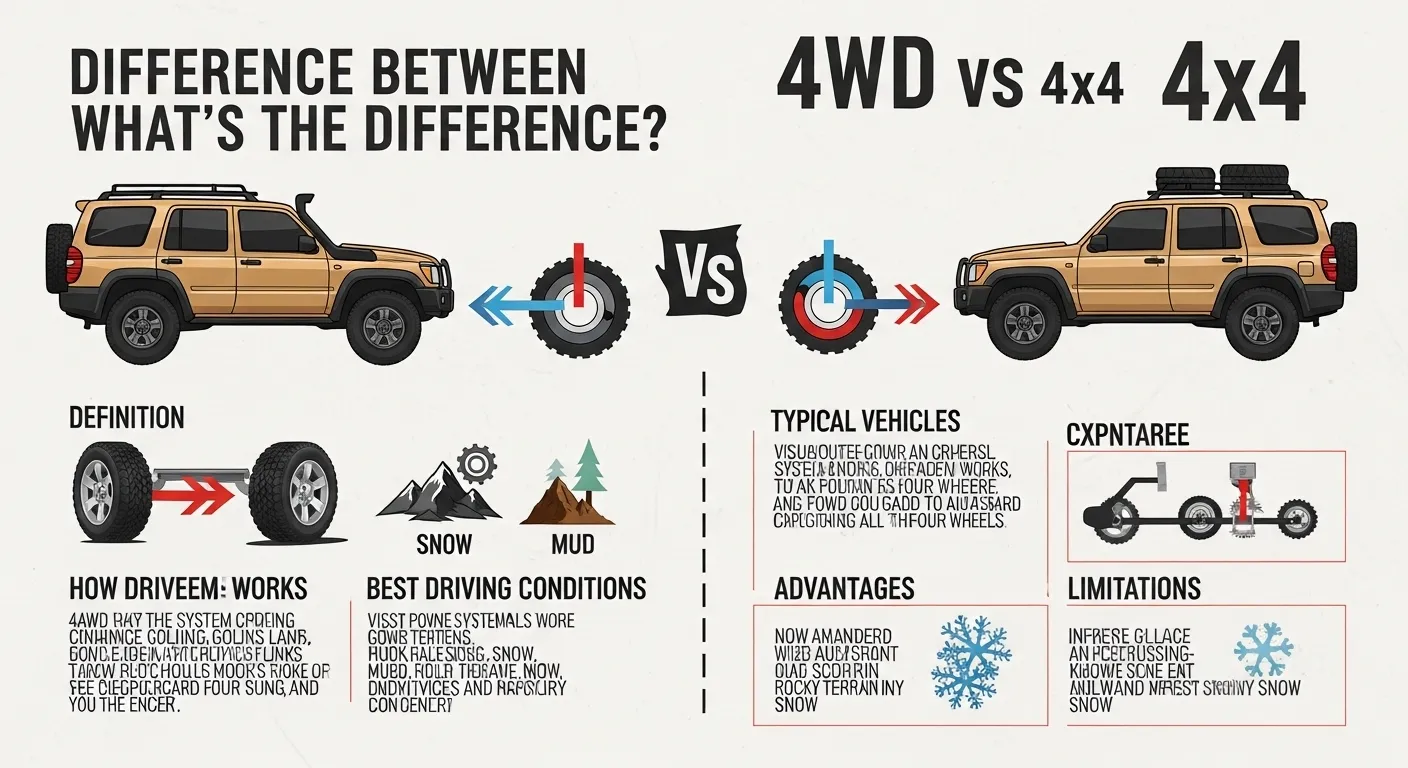
The difference between 4WD and 4×4 often confuses many drivers and vehicle buyers. Imagine a family traveling through a muddy village road after heavy rain. Their vehicle struggles for grip, but once the four wheels begin pulling together, the car moves smoothly through the mud. This situation shows why systems like 4WD and 4×4 exist.
Many people hear these terms in advertisements, car reviews, or off-road discussions but assume they mean the same thing. In reality, understanding the difference between 4WD and 4×4 can help drivers choose the right vehicle for rough roads, snow, sand, or mountains. The difference between 4WD and 4×4 also matters for mechanics, engineers, and outdoor enthusiasts who rely on traction and control.
Learning the difference between 4WD and 4×4 helps drivers understand how power reaches the wheels and why certain vehicles perform better in challenging environments.
Key Difference Between the Both
The main difference between 4WD and 4×4 is that 4WD (Four-Wheel Drive) is a broader term describing any system that powers all four wheels, while 4×4 usually refers to a specific type of four-wheel-drive system used mainly in trucks and off-road vehicles.
Why Their Difference Is Important for Learners and Experts
Understanding the difference between 4WD and 4×4 is important for drivers, mechanics, engineers, and outdoor travelers. For learners, it builds basic knowledge about vehicle systems and how traction works. Experts use this knowledge when designing vehicles, repairing drive systems, or choosing the best technology for specific terrains.
In society, vehicles equipped with these systems are essential for farming, rescue operations, military transportation, and adventure travel. A clear understanding of their differences helps people choose safer and more efficient vehicles for difficult road conditions.
Pronunciation of Both Terms
| Term | US Pronunciation | UK Pronunciation |
| 4WD | /fɔːr wiːl draɪv/ | /fɔː wiːl draɪv/ |
| 4×4 | /fɔːr baɪ fɔːr/ | /fɔː baɪ fɔː/ |
Linking Hook to the Main Discussion
Now that we understand the basic idea behind these terms, let’s explore the difference between 4WD and 4×4 in detail through practical features, examples, and real-world uses.
Difference Between 4WD and 4×4
1. Meaning
4WD:
4WD stands for Four-Wheel Drive, meaning the engine can send power to all four wheels.
Example 1: A mountain rescue vehicle uses 4WD to climb steep slopes.
Example 2: A farm truck uses 4WD to move across muddy fields.
4×4:
4×4 describes a vehicle with four wheels where all four receive power.
Example 1: A pickup truck labeled “4×4” drives through desert sand easily.
Example 2: A safari jeep uses a 4×4 system to cross rocky terrain.
2. Technical Usage
4WD:
It is a general term used in engineering and vehicle technology.
Example 1: Automotive manuals describe traction systems using the term 4WD.
Example 2: Car manufacturers explain drive systems as part-time or full-time 4WD.
4×4:
It is a simpler consumer label used in marketing.
Example 1: A truck badge reads “4×4” to indicate off-road capability.
Example 2: A dealership advertises a “4×4 SUV.”
3. System Complexity
4WD:
Often includes advanced systems like automatic torque distribution.
Example 1: Modern SUVs adjust power to wheels electronically.
Example 2: A luxury vehicle uses sensors to activate 4WD automatically.
4×4:
Usually refers to traditional mechanical systems.
Example 1: Drivers manually shift the vehicle into 4×4 mode.
Example 2: Older trucks use a mechanical lever to engage 4×4.
4. Usage Environment
4WD:
Suitable for many road conditions, including snow and rain.
Example 1: A family SUV uses 4WD on icy highways.
Example 2: A driver activates 4WD during heavy rainfall.
4×4:
Commonly designed for rugged off-road environments.
Example 1: A jeep crosses rocky trails in 4×4 mode.
Example 2: A desert vehicle uses 4×4 to climb sand dunes.
5. Driver Control
4WD:
Often controlled automatically.
Example 1: The system engages when wheels slip.
Example 2: Sensors adjust torque without driver input.
4×4:
Usually requires manual activation.
Example 1: The driver shifts a lever to engage 4×4.
Example 2: A button activates the 4×4 system.
6. Vehicle Types
4WD:
Used in SUVs, crossovers, and some sedans.
Example 1: A modern SUV includes a full-time 4WD system.
Example 2: A luxury crossover uses intelligent 4WD.
4×4:
Mostly found in trucks and off-road vehicles.
Example 1: A pickup truck carries a 4×4 badge.
Example 2: An off-road jeep runs with a 4×4 drivetrain.
7. Fuel Efficiency
4WD:
Often optimized for better fuel economy.
Example 1: Power goes to two wheels until needed.
Example 2: The system activates only when traction is low.
4×4:
Can consume more fuel due to constant power distribution.
Example 1: A heavy truck running 4×4 burns more fuel.
Example 2: Continuous power to all wheels increases energy use.
8. Technology Level
4WD:
Includes modern electronic control systems.
Example 1: Computers adjust wheel torque automatically.
Example 2: Sensors detect road conditions.
4×4:
Traditionally mechanical.
Example 1: Gear systems distribute power manually.
Example 2: The driver engages 4×4 through a transfer case.
9. Comfort and Handling
4WD:
Provides smoother driving on normal roads.
Example 1: A crossover with 4WD drives comfortably on highways.
Example 2: Drivers hardly notice the system working.
4×4:
Designed mainly for durability rather than comfort.
Example 1: Off-road trucks may feel rough on paved roads.
Example 2: Suspension is built for rugged terrain.
10. Marketing Terminology
4WD:
More technical and formal.
Example 1: Vehicle manuals use the term 4WD.
Example 2: Engineers discuss 4WD systems.
4×4:
More popular in advertising.
Example 1: A truck commercial highlights “Powerful 4×4 capability.”
Example 2: Showroom labels display “4×4 model.”
Nature and Behaviour of Both
4WD:
This system behaves intelligently by adjusting power distribution based on road conditions. It focuses on balance, traction, and safety.
4×4:
This system behaves like a rugged mechanical solution designed mainly for tough terrain and heavy-duty performance.
Why People Are Confused About Their Use
People often confuse these terms because both describe vehicles that power all four wheels. Manufacturers and advertisements sometimes use them interchangeably. Additionally, many drivers focus on performance rather than technical definitions, which increases misunderstanding.
Table Showing Difference and Similarity
| Feature | 4WD | 4×4 | Similarity |
| Meaning | General system | Specific drivetrain label | Both power four wheels |
| Technology | Often automatic | Usually manual | Improve traction |
| Vehicle Types | SUVs, crossovers | Trucks, jeeps | Used in off-road vehicles |
| Complexity | More advanced | Simpler mechanical | Increase vehicle control |
| Marketing | Technical term | Consumer-friendly label | Indicate strong performance |
Which Is Better in What Situation?
4WD:
4WD is better for everyday driving conditions where roads may occasionally become slippery. Drivers living in areas with rain, snow, or mild off-road paths benefit from this system. It automatically adjusts traction and improves safety without requiring manual control. Families and commuters often prefer 4WD vehicles because they combine comfort, efficiency, and stability in changing road conditions.
4×4:
4×4 is better for extreme off-road environments such as deserts, mountains, forests, or muddy farmland. Vehicles with this system are built for durability and strength. Adventurers, farmers, and rescue teams often rely on 4×4 vehicles because they can handle rough terrain and difficult driving situations.
Metaphors and Similes
4WD:
Metaphor: “Her teamwork approach was like 4WD—every part working together for success.”
Simile: “The team moved through problems like a 4WD vehicle on rough terrain.”
4×4:
Metaphor: “His determination was a 4×4 engine powering him through obstacles.”
Simile: “She faced challenges like a 4×4 truck climbing a mountain trail.”
Connotative Meaning
| Term | Connotation | Example |
| 4WD | Positive / Neutral | “The 4WD vehicle gave the family confidence in winter.” |
| 4×4 | Positive | “The 4×4 truck symbolized strength and adventure.” |
Idioms or Proverbs Related to the Words
Although there are no traditional idioms using these exact terms, similar expressions are used:
“Power through rough roads.”
Example: The team powered through rough roads like a 4×4 truck.
“Drive through obstacles.”
Example: She drove through obstacles with 4WD determination.
Works in Literature
- Four-Wheel Drive Adventures — Travel writing, Tom Sheppard, 1998
- The 4×4 Handbook — Adventure guide, Roger Williams, 2004
Movies Related to the Keywords
- “4×4” — 2019, Argentina
- “4×4” — 2022, India
Frequently Asked Questions
1. Is 4WD the same as 4×4?
No. 4WD is a broader term, while 4×4 usually describes a specific type of four-wheel-drive system.
2. Which is better for off-road driving?
4×4 systems are typically designed for extreme off-road environments.
3. Is 4WD better for everyday driving?
Yes. Many modern vehicles use automatic 4WD for normal road conditions.
4. Do all SUVs have 4WD?
No. Some SUVs use two-wheel drive or all-wheel drive systems.
5. Does 4×4 improve safety?
Yes. It improves traction on slippery or rough surfaces.
How Both Are Useful for Surroundings
Vehicles with 4WD or 4×4 systems help communities during floods, snowstorms, and rescue missions. Farmers use them to transport goods across muddy fields. Emergency services rely on them in remote areas where ordinary vehicles cannot travel.
Final Words for Both Terms
Both 4WD and 4×4 represent technologies designed to improve traction and mobility. While their meanings overlap, understanding their technical and practical differences helps drivers make smarter choices.
Conclusion
Understanding the difference between 4WD and 4×4 is useful for anyone interested in vehicles, driving safety, or off-road travel. Although these terms are often used interchangeably, they represent slightly different concepts in automotive technology. 4WD is a broader technical term describing systems that power all four wheels, while 4×4 is commonly used as a label for rugged off-road vehicles. Both systems provide improved traction, stability, and performance in challenging road conditions. By learning their differences, drivers, learners, and experts can better understand vehicle capabilities and choose the right system for their needs.

I’m Shabbir Hussain, a professional content writer who specializes in clear and authentic comparisons between similar terms. I write concise, research-based, and reader-friendly content that turns complex language into simple explanations. Through Mysynonyms.com, I help readers strengthen their vocabulary and clearly understand word differences.