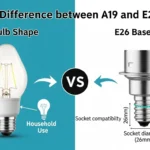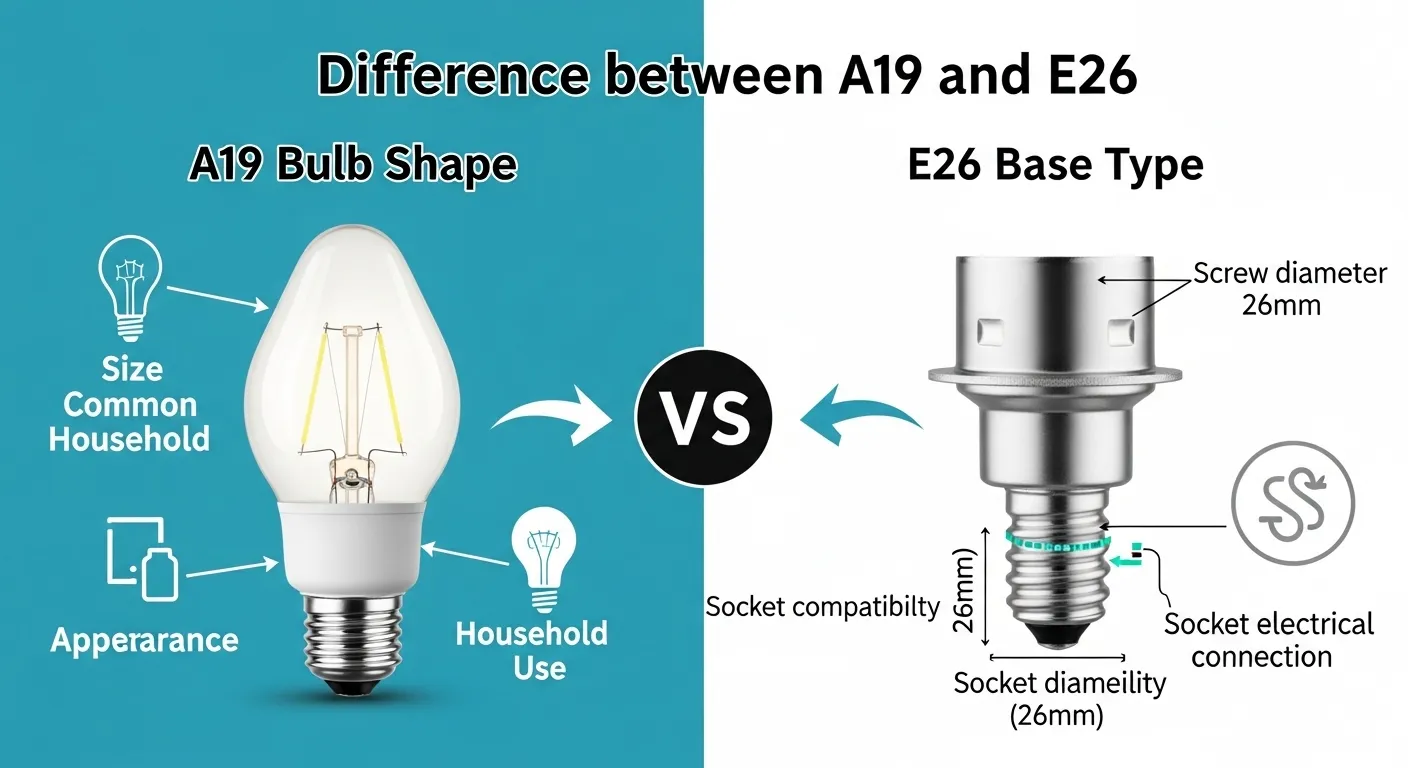
A19 and E26 are both related to light bulbs, but A19 refers to the bulb’s shape and size, while E26 refers to the base type that screws into the socket.
Understanding the difference between A19 and E26 is important when choosing the right light bulb for your home or workplace. Imagine buying a bulb that looks perfect but doesn’t fit your socket, that’s where knowing these terms becomes useful.
The difference between A19 and E26 lies in what they describe. A19 refers to the bulb’s shape and diameter, while E26 refers to the screw base size used in most standard fixtures. Learning the difference between A19 and E26 helps you avoid mismatches and ensures proper lighting. By understanding the difference between A19 and E26, you can make smarter purchasing decisions and improve lighting efficiency.
Pronunciation
A19
US: /ˌeɪˌnaɪnˈtiːn/
E26
US: /ˌiːˌtwɛntiˈsɪks/
Key Difference Between the Both
The main difference between A19 and E26 is that A19 describes the bulb’s shape and size, while E26 describes the base that fits into the socket.
Why Is Their Difference Necessary to Know for Learners and Experts?
Knowing the difference between A19 and E26 is essential for homeowners, electricians, and students. For learners, it builds basic knowledge of lighting systems. For experts, understanding the difference between A19 and E26 ensures proper installation and compatibility.
In daily life, lighting plays a key role in comfort and productivity. Misunderstanding the difference between A19 and E26 can lead to buying the wrong bulb or facing installation issues.
Difference Between A19 and E26
1. Definition
A19 is a bulb shape. E26 is a base type.
Examples
A19:
- Standard bulb shape.
- Rounded design.
E26:
- Screw base.
- Fits standard sockets.
2. Function
A19 defines appearance. E26 defines fitting.
Examples
A19:
- Determines light spread.
- Affects design.
E26:
- Connects to socket.
- Provides electrical contact.
3. Measurement
A19 refers to diameter (in eighths of an inch). E26 refers to base diameter in millimeters.
Examples
A19:
- About 2.375 inches wide.
- Standard size.
E26:
- 26 mm base.
- Common size.
4. Usage
A19 is used for general lighting. E26 is used in most household fixtures.
Examples
A19:
- Lamps.
- Ceiling lights.
E26:
- Home sockets.
- Light fixtures.
5. Compatibility
A19 bulbs often come with E26 bases. E26 bases fit many bulb shapes.
Examples
A19:
- Usually paired with E26.
- Common combo.
E26:
- Works with A19, A15, etc.
- Versatile.
6. Category
A19 belongs to bulb shape category. E26 belongs to base category.
Examples
A19:
- Shape classification.
- Design feature.
E26:
- Base classification.
- Connection type.
7. Importance
A19 affects light distribution. E26 affects installation.
Examples
A19:
- Room brightness.
- Light spread.
E26:
- Socket fit.
- Safety.
8. Standardization
A19 is a common standard shape. E26 is a standard base in North America.
Examples
A19:
- Widely used.
- Industry standard.
E26:
- Standard screw base.
- Common globally.
9. Identification
A19 is identified by shape code. E26 is identified by base code.
Examples
A19:
- Printed on packaging.
- Shape label.
E26:
- Base marking.
- Socket compatibility.
10. Relationship
A19 and E26 often come together but describe different features.
Examples
A19:
- Shape of bulb.
- Visual aspect.
E26:
- Base of bulb.
- Functional aspect.
Nature and Behaviour of Both
A19 is about the physical design and light distribution of the bulb, while E26 is about the connection and electrical compatibility with fixtures.
Why People Are Confused About Their Use?
People often confuse A19 and E26 because they are commonly mentioned together on packaging. However, they refer to completely different aspects—shape and base.
Table Showing Difference and Similarity
| Feature | A19 | E26 | Similarity |
| Type | Shape | Base | Light bulb specs |
| Function | Appearance | Connection | Lighting use |
| Measurement | Inches | Millimeters | Standardized |
| Use | Design | Fitting | Common in homes |
| Role | Light spread | Socket fit | Work together |
Which Is Better in What Situation?
A19
A19 is better when you need a standard bulb shape for general lighting in homes and offices.
E26
E26 is better when you need a compatible base that fits most standard sockets in North America.
How the Keywords Are Used in Metaphors and Similes
Examples:
- “The design was like an A19—simple and classic.”
- “The solution fit perfectly like an E26 base.”
Connotative Meaning
A19
Connotation: Standard, familiar.
Example:
“It was an A19-style choice—classic and reliable.”
E26
Connotation: Compatibility, connection.
Example:
“It fit like an E26—perfectly aligned.”
Idioms or Proverbs Related to the Words
Fit like a glove
Example:
“The bulb fit like a glove, just like an E26 base.”
Works in Literature
A19 and E26 are technical terms commonly found in electrical manuals and lighting guides.
Movie Names Made on the Keywords
There are no movies directly based on A19 or E26.
Five Frequently Asked Questions
1. What is the main difference between A19 and E26?
A19 is the bulb shape, while E26 is the base type.
2. Can an A19 bulb have an E26 base?
Yes, most A19 bulbs use E26 bases.
3. Which is more important?
Both are important for compatibility.
4. Is E26 standard?
Yes, in many regions.
5. What does 19 mean in A19?
It refers to the diameter in eighths of an inch.
How Both Are Useful for Surroundings
Both ensure proper lighting, safety, and compatibility in homes and workplaces.
Final Words for the Both
Both are essential terms that describe different but complementary parts of a light bulb.
Conclusion
The difference between A19 and E26 lies in their function and classification. A19 refers to the shape and size of the bulb, while E26 refers to the base that connects to the socket. Understanding the difference between A19 and E26 helps you choose the right bulb for your needs. By learning the difference between A19 and E26, you can ensure proper fit, functionality, and efficient lighting in your space.

I’m Shabbir Hussain, a professional content writer who specializes in clear and authentic comparisons between similar terms. I write concise, research-based, and reader-friendly content that turns complex language into simple explanations. Through Mysynonyms.com, I help readers strengthen their vocabulary and clearly understand word differences.