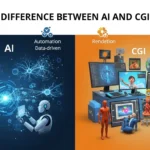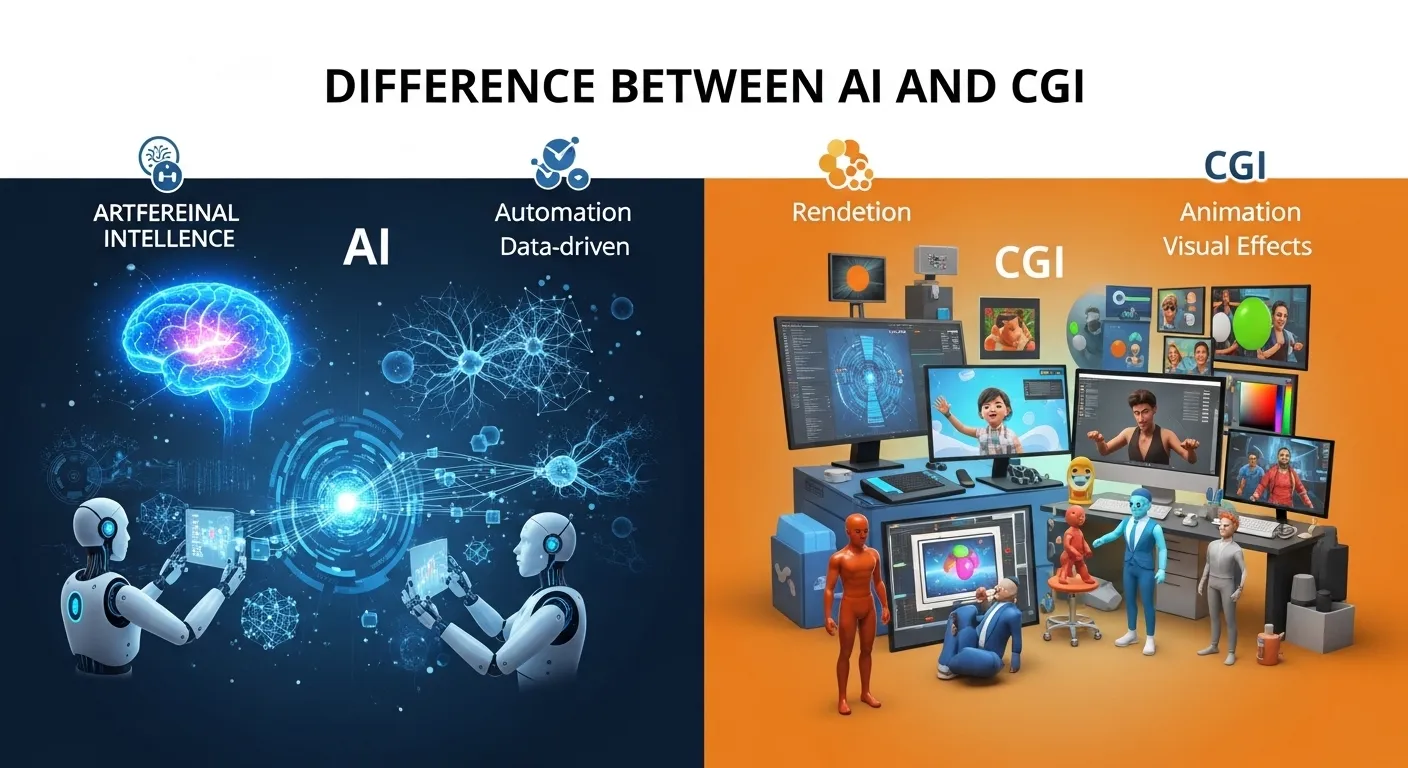
AI and CGI are both used in digital creation, but AI focuses on intelligence and automation, while CGI is used to create visual images and animations.
Understanding the difference between AI and CGI is essential in today’s digital world where technology shapes entertainment, business, and everyday life. Imagine watching a movie with stunning visual effects or using a smart assistant that responds to your voice—these experiences are powered by different technologies.
The difference between AI and CGI lies in their purpose and functionality. Artificial Intelligence (AI) enables machines to learn, think, and make decisions, while Computer-generated imagery (CGI) is used to create realistic images, animations, and visual effects. Learning the difference between AI and CGI helps users understand how modern systems work. By knowing the difference between AI and CGI, you can better appreciate both intelligent systems and digital visuals.
Pronunciation
AI
US: /ˌeɪˈaɪ/
CGI
US: /ˌsiːˌdʒiːˈaɪ/
Key Difference Between the Both
The main difference between AI and CGI is that AI focuses on machine intelligence and decision-making, while CGI focuses on creating visual content and graphics.
Why Is Their Difference Necessary to Know for Learners and Experts?
Knowing the difference between AI and CGI is important for students, developers, designers, and content creators. For learners, it builds a clear understanding of modern technologies. For experts, understanding the difference between AI and CGI helps in choosing the right tools for specific tasks.
In society, both technologies play vital roles in entertainment, automation, healthcare, and communication. Misunderstanding the difference between AI and CGI can lead to confusion about their applications and capabilities.
Difference Between AI and CGI
1. Definition
AI refers to machines that simulate human intelligence. CGI refers to computer-generated visuals.
Examples
AI:
- Voice assistants.
- Chatbots.
CGI:
- Animated movies.
- Visual effects.
2. Purpose
AI is used for decision-making. CGI is used for visual creation.
Examples
AI:
- Data analysis.
- Automation.
CGI:
- Movie effects.
- Game graphics.
3. Functionality
AI processes data and learns. CGI renders images and animations.
Examples
AI:
- Predictive models.
- Learning algorithms.
CGI:
- 3D modeling.
- Rendering scenes.
4. Application Areas
AI is used in multiple industries. CGI is mainly used in media and design.
Examples
AI:
- Healthcare.
- Finance.
CGI:
- Films.
- Video games.
5. Output
AI produces decisions or insights. CGI produces images or videos.
Examples
AI:
- Recommendations.
- Predictions.
CGI:
- Visual scenes.
- Animations.
6. Complexity
AI involves complex algorithms. CGI involves graphic rendering processes.
Examples
AI:
- Machine learning.
- Neural networks.
CGI:
- Lighting effects.
- Texture mapping.
7. Interaction
AI interacts with users. CGI does not interact directly.
Examples
AI:
- Chatbots.
- Smart assistants.
CGI:
- Movie visuals.
- Background effects.
8. Learning Ability
AI learns from data. CGI does not learn.
Examples
AI:
- Improves over time.
- Adapts behavior.
CGI:
- Static design.
- No learning.
9. Development
AI is developed using programming and data science. CGI is developed using design and animation tools.
Examples
AI:
- Python models.
- Data training.
CGI:
- Animation software.
- Graphic tools.
10. Role in Media
AI enhances automation in media. CGI creates visual effects.
Examples
AI:
- Content recommendations.
- Editing automation.
CGI:
- Movie effects.
- Animated characters.
Nature and Behaviour of Both
AI is dynamic and adaptive, capable of learning and evolving. CGI is creative and visual, focused on producing realistic or artistic images.
Why People Are Confused About Their Use?
People often confuse AI and CGI because both are used in movies and digital content. However, the key difference is that AI adds intelligence, while CGI adds visuals.
Table Showing Difference and Similarity
| Feature | AI | CGI | Similarity |
| Type | Intelligence system | Visual technology | Digital tools |
| Output | Decisions | Images | Tech-based |
| Use | Automation | Graphics | Media use |
| Learning | Yes | No | Computer-based |
| Interaction | Interactive | Non-interactive | Innovative |
Which Is Better in What Situation?
AI
AI is better for tasks that require intelligence, automation, and decision-making, such as data analysis, chatbots, and predictive systems.
CGI
CGI is better for creating visual content, such as movies, animations, and video games where realistic or artistic graphics are needed.
How the Keywords Are Used in Metaphors and Similes
Examples:
- “His thinking was like AI, smart and adaptive.”
- “The scene looked like CGI, perfect and unreal.”
Connotative Meaning
AI
Connotation: Intelligence, innovation.
Example:
“She had an AI-like mind, quick and logical.”
CGI
Connotation: Creativity, illusion.
Example:
“It felt like CGI, beautiful but artificial.”
Idioms or Proverbs Related to the Words
There are no direct idioms, but related ideas include:
Seeing is believing
Example:
“CGI challenges the idea that seeing is believing.”
Works in Literature
AI is widely discussed in science fiction and technology literature, while CGI is featured in media and film production studies.
Movie Names Made on the Keywords
- A.I. Artificial Intelligence (2001, USA) – directed by Steven Spielberg
- Avatar (2009, USA) – known for advanced CGI, directed by James Cameron
Five Frequently Asked Questions
1. What is the main difference between AI and CGI?
AI focuses on intelligence, while CGI focuses on visuals.
2. Can AI create CGI?
Yes, AI can assist in generating CGI.
3. Which is used in movies?
Both are used—AI for automation and CGI for visuals.
4. Is CGI a form of AI?
No, they are different technologies.
5. Which is more advanced?
Both are advanced but serve different purposes.
How Both Are Useful for Surroundings
AI improves automation and decision-making, while CGI enhances entertainment and visual communication, making both essential in modern life.
Final Words for the Both
AI and CGI are powerful technologies that serve different but complementary roles in the digital world.
Conclusion
The difference between AI and CGI lies in their purpose and functionality. AI focuses on simulating intelligence and decision-making, while CGI focuses on creating visual images and effects. Understanding the difference between AI and CGI helps individuals and professionals use these technologies effectively. By learning the difference between AI and CGI, you can better appreciate how modern digital systems work.

I’m Shabbir Hussain, a professional content writer who specializes in clear and authentic comparisons between similar terms. I write concise, research-based, and reader-friendly content that turns complex language into simple explanations. Through Mysynonyms.com, I help readers strengthen their vocabulary and clearly understand word differences.