Imagine you are watching a movie online with your family. The internet connection looks strong, but the video still pauses again and again. Sometimes the movie loads quickly but the quality becomes blurry. In this situation, two important concepts of networking are working behind the scenes: bandwidth and latency. Understanding the difference between bandwidth and latency helps us understand why internet speed behaves the way it does.
Bandwidth refers to the amount of data that can travel through a network in a given time. Latency refers to the delay that occurs before data begins to move. The difference between bandwidth and latency is important because both affect how fast and smoothly information travels online. Many people think they are the same thing, but the difference between bandwidth and latency shows that one measures capacity while the other measures delay. When we understand the difference between bandwidth and latency, we can improve our internet experience and choose better networking solutions.
Before diving deeper, let us first look at how these two terms are pronounced.
Pronunciation
Bandwidth
- US: /ˈbænd.wɪdθ/
- UK: /ˈbænd.wɪdθ/
Latency
- US: /ˈleɪ.tən.si/
- UK: /ˈleɪ.tən.si/
Both words are common in computer networking, telecommunications, and digital communication.
Linking Hook
Now that we know the basic meaning and pronunciation, let us explore the difference between bandwidth and latency in detail to clearly understand how each affects network performance.
Difference Between Bandwidth and Latency
Below are ten important points explaining the difference between bandwidth and latency.
1. Definition
Bandwidth is the maximum amount of data that can be transmitted through a network in a certain time. Latency is the time it takes for data to travel from the source to the destination.
Examples:
Bandwidth examples
- A 100 Mbps internet connection can transfer large files quickly.
- Streaming platforms use high bandwidth to deliver HD videos.
Latency examples
- Online gaming suffers when latency is high.
- Video calls lag when latency increases.
2. Measurement Units
Bandwidth is measured in bits per second (bps) such as Mbps or Gbps. Latency is measured in milliseconds (ms).
Examples:
Bandwidth
- A fiber connection may offer 1 Gbps bandwidth.
- A mobile network may provide 50 Mbps bandwidth.
Latency
- A 20 ms latency connection feels very responsive.
- A 200 ms latency causes noticeable delay.
3. Function
Bandwidth determines how much data can move at once. Latency determines how fast the communication begins.
Examples:
Bandwidth
- Downloading large files requires higher bandwidth.
- Cloud storage backups need large bandwidth.
Latency
- Online games require low latency.
- Remote desktop systems depend on minimal latency.
4. Real-World Analogy
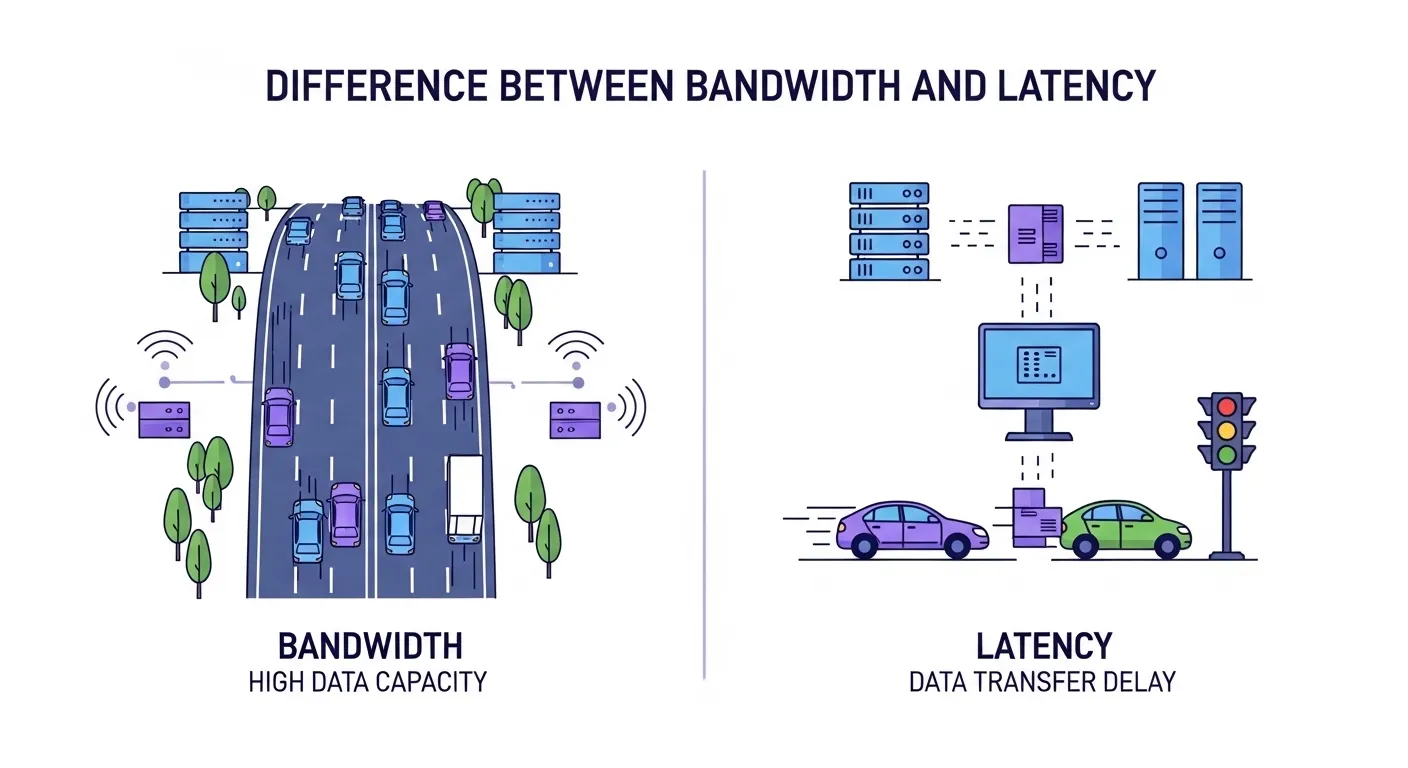
Bandwidth is like the width of a highway, while latency is like the travel time of a car.
Examples:
Bandwidth
- A six-lane highway carries more cars.
- A wider road allows more traffic flow.
Latency
- A shorter route reduces travel time.
- Traffic lights can increase travel delay.
5. Impact on Performance
Bandwidth affects how much data can be transferred. Latency affects how quickly communication responds.
Examples:
Bandwidth
- Streaming 4K videos requires large bandwidth.
- Large downloads benefit from more bandwidth.
Latency
- Video conferencing requires low latency.
- Voice calls break when latency rises.
6. Network Type Influence
Different network technologies affect bandwidth and latency differently.
Examples:
Bandwidth
- Fiber optics provide very high bandwidth.
- Satellite connections offer moderate bandwidth.
Latency
- Satellite internet has higher latency.
- Fiber networks usually have lower latency.
7. User Experience
Bandwidth influences loading capacity, while latency influences responsiveness.
Examples:
Bandwidth
- Multiple users streaming videos need higher bandwidth.
- Offices need high bandwidth for cloud services.
Latency
- Gamers require very low latency.
- Traders need low latency for fast transactions.
8. Causes of Limitations
Bandwidth is limited by network capacity. Latency is affected by distance and processing delays.
Examples:
Bandwidth
- Old cables reduce bandwidth capacity.
- Congested networks lower available bandwidth.
Latency
- Long physical distances increase latency.
- Network routing delays increase latency.
9. Optimization Methods
Bandwidth can be increased by upgrading internet plans. Latency can be reduced by improving routing and hardware.
Examples:
Bandwidth
- Upgrading to fiber increases bandwidth.
- Businesses buy dedicated high-bandwidth lines.
Latency
- Using local servers reduces latency.
- Gaming servers placed closer to users lower latency.
10. Role in Modern Technology
Both play important roles in modern internet systems.
Examples:
Bandwidth
- Video streaming services rely on high bandwidth.
- Cloud computing requires massive bandwidth.
Latency
- Autonomous vehicles require low latency communication.
- Real-time VR systems depend on minimal latency.
Nature and Behaviour of Both
Bandwidth Nature
Bandwidth behaves like capacity. When capacity increases, more data can move simultaneously. It mainly affects bulk data transfer.
Latency Nature
Latency behaves like delay. Even with high bandwidth, large delays can slow real-time communication.
Why People Are Confused About Their Use
Many people assume internet speed depends only on bandwidth. Internet providers often advertise higher bandwidth numbers, which leads people to believe it solves all performance problems. However, latency plays an equally important role, especially in real-time applications such as gaming, video calls, and remote control systems. Because both influence speed and performance, users often confuse the two terms.
Table Showing Difference and Similarity
| Aspect | Bandwidth | Latency | Similarity |
| Meaning | Data capacity of network | Delay in data transfer | Both affect internet performance |
| Measurement | Bits per second | Milliseconds | Both measured in networking metrics |
| Role | Determines volume of data | Determines response speed | Both impact user experience |
| Importance | Useful for large transfers | Useful for real-time communication | Both needed for stable networks |
Which Is Better in What Situation?
High bandwidth is better when large amounts of data must be transferred. For example, downloading movies, streaming ultra-high-definition videos, or backing up files to cloud storage requires strong bandwidth. In these situations, the capacity of the connection matters more than the delay.
Low latency is more important in situations where immediate response is required. Online gaming, live video conferencing, stock trading platforms, and remote robotics depend on quick data response. Even with high bandwidth, a high latency connection can feel slow and unresponsive.
Use in Metaphors and Similes
Bandwidth metaphors
- “Her mental bandwidth was full.”
- “The team lacked bandwidth to handle more work.”
Latency metaphors
- “His response had emotional latency.”
- “There was a latency in decision-making.”
Similes
- “Data moved like water through a wide pipe.” (bandwidth)
- “The reply came like an echo after a delay.” (latency)
Connotative Meaning
Bandwidth (mostly positive or neutral)
Examples
- “The manager has enough bandwidth to handle new projects.”
- “Students need mental bandwidth to focus on studies.”
Latency (mostly negative)
Examples
- “There was latency in the system response.”
- “Decision latency caused project delays.”
Idioms or Proverbs Related to the Words
Although these words are technical, they connect with common expressions.
Examples
- “Too much on one’s plate” (similar to lack of bandwidth)
Example: The manager had too much on his plate to start another project. - “Better late than never” (related to latency or delay)
Example: The update arrived late, but better late than never.
Works in Literature
(Because these are technical terms, they appear mainly in academic works.)
- Computer Networking: A Top-Down Approach — Educational Textbook, James Kurose & Keith Ross, 2000
- Data Communications and Networking — Technical Book, Behrouz A. Forouzan, 2006
- Networking Fundamentals — Technology Guide, Gordon Davies, 2007
Movies Related to the Keywords
(No mainstream movies are directly titled after these terms, but they appear in technology themes.)
- The Social Network — 2010, USA
- Hackers — 1995, USA
- Blackhat — 2015, USA
Frequently Asked Questions
1. What is the main difference between bandwidth and latency?
Bandwidth measures how much data can move through a network, while latency measures the delay before data starts moving.
2. Can high bandwidth reduce latency?
No. High bandwidth increases capacity but does not always reduce delay.
3. Why is latency important in gaming?
Games require real-time communication. High latency causes lag and slow responses.
4. Which matters more for streaming videos?
Bandwidth is more important because video streaming requires large amounts of data.
5. How can latency be reduced?
Latency can be reduced by using faster servers, better routing paths, and networks closer to users.
How Both Are Useful for Surroundings
Bandwidth and latency are essential for modern digital life. They influence education, healthcare, communication, and business operations. High bandwidth supports online learning platforms and cloud services. Low latency enables real-time applications such as telemedicine, autonomous vehicles, and remote collaboration. Together, they shape the efficiency of digital infrastructure and help societies stay connected.
Final Words for Both
Bandwidth represents capacity, while latency represents speed of response. Both must work together to create a fast and reliable network.
Conclusion
The difference between bandwidth and latency explains why internet performance is not just about speed but also about responsiveness. Bandwidth determines how much information can travel through a network at once, while latency determines how quickly the communication begins. A network with high bandwidth but high latency may still feel slow during real-time activities. Likewise, low latency with very low bandwidth may struggle with large data transfers. Understanding the difference between bandwidth and latency helps users choose better internet connections and design more efficient digital systems. In the modern world of streaming, gaming, cloud computing, and remote communication, both concepts are essential for smooth and reliable connectivity.

I’m Shabbir Hussain, a professional content writer who specializes in clear and authentic comparisons between similar terms. I write concise, research-based, and reader-friendly content that turns complex language into simple explanations. Through Mysynonyms.com, I help readers strengthen their vocabulary and clearly understand word differences.