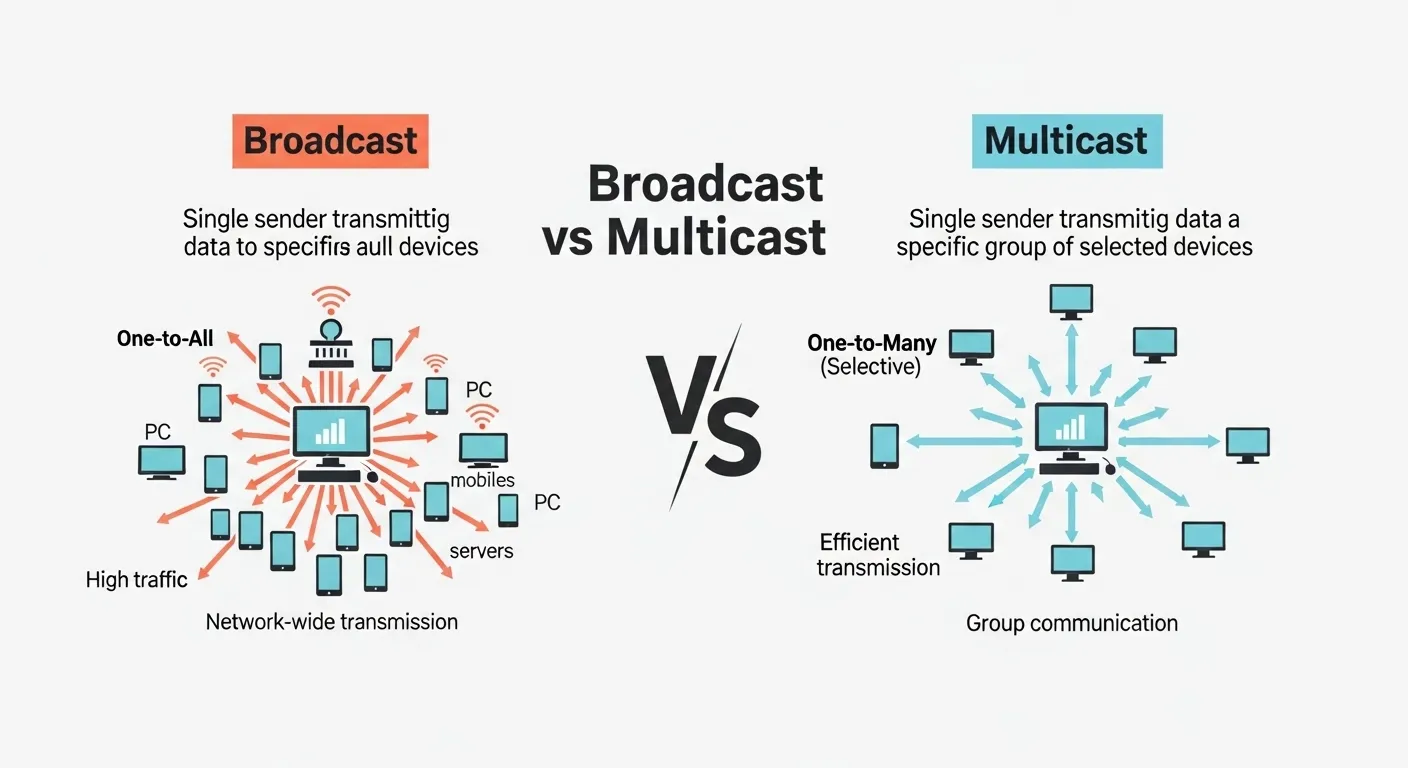
Broadcast and multicast are both data transmission methods, but broadcast sends data to all devices in a network, while multicast sends data only to a specific group of selected devices.
Understanding the difference between broadcast and multicast is essential in computer networking and communication systems. Imagine sending a message to everyone in a room, that’s broadcast. Now imagine sending a message only to a selected group of people interested in a topic, that’s multicast.
The difference between broadcast and multicast lies in how data is distributed across a network. Broadcast sends data to every device, whether they need it or not, while multicast targets only specific receivers. Learning the difference between broadcast and multicast helps students, IT professionals, and network engineers design efficient systems. By understanding the difference between broadcast and multicast, you can reduce network congestion and improve performance.
Pronunciation
Broadcast
US: /ˈbrɔːdkæst/
Multicast
US: /ˈmʌltɪkæst/
Key Difference Between the Both
The main difference between broadcast and multicast is that broadcast delivers data to all devices in a network, whereas multicast delivers data only to a selected group of devices.
Why Is Their Difference Necessary to Know for Learners and Experts?
Knowing the difference between broadcast and multicast is important for networking students, engineers, and system administrators. For learners, it builds a foundation in data communication. For experts, understanding the difference between broadcast and multicast helps optimize bandwidth and network efficiency.
In real-world systems like streaming services or online meetings, multicast is often preferred to avoid unnecessary data transfer. Therefore, understanding the difference between broadcast and multicast improves network performance and scalability.
Difference Between Broadcast and Multicast
1. Definition
Broadcast sends data to all devices in a network. Multicast sends data to a selected group of devices.
Examples
Broadcast:
- Sending a message to all computers in a LAN.
- Network-wide announcements.
Multicast:
- Streaming video to subscribed users.
- Online group meetings.
2. Target Audience
Broadcast targets every device. Multicast targets a specific group.
Examples
Broadcast:
- All users receive the message.
- No filtering.
Multicast:
- Only subscribed users receive data.
- Controlled distribution.
3. Network Efficiency
Broadcast is less efficient. Multicast is more efficient.
Examples
Broadcast:
- Wastes bandwidth.
- Unnecessary data delivery.
Multicast:
- Saves bandwidth.
- Sends only needed data.
4. Data Traffic
Broadcast creates high network traffic. Multicast reduces traffic.
Examples
Broadcast:
- Can slow down network.
- Heavy load.
Multicast:
- Optimized traffic flow.
- Better performance.
5. Usage
Broadcast is used for simple communication. Multicast is used for group communication.
Examples
Broadcast:
- ARP requests.
- Network discovery.
Multicast:
- Live streaming.
- Video conferencing.
6. Addressing
Broadcast uses a special broadcast address. Multicast uses group addresses.
Examples
Broadcast:
- One address for all devices.
- Universal delivery.
Multicast:
- Specific group addresses.
- Selective delivery.
7. Control
Broadcast has no control over receivers. Multicast allows control over group membership.
Examples
Broadcast:
- Cannot limit receivers.
- All devices included.
Multicast:
- Users can join or leave groups.
- Controlled access.
8. Scalability
Broadcast is not scalable. Multicast is scalable.
Examples
Broadcast:
- Poor performance in large networks.
- Limited use.
Multicast:
- Works well in large systems.
- Efficient scaling.
9. Implementation
Broadcast is simple to implement. Multicast is more complex.
Examples
Broadcast:
- Easy setup.
- Minimal configuration.
Multicast:
- Requires protocols like IGMP.
- Needs configuration.
10. Real-Life Analogy
Broadcast is like announcing on loudspeaker. Multicast is like sending invites to a group.
Examples
Broadcast:
- Public announcement.
- Everyone hears it.
Multicast:
- Private group meeting.
- Only invited people attend.
Nature and Behaviour of Both
Broadcast is open, wide-reaching, and simple but inefficient. Multicast is selective, efficient, and controlled, making it suitable for modern network applications.
Why People Are Confused About Their Use?
People often confuse broadcast and multicast because both involve sending data to multiple receivers. However, the key difference is that broadcast sends to all devices, while multicast targets a specific group.
Table Showing Difference and Similarity
| Feature | Broadcast | Multicast | Similarity |
| Target | All devices | Selected group | Data transmission |
| Efficiency | Low | High | Network communication |
| Traffic | High | Optimized | Used in networks |
| Control | None | Controlled | Multi-receiver |
| Usage | Basic | Advanced | Communication method |
Which Is Better in What Situation?
Broadcast
Broadcast is better for simple network tasks where all devices need the same information, such as discovery or announcements.
Multicast
Multicast is better for applications like streaming, gaming, or conferencing where only specific users need the data.
How the Keywords Are Used in Metaphors and Similes
Examples:
- “His message spread like a broadcast—reaching everyone instantly.”
- “The update was shared like multicast—only to selected users.”
Connotative Meaning
Broadcast
Connotation: Wide-reaching, open, general.
Example:
“The news was broadcast to everyone.”
Multicast
Connotation: Targeted, efficient, selective.
Example:
“The message was multicast to a specific group.”
Idioms or Proverbs Related to the Words
Spread the word
Example:
“They used broadcast to spread the word quickly.”
Works in Literature
Broadcast and multicast are technical networking terms mainly found in computer science textbooks and IT documentation. There is no significant literature found in these terms.
Movie Names Made on the Keywords
There are no movies directly based on broadcast or multicast as technical networking concepts, because both are technical terms.
Five Frequently Asked Questions
1. What is the main difference between broadcast and multicast?
Broadcast sends data to all devices, while multicast sends to a specific group.
2. Which is more efficient?
Multicast is more efficient.
3. Is broadcast still used?
Yes, for basic network functions.
4. Where is multicast used?
In streaming and group communication.
5. Can multicast reduce bandwidth usage?
Yes, significantly.
How Both Are Useful for Surroundings
Both broadcast and multicast help in communication and data sharing across networks, enabling modern digital systems to function efficiently.
Final Words for the Both
Broadcast and multicast serve different purposes in networking. Choosing the right method ensures better performance and efficiency.
Conclusion
The difference between broadcast and multicast lies in their data distribution method and efficiency. Broadcast sends data to all devices, while multicast targets a specific group, making it more efficient. Understanding the difference between broadcast and multicast helps in designing better networks and improving communication systems. By learning the difference between broadcast and multicast, users and professionals can optimize performance and reduce unnecessary data traffic.

I’m Shabbir Hussain, a professional content writer who specializes in clear and authentic comparisons between similar terms. I write concise, research-based, and reader-friendly content that turns complex language into simple explanations. Through Mysynonyms.com, I help readers strengthen their vocabulary and clearly understand word differences.