Cat6 and Cat7 are both Ethernet cables, but Cat6 is widely used for standard networking, while Cat7 offers higher speed, better shielding, and improved performance for advanced setups.
Understanding the difference between Cat6 and Cat7 is important when setting up a reliable internet or network connection. Imagine upgrading your home or office network and choosing between two cables that look similar but perform differently. That’s where Cat6 and Cat7 come in.
The difference between Cat6 and Cat7 lies in their speed, shielding, frequency, and usage. While Cat6 is common in homes and small offices, Cat7 is designed for high-performance environments with minimal interference. Learning the difference between Cat6 and Cat7 helps you choose the right cable for your needs. By understanding the difference between Cat6 and Cat7, you can ensure faster speeds, better stability, and future-ready networking.
Pronunciation
Cat6 (Category 6)
US: /ˌkæt sɪks/
Cat7 (Category 7)
US: /ˌkæt ˈsɛvən/
Key Difference Between the Both
The main difference between Cat6 and Cat7 is that Cat6 supports high-speed networking up to 10 Gbps over shorter distances, while Cat7 supports higher frequencies and better shielding for improved performance and reduced interference.
Why Is Their Difference Necessary to Know for Learners and Experts?
Knowing the difference between Cat6 and Cat7 is essential for IT professionals, network engineers, and everyday users. For beginners, it helps in selecting the right cable for home use. For experts, understanding the difference between Cat6 and Cat7 ensures optimal network performance and future scalability.
In real-world applications, the right cable affects internet speed, stability, and reliability. Therefore, understanding the difference between Cat6 and Cat7 ensures efficient and long-lasting network setups.
Difference Between Cat6 and Cat7
1. Speed
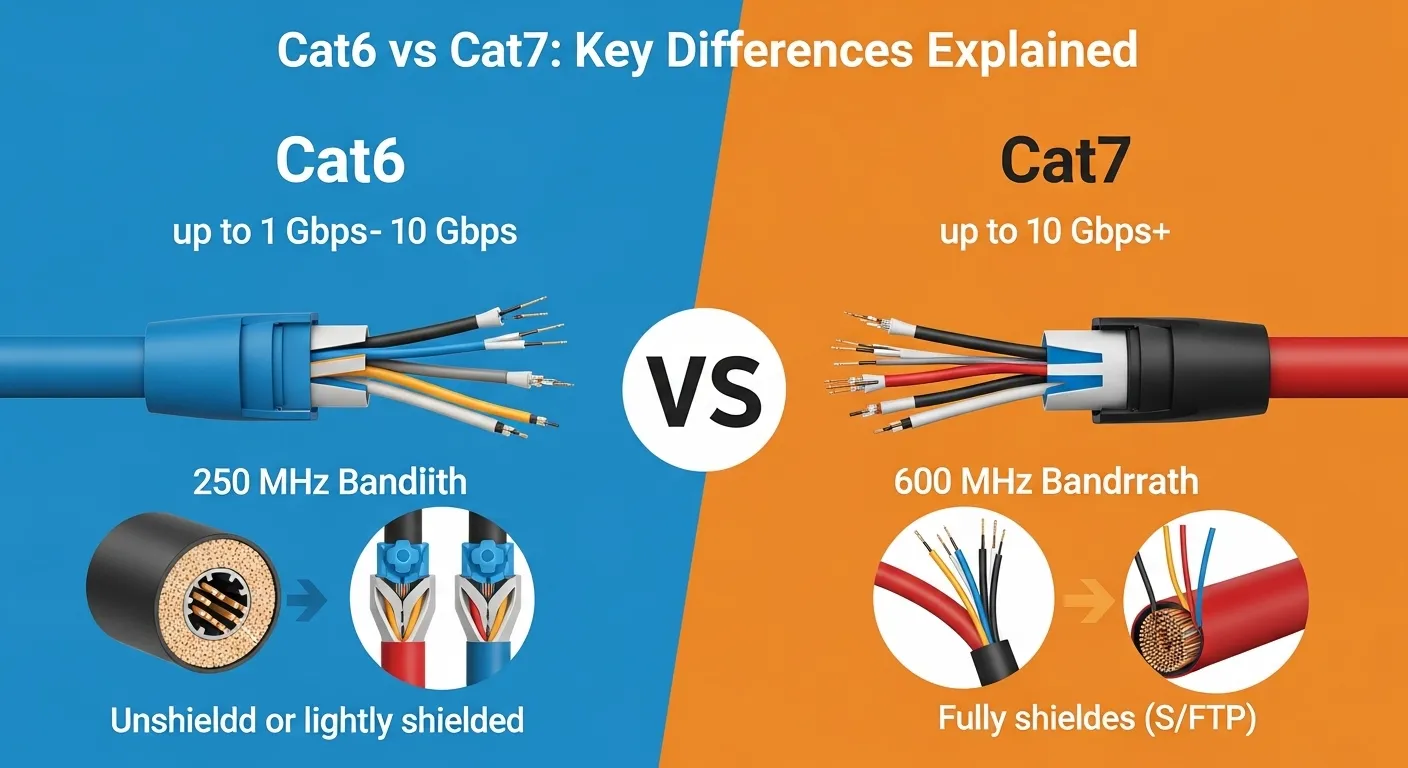
Cat6 supports up to 10 Gbps (short distances). Cat7 also supports 10 Gbps but is optimized for higher performance.
Examples
Cat6:
- Home internet setup.
- Office LAN connections.
Cat7:
- Data centers.
- High-speed networks.
2. Frequency
Cat6 operates up to 250 MHz. Cat7 operates up to 600 MHz.
Examples
Cat6:
- Standard data transmission.
- Moderate bandwidth use.
Cat7:
- High-frequency applications.
- Heavy data traffic.
3. Shielding
Cat6 has basic shielding (or unshielded versions). Cat7 is fully shielded.
Examples
Cat6:
- UTP (Unshielded Twisted Pair).
- Some STP versions.
Cat7:
- Individually shielded pairs.
- Overall cable shielding.
4. Interference Resistance
Cat7 has better protection against interference than Cat6.
Examples
Cat6:
- May experience interference in busy environments.
- Suitable for homes.
Cat7:
- Minimal interference.
- Ideal for industrial setups.
5. Cable Thickness
Cat7 cables are thicker due to extra shielding. Cat6 cables are thinner and more flexible.
Examples
Cat6:
- Easy to install.
- Flexible routing.
Cat7:
- Less flexible.
- Requires careful installation.
6. Connectors
Cat6 commonly uses RJ45 connectors. Cat7 may use specialized connectors but is often compatible with RJ45.
Examples
Cat6:
- Standard Ethernet ports.
- Widely supported.
Cat7:
- GG45 or TERA connectors.
- Backward compatible.
7. Cost
Cat7 is more expensive than Cat6.
Examples
Cat6:
- Budget-friendly.
- Suitable for most users.
Cat7:
- Higher cost.
- Premium installations.
8. Usage
Cat6 is used in homes and offices. Cat7 is used in high-performance environments.
Examples
Cat6:
- Home networking.
- Small business setups.
Cat7:
- Data centers.
- Enterprise networks.
9. Future-Proofing
Cat7 is more future-proof due to higher specs. Cat6 is sufficient for current needs.
Examples
Cat6:
- Meets today’s requirements.
- Limited future expansion.
Cat7:
- Supports future technologies.
- Long-term investment.
10. Installation
Cat6 is easier to install. Cat7 requires more careful handling.
Examples
Cat6:
- DIY-friendly.
- Simple setup.
Cat7:
- Professional installation preferred.
- Complex setup.
Nature and Behaviour of Both
Cat6 is practical, flexible, and widely used for everyday networking. Cat7 is advanced, high-performance, and designed for environments requiring maximum speed and minimal interference.
Why People Are Confused About Their Use?
People often confuse Cat6 and Cat7 because both support high-speed internet and look similar. The differences are mostly technical and related to performance and shielding.
Table Showing Difference and Similarity
| Feature | Cat6 | Cat7 | Similarity |
| Speed | Up to 10 Gbps | Up to 10 Gbps+ | Both Ethernet cables |
| Frequency | 250 MHz | 600 MHz | Data transmission |
| Shielding | Basic/optional | Full shielding | Twisted pair design |
| Cost | Lower | Higher | Used in networks |
| Usage | Home/office | Enterprise/data centers | Internet connectivity |
Which Is Better in What Situation?
Cat6
Cat6 is better for home networks, small offices, and general use where cost and flexibility matter.
Cat7
Cat7 is better for high-performance environments, large networks, and areas with high interference.
How the Keywords Are Used in Metaphors and Similes
Examples:
- “His setup was as reliable as a Cat6 cable.”
- “The system ran as smoothly as a Cat7 connection.”
Connotative Meaning
Cat6
Connotation: Reliable, practical, affordable.
Example:
“Cat6 cables are the backbone of everyday networking.”
Cat7
Connotation: Advanced, powerful, premium.
Example:
“Cat7 represents top-tier performance.”
Idioms or Proverbs Related to the Words
Stay connected
Example:
“In today’s world, staying connected is essential—just like using the right cable.”
Works in Literature
Cat6 and Cat7 are technical networking terms and appear mainly in IT manuals, networking guides, and engineering documentation.
Movie Names Made on the Keywords
There are no movies directly based on Cat6 or Cat7, as they are technical cable standards.
Five Frequently Asked Questions
1. What is the main difference between Cat6 and Cat7?
Cat7 has better shielding and higher frequency than Cat6.
2. Is Cat7 faster than Cat6?
It offers better performance, especially in high-interference environments.
3. Which is better for home use?
Cat6 is usually sufficient.
4. Is Cat7 worth the extra cost?
Only for advanced or future-proof setups.
5. Are Cat7 cables compatible with standard ports?
Yes, most are compatible with RJ45.
How Both Are Useful for Surroundings
Both Cat6 and Cat7 cables enable fast and stable internet connections, supporting communication, work, and entertainment.
Final Words for the Both
Cat6 and Cat7 are both valuable networking solutions. The choice depends on your needs, budget, and future plans.
Conclusion
The difference between Cat6 and Cat7 lies in their performance, shielding, and usage. Cat6 is a practical and widely used cable suitable for most networking needs, while Cat7 offers advanced features for high-performance environments. Understanding the difference between Cat6 and Cat7 helps you choose the right cable for your setup. By learning the difference between Cat6 and Cat7, you can ensure better speed, reliability, and long-term efficiency.

I’m Shabbir Hussain, a professional content writer who specializes in clear and authentic comparisons between similar terms. I write concise, research-based, and reader-friendly content that turns complex language into simple explanations. Through Mysynonyms.com, I help readers strengthen their vocabulary and clearly understand word differences.