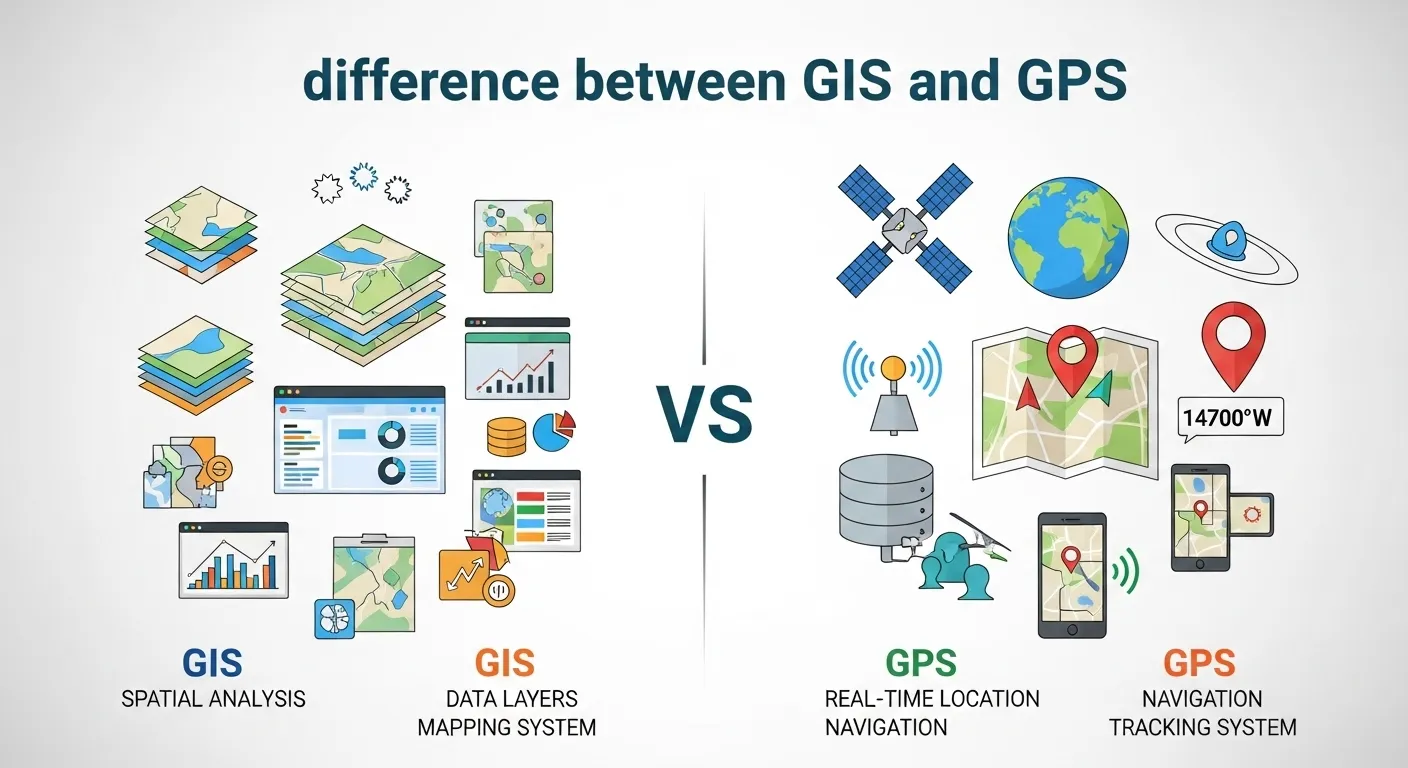
GIS and GPS are both mapping technologies, but GPS provides location data, while GIS analyses and manages that data to create useful maps and insights.
Understanding the difference between GIS and GPS is essential in today’s technology-driven world. Imagine using your phone to find your exact location, that’s GPS at work. Now imagine analysing maps to plan cities, track resources, or study environmental changes, that’s GIS.
The difference between GIS and GPS lies in their purpose and functionality. Global Positioning System (GPS) is used to determine precise locations using satellites, while Geographic Information System (GIS) is used to store, analyze, and visualize geographic data. Learning the difference between GIS and GPS helps students, researchers, and professionals use these tools effectively. By understanding the difference between GIS and GPS, you can better navigate, analyze, and interpret spatial information.
Pronunciation
GIS
US: /dʒiː-ɑːr-ˈɛs/ (commonly pronounced “jee-eye-ess”)
GPS
US: /dʒiː-piː-ˈɛs/
Key Difference Between the Both
The main difference between GIS and GPS is that GPS provides location coordinates, while GIS uses that data to analyze, interpret, and create meaningful maps.
Why Is Their Difference Necessary to Know for Learners and Experts?
Knowing the difference between GIS and GPS is important for students, geographers, engineers, and planners. For learners, it builds a strong foundation in geography and technology. For experts, understanding the difference between GIS and GPS enables efficient use of spatial data.
In society, these technologies support navigation, disaster management, urban planning, and environmental monitoring. Misunderstanding the difference between GIS and GPS can limit their effective use in real-world applications.
Difference Between GIS and GPS
1. Definition
GPS is a satellite-based system for location tracking. GIS is a system for managing and analyzing geographic data.
Examples
GPS:
- Finding your location on a map.
- Navigation apps.
GIS:
- Creating maps.
- Analyzing land use.
2. Function
GPS provides coordinates. GIS processes and analyzes data.
Examples
GPS:
- Latitude and longitude.
- Real-time tracking.
GIS:
- Data visualization.
- Spatial analysis.
3. Components
GPS relies on satellites and receivers. GIS includes software, data, and tools.
Examples
GPS:
- Satellites in orbit.
- GPS device.
GIS:
- Computer systems.
- Mapping software.
4. Purpose
GPS is used for navigation. GIS is used for decision-making.
Examples
GPS:
- Driving directions.
- Location tracking.
GIS:
- Urban planning.
- Resource management.
5. Data Handling
GPS collects data. GIS stores and analyzes data.
Examples
GPS:
- Collects location points.
- Real-time input.
GIS:
- Stores large datasets.
- Performs analysis.
6. Output
GPS gives coordinates. GIS produces maps and reports.
Examples
GPS:
- Exact location.
- Coordinates display.
GIS:
- Thematic maps.
- Graphs and models.
7. Usage Area
GPS is used in navigation and tracking. GIS is used in research and planning.
Examples
GPS:
- Smartphones.
- Vehicles.
GIS:
- Government planning.
- Environmental studies.
8. Complexity
GPS is simple to use. GIS is more complex.
Examples
GPS:
- Easy interface.
- User-friendly.
GIS:
- Requires training.
- Advanced tools.
9. Real-Time Capability
GPS works in real time. GIS may use real-time or stored data.
Examples
GPS:
- Live tracking.
- Instant updates.
GIS:
- Historical data.
- Analysis over time.
10. Dependency
GIS can use GPS data. GPS does not depend on GIS.
Examples
GPS:
- Works independently.
- Standalone system.
GIS:
- Uses GPS input.
- Integrates multiple sources.
Nature and Behaviour of Both
GPS is a real-time location system that provides precise positioning. GIS is an analytical system that processes and visualizes spatial data for decision-making.
Why People Are Confused About Their Use?
People often confuse GIS and GPS because both deal with maps and locations. However, the key difference is that GPS finds your location, while GIS analyzes and presents that location data.
Table Showing Difference and Similarity
| Feature | GPS | GIS | Similarity |
| Function | Location tracking | Data analysis | Mapping tools |
| Data | Coordinates | Processed data | Geographic |
| Use | Navigation | Planning | Spatial systems |
| Complexity | Simple | Complex | Technology-based |
| Output | Location | Maps | Visual tools |
Which Is Better in What Situation?
GPS
GPS is better for real-time navigation and tracking, such as finding directions or locating places.
GIS
GIS is better for analyzing geographic data, planning projects, and making informed decisions.
How the Keywords Are Used in Metaphors and Similes
Examples:
- “He needed a GPS for his life decisions.”
- “Her mind worked like a GIS, analyzing every detail.”
Connotative Meaning
GPS
Connotation: Direction, guidance.
Example:
“She acted as a GPS, guiding the team.”
GIS
Connotation: Insight, analysis.
Example:
“He used a GIS-like approach to solve problems.”
Idioms or Proverbs Related to the Words
Find your way
Example:
“GPS helps you find your way in unknown places.”
Works in Literature
GIS and GPS are modern technological terms mainly found in geography, engineering, and environmental studies literature.
Movie Names Made on the Keywords
There are no major movies directly based on as both are technical systems.
Five Frequently Asked Questions
1. What is the main difference between GIS and GPS?
GPS provides location, while GIS analyzes geographic data.
2. Can GIS work without GPS?
Yes, but GPS enhances accuracy.
3. Is GPS part of GIS?
GPS can provide data for GIS.
4. Which is easier to use?
GPS is easier.
5. Where are they used?
GPS in navigation, GIS in planning and analysis.
How Both Are Useful for Surroundings
Both GIS and GPS improve navigation, planning, disaster response, and environmental management, making them essential tools in modern society.
Final Words for the Both
GIS is like a powerful brain that analyzes and interprets geographic data to help us understand patterns, relationships, and trends in the world around us. It is essential for decision-making in fields like urban development, agriculture, and environmental protection.
On the other hand, GPS acts like a guide that tells you exactly where you are at any moment. It plays a crucial role in everyday navigation, helping people reach destinations quickly and accurately.
Both are complementary technologies that work together to provide accurate location data and meaningful insights.
Conclusion
The difference between GIS and GPS lies in their function and purpose. GPS is used to determine precise locations, while GIS analyses and interprets that data to create maps and insights. Understanding the difference between GIS and GPS helps individuals and professionals use these technologies effectively. By learning the difference between GIS and GPS, you can better navigate and understand the world around you.

I’m Shabbir Hussain, a professional content writer who specializes in clear and authentic comparisons between similar terms. I write concise, research-based, and reader-friendly content that turns complex language into simple explanations. Through Mysynonyms.com, I help readers strengthen their vocabulary and clearly understand word differences.