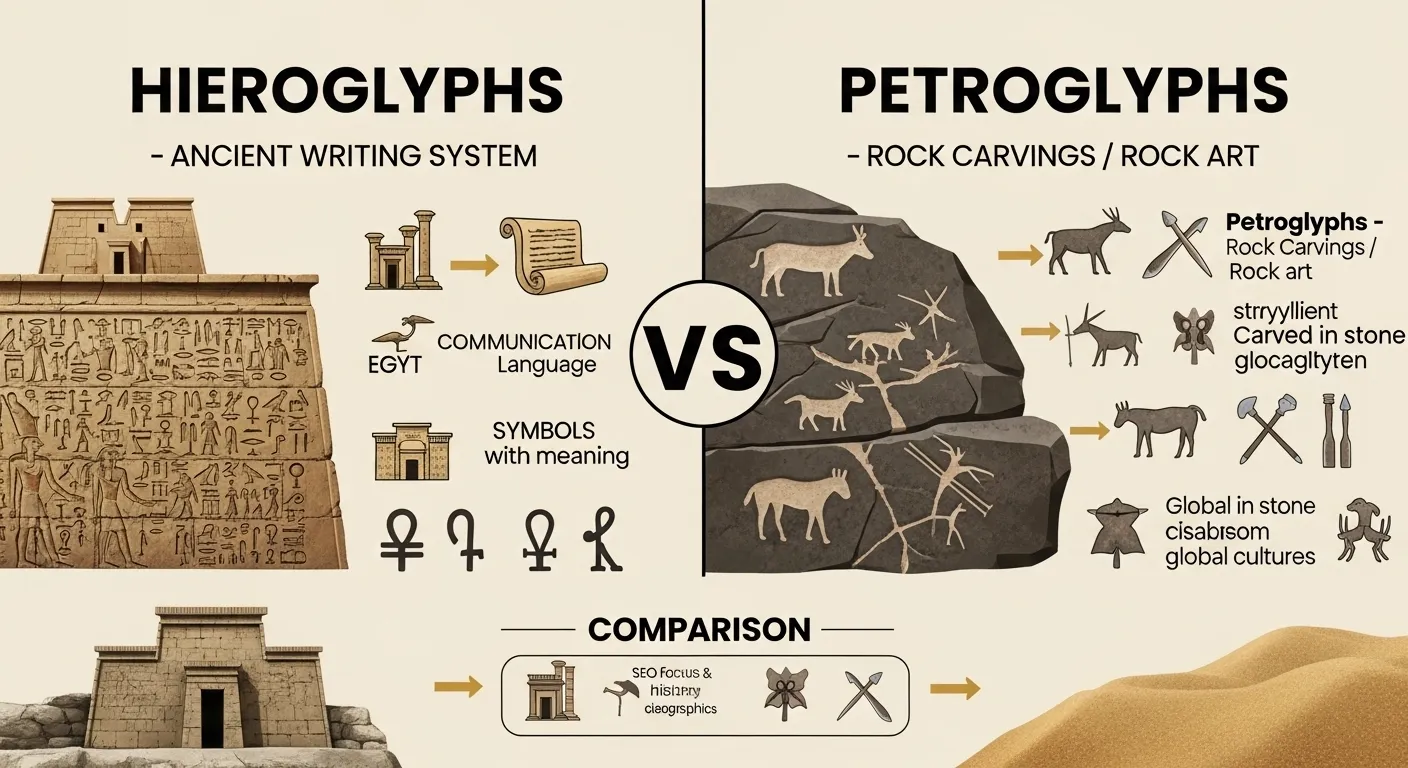
Hieroglyphs are a formal writing system using symbolic characters, while petroglyphs are images carved into rock surfaces without necessarily forming a written language.
Understanding the difference between hieroglyphs and petroglyphs helps us explore how ancient humans communicated and expressed ideas. “Imagine walking through an ancient temple where artists have covered the walls with detailed symbols, these are hieroglyphs. Now picture standing near a rocky cliff where people have carved simple figures and shapes into the stone, these are petroglyphs.”
The difference between hieroglyphs and petroglyphs lies in their purpose, structure, and meaning. Hieroglyphs are part of a structured writing system used to record language, while petroglyphs are artistic or symbolic carvings that may not represent formal writing. Learning the difference between hieroglyphs and petroglyphs helps historians, students, and enthusiasts understand ancient cultures and communication methods. By knowing the difference between hieroglyphs and petroglyphs, we can better appreciate the creativity and intelligence of early civilizations.
Pronunciation
Hieroglyphs
US: /ˈhaɪərəɡlɪfs/
UK: /ˈhaɪərəɡlɪfs/
Petroglyphs
US: /ˈpɛtrəɡlɪfs/
UK: /ˈpɛtrəɡlɪfs/
Key Difference Between the Both
“The main difference between hieroglyphs and petroglyphs lies in their purpose: hieroglyphs represent language as a formal writing system, while petroglyphs depict carved images or symbols that may not form a structured language.”
Why Is Their Difference Necessary to Know for Learners and Experts?
Knowing the difference between hieroglyphs and petroglyphs is important for students of history, archaeology, and linguistics. For learners, it clarifies the distinction between writing and art. For experts, understanding the difference between hieroglyphs and petroglyphs helps in interpreting ancient artifacts correctly.
In society, these forms of expression provide insight into early human life, beliefs, and communication. Understanding the difference between hieroglyphs and petroglyphs helps preserve cultural heritage and promotes appreciation of ancient civilizations.
Difference Between Hieroglyphs and Petroglyphs
1. Definition
Hieroglyphs are a system of writing using symbols to represent sounds, words, or ideas. Petroglyphs are images carved into rock surfaces.
Examples
Hieroglyphs:
- Egyptian temple inscriptions.
- Symbols representing words or sounds.
Petroglyphs:
- Animal carvings on cave walls.
- Rock art depicting hunting scenes.
2. Purpose
“People use hieroglyphs for communication and recording language, while they use petroglyphs for artistic or symbolic expression.”
Examples
Hieroglyphs:
- Recording historical events.
- Writing religious texts.
Petroglyphs:
- Showing daily life scenes.
- Expressing beliefs or rituals.
3. Structure
Hieroglyphs follow a structured system with rules. Petroglyphs have no fixed structure.
Examples
Hieroglyphs:
- Organized symbols forming sentences.
- Grammar-like rules.
Petroglyphs:
- Random or simple drawings.
- No formal arrangement.
4. Origin
Hieroglyphs are mainly associated with ancient Egypt. Petroglyphs are found worldwide.
Examples
Hieroglyphs:
- Egyptian pyramids.
- Ancient Egyptian temples.
Petroglyphs:
- Rock carvings in deserts.
- Cave art in different continents.
5. Medium
Hieroglyphs are written or painted on surfaces like papyrus or walls. Petroglyphs are carved directly into rock.
Examples
Hieroglyphs:
- Painted temple walls.
- Written on scrolls.
Petroglyphs:
- Carved into stone surfaces.
- Engraved on cliffs.
6. Complexity
Hieroglyphs are complex and detailed. Petroglyphs are usually simpler.
Examples
Hieroglyphs:
- Detailed symbols with meanings.
- Multiple layers of interpretation.
Petroglyphs:
- Simple shapes and figures.
- Easy to recognize.
7. Language Representation
Hieroglyphs represent language and can be read. Petroglyphs do not represent a full language.
Examples
Hieroglyphs:
- Can be translated into words.
- Used as written communication.
Petroglyphs:
- Cannot form full sentences.
- Represent ideas visually.
8. Cultural Use
Hieroglyphs were used by trained scribes. Petroglyphs were created by various people.
Examples
Hieroglyphs:
- Used in official records.
- Written by educated individuals.
Petroglyphs:
- Created by early communities.
- Used in everyday expression.
9. Preservation
Hieroglyphs may fade if painted, while petroglyphs last longer due to carving.
Examples
Hieroglyphs:
- Paint may erode.
- Requires preservation.
Petroglyphs:
- Durable carvings.
- Survive for thousands of years.
10. Interpretation
Hieroglyphs can be translated with knowledge of the language. Petroglyphs are often open to interpretation.
Examples
Hieroglyphs:
- Deciphered using linguistic methods.
- Clear meaning once understood.
Petroglyphs:
- Interpreted differently by experts.
- Meaning may remain unknown.
Nature and Behaviour of Both
“Hieroglyphs serve as a structured, linguistic, and formal system for communication and documentation.” Petroglyphs are artistic, symbolic, and expressive, reflecting culture and daily life.
Why People Are Confused About Their Use?
People often confuse hieroglyphs and petroglyphs because both involve symbols and ancient carvings. However, the key difference is that hieroglyphs are a writing system, while petroglyphs are visual carvings without structured language.
Table Showing Difference and Similarity
| Feature | Hieroglyphs | Petroglyphs | Similarity |
| Meaning | Writing system | Rock carvings | Both use symbols |
| Structure | Organized | Unstructured | Ancient expression |
| Purpose | Communication | Art/symbolism | Cultural significance |
| Origin | Egypt | Worldwide | Historical value |
| Medium | Written/painted | Carved in rock | Visual representation |
Which Is Better in What Situation?
Hieroglyphs
Hieroglyphs are better for recording language, history, and formal communication.
Petroglyphs
Petroglyphs are better for artistic expression and symbolic storytelling.
How the Keywords Are Used in Metaphors and Similes
Examples:
- “His notes looked like hieroglyphs—complex and hard to understand.”
- “The markings on the wall were like petroglyphs, telling a silent story.”
Connotative Meaning
Hieroglyphs
Connotation: Complex, mysterious, intellectual.
Example:
“The code looked like hieroglyphs to beginners.”
Petroglyphs
Connotation: Ancient, artistic, symbolic.
Example:
“The design resembled petroglyphs from early cultures.”
Idioms or Proverbs Related to the Words
There are no direct idioms, but similar expressions exist:
Written in stone
Example:
“His decision was written in stone like a petroglyph.”
Works in Literature
- The Egyptian Book of the Dead – Ancient funerary text using hieroglyphs
- The Oxford Handbook of the Archaeology of Rock Art – Academic work on petroglyphs
Movie Names Made on the Keywords
- The Mummy (1999) – features Egyptian hieroglyphs
- 10,000 BC (2008) – includes rock carvings and petroglyph-like imagery
Five Frequently Asked Questions
1. What is the main difference between hieroglyphs and petroglyphs?
Hieroglyphs are a writing system, while petroglyphs are carved images.
2. Can petroglyphs be read like language?
No, they are usually symbolic and not structured language.
3. Where are hieroglyphs found?
Mainly in ancient Egypt.
4. Are petroglyphs found worldwide?
Yes, they appear in many regions.
5. Which is older?
Petroglyphs are generally older than hieroglyphs.
How Both Are Useful for Surroundings
Both hieroglyphs and petroglyphs help us understand ancient cultures, beliefs, and ways of communication. They are valuable historical and cultural resources.
Final Words for the Both
Hieroglyphs and petroglyphs represent two unique forms of human expression—one linguistic and structured, the other artistic and symbolic.
Conclusion
The difference between hieroglyphs and petroglyphs lies in their purpose, structure, and meaning. Hieroglyphs are a formal writing system to represent language, while petroglyphs are carved images that express ideas without forming a structured language. Understanding the difference between hieroglyphs and petroglyphs helps us appreciate the richness of ancient communication and creativity. By learning the difference between hieroglyphs and petroglyphs, we gain deeper insight into human history and cultural evolution.

I’m Shabbir Hussain, a professional content writer who specializes in clear and authentic comparisons between similar terms. I write concise, research-based, and reader-friendly content that turns complex language into simple explanations. Through Mysynonyms.com, I help readers strengthen their vocabulary and clearly understand word differences.