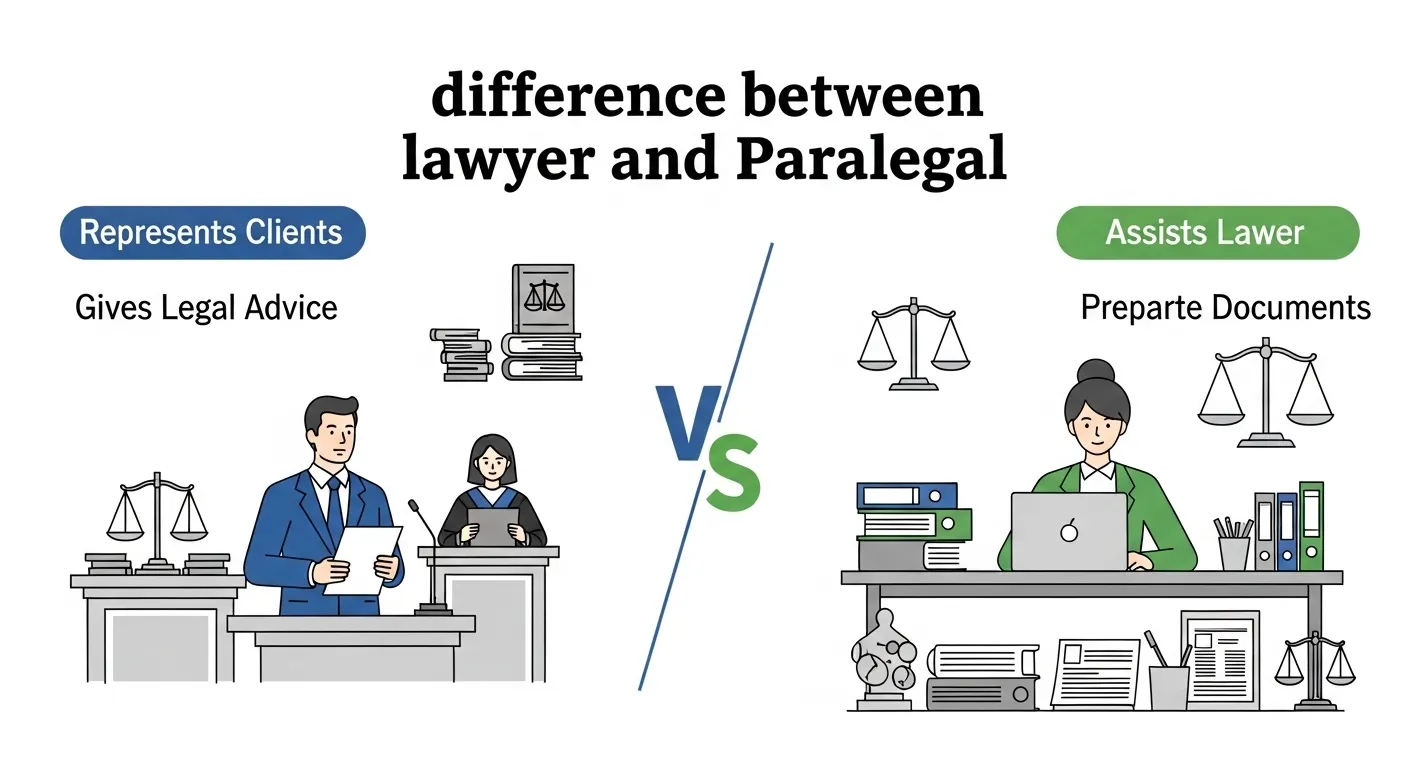
A lawyer is a licensed legal professional who can represent clients in court and provide legal advice, while a paralegal supports lawyers by handling research, documentation, and administrative legal tasks.
Understanding the difference between lawyer and paralegal is essential for anyone interested in the legal field or seeking legal services. Imagine facing a legal issue—you might meet a professional who advises you, represents you in court, and makes strategic decisions. At the same time, another skilled professional works behind the scenes, preparing documents, organizing evidence, and conducting research.
The difference between lawyer and paralegal lies mainly in authority, education, and responsibilities. Lawyer are licensed to practice law and can represent clients, while Paralegal assist lawyers in handling legal work but cannot provide legal advice independently. Learning the difference between lawyer and paralegal helps clients know whom to approach and helps students choose the right career path. By understanding the difference between lawyer and paralegal, you gain clarity about how the legal system functions effectively.
Pronunciation
Lawyer
US: /ˈlɔːjər/
Paralegal
US: /ˌpærəˈliːɡəl/
Key Difference Between the Both
The main difference between lawyer and paralegal is that a lawyer is legally authorized to give advice and represent clients in court, while a paralegal supports legal work but cannot practice law independently.
Why Is Their Difference Necessary to Know for Learners and Experts?
Knowing the difference between lawyer and paralegal is important for both beginners and professionals. For students, it helps in choosing a career path in the legal field. For clients, it ensures they seek the right professional for their needs.
In society, both roles are crucial. Lawyers ensure justice and legal representation, while paralegals improve efficiency by managing essential tasks. Misunderstanding the difference between lawyer and paralegal can lead to confusion about legal authority and responsibilities.
Difference Between Lawyer and Paralegal
1. Definition
A lawyer is a licensed legal expert. A paralegal is a trained legal assistant.
Examples
Lawyer:
- Represents clients in court
- Provides legal advice
Paralegal:
- Prepares legal documents
- Assists in research
2. Education Requirements
Lawyers require a law degree and licensing. Paralegals usually need certification or a diploma.
Examples
Lawyer:
- Law school graduate
- Passes bar exam
Paralegal:
- Diploma or certificate
- Specialized training
3. Licensing
Lawyers must be licensed. Paralegals do not require a license in most cases.
Examples
Lawyer:
- Registered with legal authorities
- Must follow legal regulations
Paralegal:
- No license required
- Works under supervision
4. Authority
Lawyers have full legal authority. Paralegals have limited authority.
Examples
Lawyer:
- Can sign legal documents
- Can represent clients
Paralegal:
- Cannot represent clients
- Cannot sign legal pleadings
5. Court Representation
Lawyers can appear in court. Paralegals cannot.
Examples
Lawyer:
- Argues cases
- Defends clients
Paralegal:
- Assists in preparation
- Organizes case files
6. Legal Advice
Lawyers can give legal advice. Paralegals cannot.
Examples
Lawyer:
- Advises clients
- Interprets laws
Paralegal:
- Provides information only
- Supports lawyer decisions
7. Responsibilities
Lawyers handle complex legal tasks. Paralegals handle supportive tasks.
Examples
Lawyer:
- Case strategy
- Negotiations
Paralegal:
- Drafting documents
- Legal research
8. Salary
Lawyers earn higher salaries. Paralegals earn less comparatively.
Examples
Lawyer:
- High income potential
- Depends on specialization
Paralegal:
- Moderate income
- Stable career
9. Work Independence
Lawyers can work independently. Paralegals work under lawyers.
Examples
Lawyer:
- Own law firm
- Independent practice
Paralegal:
- Works in firms
- Supports attorneys
10. Career Path
Lawyers follow a long academic path. Paralegals have a shorter path.
Examples
Lawyer:
- Years of study
- Professional exams
Paralegal:
- Short courses
- Quick entry into field
Nature and Behaviour of Both
Lawyers are decision-makers who take responsibility for legal outcomes. Paralegals are detail-oriented professionals who ensure smooth workflow and accuracy in legal processes.
Why People Are Confused About Their Use?
People often confuse lawyers and paralegals because both work in legal environments and deal with similar tasks. However, the key difference is authority—lawyers can practice law, while paralegals cannot.
Table Showing Difference and Similarity
| Feature | Lawyer | Paralegal | Similarity |
| Role | Legal expert | Legal assistant | Work in law |
| Authority | Full | Limited | Support justice |
| Education | Law degree | Diploma/certificate | Legal knowledge |
| Court | Yes | No | Case involvement |
| Advice | Yes | No | Client interaction |
Which Is Better in What Situation?
Lawyer
A lawyer is better when you need legal advice, representation, or decision-making in legal matters. They are essential in court cases, negotiations, and legal disputes.
Paralegal
A paralegal is better for handling documentation, research, and administrative tasks. They help reduce costs and improve efficiency in legal work.
How the Keywords Are Used in Metaphors and Similes
Examples:
- “He argued like a lawyer—confident and persuasive.”
- “She worked like a paralegal—organized and detail-focused.”
Connotative Meaning
Lawyer
Connotation: Authority, expertise.
Example:
“He handled the situation like a lawyer—strategically and confidently.”
Paralegal
Connotation: Support, efficiency.
Example:
“She managed everything like a paralegal—precise and reliable.”
Idioms or Proverbs Related to the Words
Know the law of the land
Example:
“A good lawyer always knows the law of the land.”
Works in Literature
- To Kill a Mockingbird (Novel, Harper Lee, 1960)
- The Firm (Legal thriller, John Grisham, 1991)
Movie Names Made on the Keywords
- The Lincoln Lawyer (2011, USA)
- A Few Good Men (1992, USA)
Five Frequently Asked Questions
1. What is the main difference between lawyer and paralegal?
A lawyer can represent clients and give legal advice, while a paralegal supports legal work.
2. Can a paralegal become a lawyer?
Yes, with further education and passing the bar exam.
3. Do paralegals go to court?
No, they assist but do not represent clients.
4. Who earns more?
Lawyers generally earn more.
5. Is a paralegal a good career?
Yes, it offers stability and quicker entry into the legal field.
How Both Are Useful for Surroundings
Both lawyers and paralegals contribute to maintaining justice and order in society. Lawyers ensure legal representation, while paralegals improve efficiency and accessibility of legal services.
Final Words for the Both
Lawyers and paralegals are essential parts of the legal system, each playing a unique and valuable role.
Conclusion
The difference between lawyer and paralegal lies in authority, education, and responsibilities. Lawyers are licensed professionals who can represent clients and provide legal advice, while paralegals assist in legal work without practicing law independently.
Understanding the difference between lawyer and paralegal helps individuals make informed decisions about legal services and career paths. By learning the difference between lawyer and paralegal, you gain a clearer picture of how the legal system operates efficiently.

I’m Shabbir Hussain, a professional content writer who specializes in clear and authentic comparisons between similar terms. I write concise, research-based, and reader-friendly content that turns complex language into simple explanations. Through Mysynonyms.com, I help readers strengthen their vocabulary and clearly understand word differences.