MOA and MRAD are both units used to measure angles in shooting and optics, but MOA is based on degrees while MRAD is based on radians.
Understanding the difference b.etween MOA and MRAD is essential for shooters, hunters, and precision enthusiasts. Imagine aiming at a distant target—small adjustments can make a big difference, and knowing how your scope measures those adjustments is crucial.
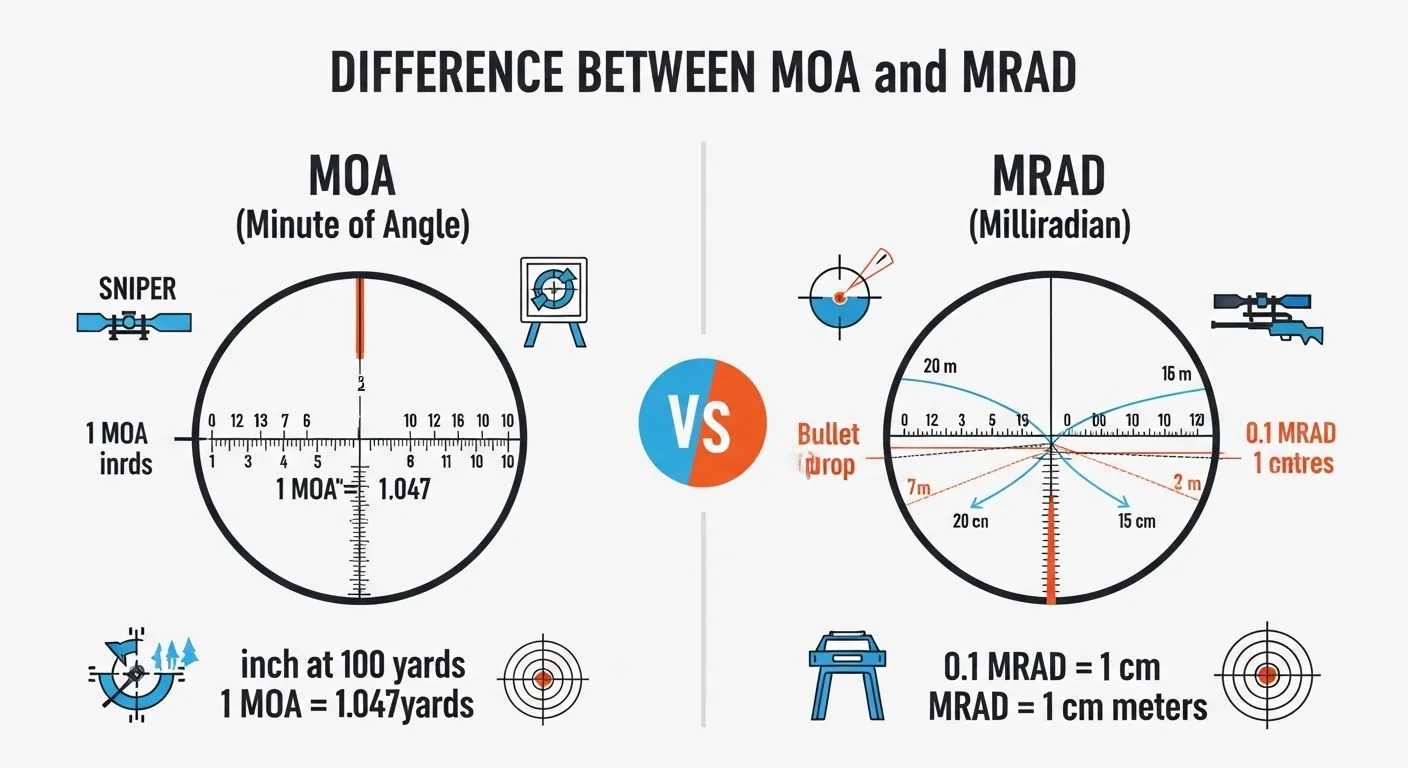
The difference between MOA and MRAD lies in how angles are calculated and applied. Minute of angle (MOA) is based on degrees, where one minute is 1/60 of a degree. On the other hand, Milliradian (MRAD) is based on radians, where one milliradian equals one-thousandth of a radian. Learning the difference between MOA and MRAD helps improve accuracy and consistency. By understanding the difference between MOA and MRAD, you can choose the right system for your needs.
Pronunciation
MOA
US: /ˌɛm.oʊˈeɪ/
MRAD
US: /ˈɛmˌræd/
Key Difference Between the Both
The main difference between MOA and MRAD is that MOA is degree-based and commonly used in the US, while MRAD is metric-based and widely used internationally.
Why Is Their Difference Necessary to Know for Learners and Experts?
Knowing the difference between MOA and MRAD is important for accuracy in shooting and optics. For learners, it builds foundational understanding. For experts, understanding the difference between MOA and MRAD ensures precise adjustments.
In practical situations, such as long-range shooting, misunderstanding the difference between MOA and MRAD can lead to missed targets and poor performance.
Difference Between MOA and MRAD
1. Definition
MOA is a unit of angular measurement based on degrees. MRAD is based on radians.
Examples
MOA:
- Used in scopes.
- Measures small angles.
MRAD:
- Used in optics.
- Measures angular distance.
2. Measurement System
MOA uses the imperial system. MRAD uses the metric system.
Examples
MOA:
- Inches at distance.
- US preference.
MRAD:
- Meters at distance.
- Global use.
3. Value at Distance
1 MOA ≈ 1.047 inches at 100 yards. 1 MRAD ≈ 3.6 inches at 100 yards.
Examples
MOA:
- Smaller adjustments.
- Fine tuning.
MRAD:
- Larger increments.
- Easier calculation.
4. Adjustment Scale
MOA adjustments are smaller. MRAD adjustments are larger.
Examples
MOA:
- 1/4 MOA clicks.
- Precise changes.
MRAD:
- 0.1 MRAD clicks.
- Faster adjustments.
5. Ease of Calculation
MOA calculations can be complex. MRAD is easier with metric system.
Examples
MOA:
- Requires conversion.
- Less intuitive.
MRAD:
- Simple math.
- Direct scaling.
6. Usage
MOA is common in the US. MRAD is used worldwide.
Examples
MOA:
- American shooters.
- Traditional systems.
MRAD:
- Military use.
- International shooters.
7. Precision
MOA offers finer adjustments. MRAD offers simpler scaling.
Examples
MOA:
- High precision.
- Small increments.
MRAD:
- Practical accuracy.
- Larger steps.
8. Reticle Design
MOA reticles use MOA markings. MRAD reticles use MRAD markings.
Examples
MOA:
- MOA grid.
- Matching turrets.
MRAD:
- MRAD grid.
- Matching system.
9. Learning Curve
MOA may take longer to learn. MRAD is often easier.
Examples
MOA:
- More calculations.
- Practice needed.
MRAD:
- Simple understanding.
- Quick learning.
10. Preference
Choice depends on user preference and system.
Examples
MOA:
- Preferred for precision.
- Familiar to some users.
MRAD:
- Preferred for simplicity.
- Modern choice.
Nature and Behaviour of Both
MOA is precise and traditional, while MRAD is practical and widely used in modern systems.
Why People Are Confused About Their Use?
People often confuse MOA and MRAD because both measure angles and are used in similar equipment. However, they differ in calculation and system.
Table Showing Difference and Similarity
| Feature | MOA | MRAD | Similarity |
| Basis | Degrees | Radians | Angular units |
| System | Imperial | Metric | Used in optics |
| Precision | Higher | Practical | Accurate |
| Use | US | Global | Shooting |
| Calculation | Complex | Simple | Measurement |
Which Is Better in What Situation?
MOA
MOA is better for shooters who prefer finer adjustments and are comfortable with the imperial system.
MRAD
MRAD is better for those who prefer easier calculations and use the metric system.
How the Keywords Are Used in Metaphors and Similes
Examples:
- “His aim was MOA-level precise.”
- “Her strategy was MRAD—simple and effective.”
Connotative Meaning
MOA
Connotation: Precision, detail.
Example:
“It was a MOA-like adjustment—very precise.”
MRAD
Connotation: Simplicity, efficiency.
Example:
“He used an MRAD approach—quick and accurate.”
Idioms or Proverbs Related to the Words
Hit the mark
Example:
“He hit the mark with perfect MOA accuracy.”
Works in Literature
MOA and MRAD are discussed in shooting manuals, military training guides, and optics textbooks.
Movie Names Made on the Keywords
There are no movies directly based on MOA or MRAD.
Five Frequently Asked Questions
1. What is the main difference between MOA and MRAD?
MOA is degree-based, while MRAD is radian-based.
2. Which is more accurate?
Both are accurate but differ in scale.
3. Which is easier to use?
MRAD is generally easier.
4. Are they interchangeable?
No, but they can be converted.
5. Which is better for beginners?
MRAD is often easier to learn.
How Both Are Useful for Surroundings
Both MOA and MRAD improve accuracy in shooting, hunting, and optics applications.
Final Words for the Both
MOA and MRAD are essential tools for precision measurement, each with unique advantages.
Conclusion
The difference between MOA and MRAD lies in their measurement system and application. MOA is based on degrees and offers fine precision, while MRAD is based on radians and provides easier calculations. Understanding the difference between MOA and MRAD helps improve accuracy and performance. By learning the difference between MOA and MRAD, users can choose the best system for their needs.

I’m Shabbir Hussain, a professional content writer who specializes in clear and authentic comparisons between similar terms. I write concise, research-based, and reader-friendly content that turns complex language into simple explanations. Through Mysynonyms.com, I help readers strengthen their vocabulary and clearly understand word differences.