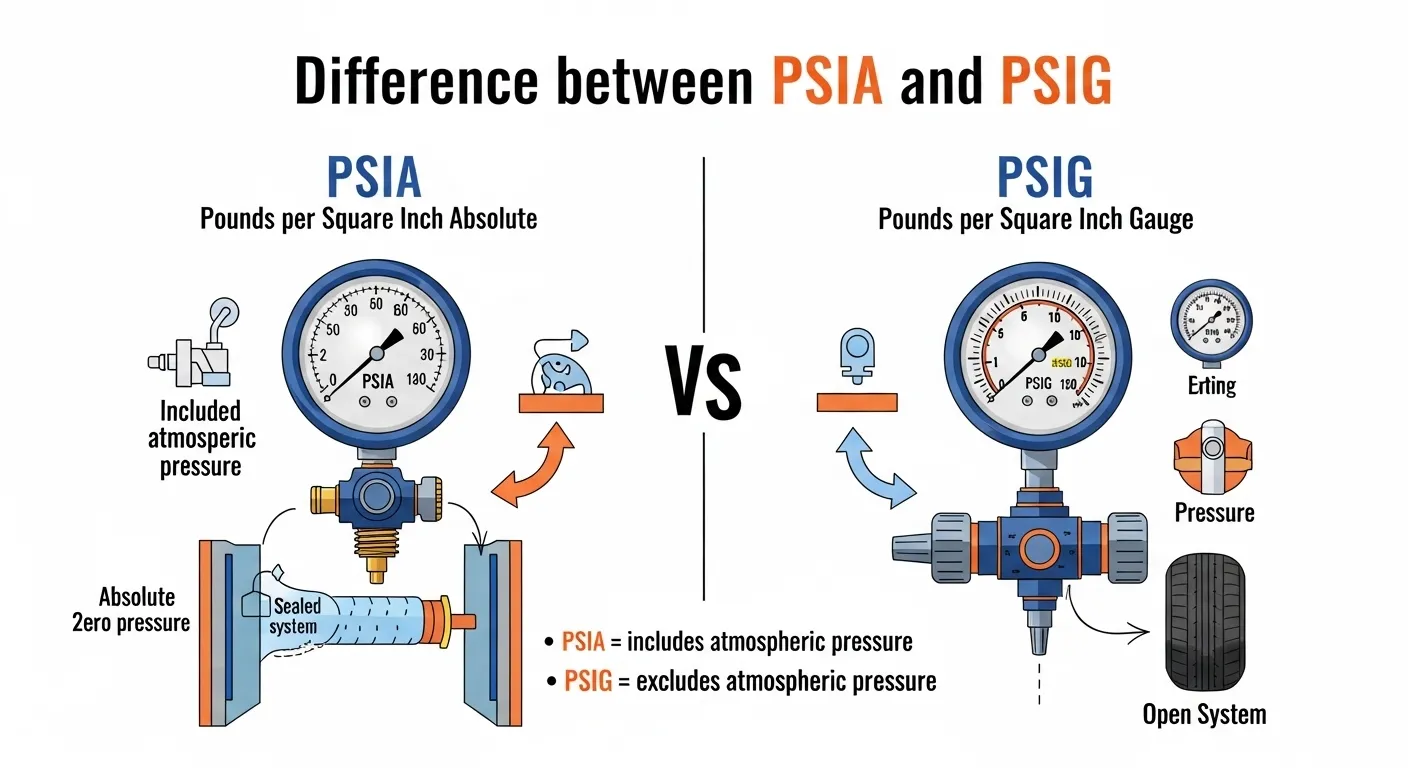
PSIA and PSIG both measure pressure, but PSIA includes atmospheric pressure, while PSIG measures pressure relative to atmospheric pressure.
Understanding the difference between PSIA and PSIG is essential in engineering, physics, and everyday applications involving pressure systems. Imagine measuring the pressure inside a tire or a gas tank—sometimes you measure only the pressure above the atmosphere, while other times you measure the total pressure including the air around you.
The difference between PSIA and PSIG lies in their reference point. Pound per square inch absolute (PSIA) measures pressure relative to a perfect vacuum, while Pound per square inch gauge (PSIG) measures pressure relative to atmospheric pressure. Learning the difference between PSIA and PSIG helps ensure accurate readings in systems like HVAC, automotive, and industrial processes. By understanding the difference between PSIA and PSIG, you can avoid costly errors and improve safety.
Pronunciation
PSIA
US: /piː-ɛs-aɪ-eɪ/
PSIG
US: /piː-ɛs-aɪ-dʒiː/
Key Difference Between the Both
The main difference between PSIA and PSIG is that PSIA measures total pressure including atmospheric pressure, while PSIG measures pressure above atmospheric pressure.
Why Is Their Difference Necessary to Know for Learners and Experts?
Knowing the difference between PSIA and PSIG is important for engineers, technicians, and students. For learners, it builds a foundation in pressure measurement. For experts, understanding the difference between PSIA and PSIG ensures precise calculations and system safety.
In real-world applications like gas storage, refrigeration, and tire pressure, misunderstanding the difference between PSIA and PSIG can lead to incorrect readings and potential hazards.
Difference Between PSIA and PSIG
1. Definition
PSIA measures absolute pressure. PSIG measures gauge pressure.
Examples
PSIA:
- Total pressure in a system.
- Includes atmospheric pressure.
PSIG:
- Pressure above atmosphere.
- Common in gauges.
2. Reference Point
PSIA uses a vacuum as reference. PSIG uses atmospheric pressure.
Examples
PSIA:
- Zero at vacuum.
- Absolute scale.
PSIG:
- Zero at atmospheric pressure.
- Relative scale.
3. Atmospheric Pressure Inclusion
PSIA includes atmospheric pressure. PSIG excludes it.
Examples
PSIA:
- 14.7 psi at sea level when no added pressure.
- Includes air pressure.
PSIG:
- 0 psi at atmospheric level.
- Ignores air pressure.
4. Usage
PSIA is used in scientific calculations. PSIG is used in everyday measurements.
Examples
PSIA:
- Engineering systems.
- Gas laws.
PSIG:
- Tire pressure.
- Air compressors.
5. Measurement Tools
PSIA requires specialized instruments. PSIG uses standard gauges.
Examples
PSIA:
- Absolute pressure sensors.
- Advanced devices.
PSIG:
- Pressure gauges.
- Common tools.
6. Zero Point
PSIA zero equals no pressure. PSIG zero equals atmospheric pressure.
Examples
PSIA:
- Vacuum condition.
- True zero.
PSIG:
- Normal air pressure.
- Relative zero.
7. Calculation Relationship
PSIA equals PSIG plus atmospheric pressure.
Examples
PSIA:
- 30 PSIA = 15 PSIG + 14.7
- Includes atmosphere.
PSIG:
- 15 PSIG = 30 PSIA – 14.7
- Excludes atmosphere.
8. Accuracy
PSIA is more accurate for scientific work. PSIG is sufficient for practical use.
Examples
PSIA:
- Precise calculations.
- Research use.
PSIG:
- Everyday accuracy.
- General use.
9. Application Field
PSIA is used in physics and engineering. PSIG is used in daily equipment.
Examples
PSIA:
- Aerospace systems.
- Chemical processes.
PSIG:
- Car tires.
- HVAC systems.
10. Importance
Both are important but serve different needs.
Examples
PSIA:
- Critical for calculations.
- Ensures accuracy.
PSIG:
- Useful for routine checks.
- Easy to read.
Nature and Behaviour of Both
PSIA provides a complete and absolute measurement of pressure, making it essential for scientific accuracy. PSIG provides a relative measurement, making it practical for everyday applications.
Why People Are Confused About Their Use?
People often confuse PSIA and PSIG because both use the same unit (psi). However, the key difference is their reference point—absolute versus atmospheric.
Table Showing Difference and Similarity
| Feature | PSIA | PSIG | Similarity |
| Type | Absolute pressure | Gauge pressure | Same unit (psi) |
| Reference | Vacuum | Atmosphere | Pressure measure |
| Use | Scientific | Practical | Widely used |
| Zero | True zero | Atmospheric | Related values |
| Accuracy | High | Moderate | Important |
Which Is Better in What Situation?
PSIA
PSIA is better for scientific calculations, engineering designs, and situations requiring absolute accuracy.
PSIG
PSIG is better for everyday use, such as checking tire pressure or operating machinery.
How the Keywords Are Used in Metaphors and Similes
Examples:
- “His understanding was PSIA, complete and absolute.”
- “Her view was PSIG, relative to the situation.”
Connotative Meaning
PSIA
Connotation: Absolute, complete.
Example:
“It was a PSIA-level truth—fully accurate.”
PSIG
Connotation: Relative, practical.
Example:
“His judgment was PSIG—based on context.”
Idioms or Proverbs Related to the Words
There are no direct idioms, but similar ideas exist:
Measure twice, cut once
Example:
“Use PSIA when accuracy matters—measure twice.”
Works in Literature
PSIA and PSIG are technical terms found in engineering textbooks, physics materials, and industrial manuals.
Movie Names Made on the Keywords
There are no movies directly based on PSIA or PSIG.
Five Frequently Asked Questions
1. What is the main difference between PSIA and PSIG?
PSIA includes atmospheric pressure, while PSIG does not.
2. What is atmospheric pressure in psi?
About 14.7 psi at sea level.
3. How do you convert PSIG to PSIA?
Add atmospheric pressure.
4. Which is used in daily life?
PSIG.
5. Why is PSIA important?
For accurate scientific measurements.
How Both Are Useful for Surroundings
Both are essential for safe and accurate pressure measurement in industries and daily applications.
Final Words for the Both
Both are closely related but differ in reference points and applications.
Conclusion
The difference between PSIA and PSIG lies in how pressure is measured. PSIA measures absolute pressure including atmospheric pressure, while PSIG measures pressure relative to the atmosphere. Understanding the difference between PSIA and PSIG is crucial for accurate measurement and safe system operation. By learning the difference between PSIA and PSIG, individuals can make better decisions in both technical and everyday situations.

I’m Shabbir Hussain, a professional content writer who specializes in clear and authentic comparisons between similar terms. I write concise, research-based, and reader-friendly content that turns complex language into simple explanations. Through Mysynonyms.com, I help readers strengthen their vocabulary and clearly understand word differences.