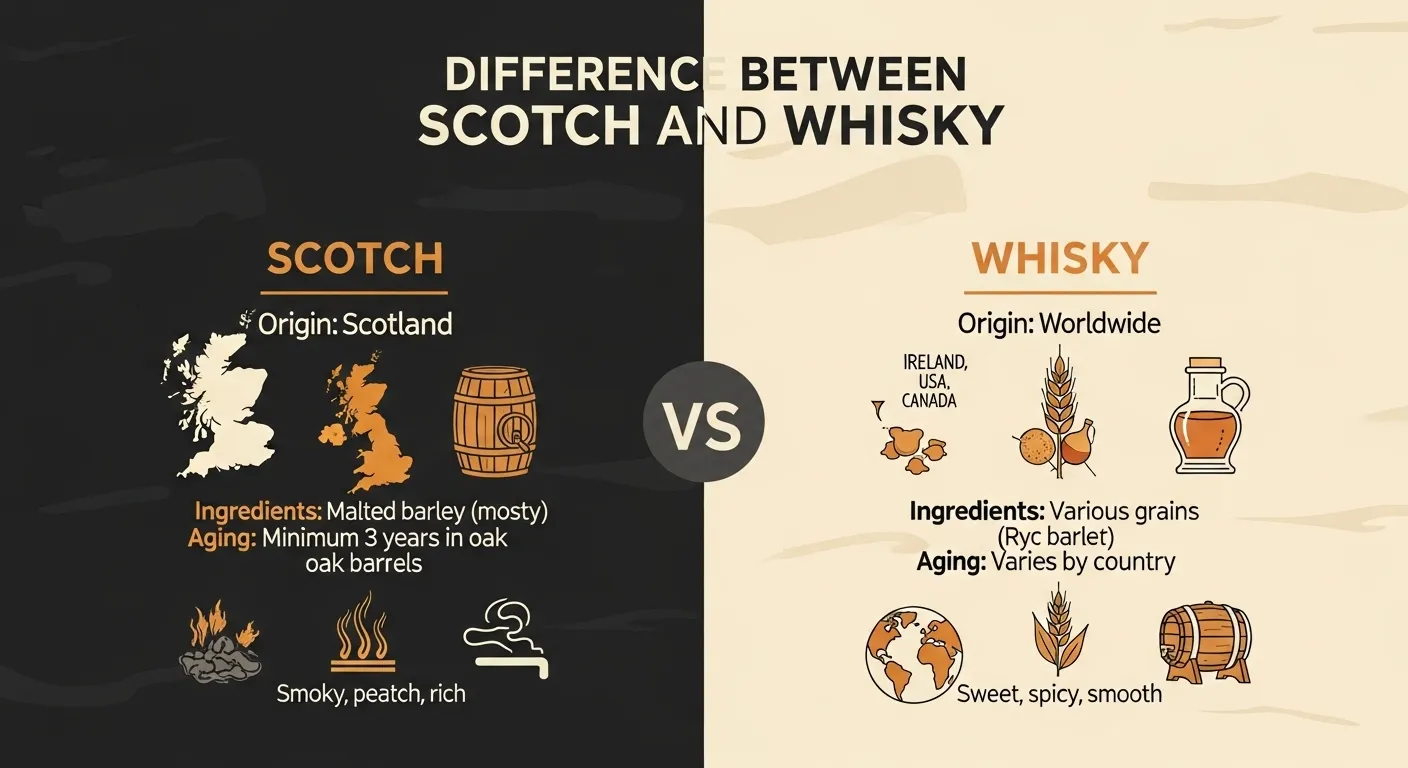
Scotch is a type of whisky made specifically in Scotland under strict regulations, while whisky is a broader term that includes spirits made in different countries like Ireland, the USA, and Japan.
Understanding the difference between Scotch and whisky can help both beginners and enthusiasts appreciate this popular spirit more deeply. Imagine walking into a store and seeing bottles labeled “Scotch” and others simply called “whisky.” At first glance, they may seem the same, but there are important differences behind those labels.
The difference between Scotch and whisky mainly lies in their origin, production methods, and flavor profiles. Scotch is a specific category of whisky produced in Scotland, while whisky is a general term used worldwide. Learning the difference between Scotch and whisky allows you to choose the right drink based on taste, tradition, and quality. By understanding the difference between Scotch and whisky, you can better enjoy the rich history and craftsmanship behind each type.
Pronunciation
Scotch
US: /skɒtʃ/
UK: /skɒtʃ/
Whisky
US: /ˈwɪski/
UK: /ˈwɪski/
Key Difference Between the Both
The main difference between Scotch and whisky is that Scotch must be made in Scotland following strict rules, while whisky is a general category of distilled spirits produced in various countries.
Why Is Their Difference Necessary to Know for Learners and Experts?
Knowing the difference between Scotch and whisky is important for consumers, bartenders, and enthusiasts. For beginners, it helps in making informed choices. For experts, understanding the difference between Scotch and whisky allows deeper appreciation of regional styles and production techniques.
In society, whisky plays a cultural and economic role in many countries. Knowing the difference between Scotch and whisky helps preserve traditions and ensures proper labeling and quality standards.
Difference Between Scotch and Whisky
1. Definition
Scotch is a whisky produced in Scotland. Whisky is a general term for distilled grain spirits.
Examples
Scotch:
- A bottle labeled “Scotch whisky” from Scotland.
- Single malt Scotch from Scottish distilleries.
Whisky:
- Irish whisky.
- American bourbon whisky.
2. Origin
Scotch comes only from Scotland. Whisky is produced worldwide.
Examples
Scotch:
- Made in Scottish regions.
- Must follow Scottish laws.
Whisky:
- Made in Ireland, USA, Japan, etc.
- Different regional styles.
3. Spelling
Scotch uses the term “whisky.” Some countries use “whiskey” (with an “e”).
Examples
Scotch:
- Labeled as “Scotch whisky.”
- Uses Scottish spelling.
Whisky:
- Irish whiskey includes an “e.”
- American whiskey follows similar spelling.
4. Ingredients
Scotch is often made from malted barley. Whisky can be made from various grains.
Examples
Scotch:
- Malted barley.
- Sometimes blended grains.
Whisky:
- Corn (bourbon).
- Rye or wheat.
5. Aging Requirements
Scotch must be aged for at least 3 years in oak barrels. Whisky aging rules vary by country.
Examples
Scotch:
- Minimum 3 years aging.
- Often aged longer.
Whisky:
- Bourbon aged in new oak barrels.
- Irish whiskey aging rules differ.
6. Production Process
Scotch often uses traditional methods like pot stills. Whisky production varies globally.
Examples
Scotch:
- Double distillation.
- Traditional Scottish techniques.
Whisky:
- May use column stills.
- Different methods in different countries.
7. Flavor Profile
Scotch often has smoky or peaty flavors. Whisky flavors vary widely.
Examples
Scotch:
- Smoky taste from peat.
- Rich and complex.
Whisky:
- Sweet bourbon flavor.
- Light and smooth Irish whisky.
8. Types
Scotch includes specific categories like single malt and blended. Whisky includes many global types.
Examples
Scotch:
- Single malt Scotch.
- Blended Scotch.
Whisky:
- Bourbon.
- Rye whisky.
9. Regulations
Scotch is strictly regulated by law. Whisky regulations depend on country.
Examples
Scotch:
- Must be made in Scotland.
- Strict quality standards.
Whisky:
- Varies by region.
- Different legal requirements.
10. Global Identity
Scotch is a protected regional product. Whisky is a global spirit category.
Examples
Scotch:
- Recognized worldwide as Scottish.
- Protected by law.
Whisky:
- Produced globally.
- Diverse styles and identities.
Nature and Behaviour of Both
Scotch is traditional, regulated, and region-specific with a strong identity tied to Scotland. Whisky is diverse, flexible, and varies widely depending on where and how it is produced.
Why People Are Confused About Their Use?
People often confuse Scotch and whisky because Scotch is a type of whisky. The terms are sometimes used interchangeably, even though Scotch refers to a specific origin and style.
Table Showing Difference and Similarity
| Feature | Scotch | Whisky | Similarity |
| Meaning | Whisky from Scotland | General spirit category | Both distilled spirits |
| Origin | Scotland | Worldwide | Grain-based alcohol |
| Flavor | Often smoky | Varies widely | Aged in barrels |
| Rules | Strict | Varies | Quality controlled |
| Types | Limited categories | Many global types | Popular beverages |
Which Is Better in What Situation?
Scotch
Scotch is ideal for those who appreciate tradition, complex flavors, and smoky or peaty profiles. It is often enjoyed slowly and is popular among experienced drinkers.
Whisky
Whisky is better for those who want variety and flexibility. With many styles like bourbon and Irish whiskey, it suits different tastes and occasions.
How the Keywords Are Used in Metaphors and Similes
Examples:
- “His taste was as refined as fine Scotch.”
- “Life felt smooth like aged whisky.”
Connotative Meaning
Scotch
Connotation: Premium, traditional, and refined.
Example:
“He preferred Scotch for its rich heritage.”
Whisky
Connotation: Versatile and widely enjoyed.
Example:
“Whisky is popular across cultures.”
Idioms or Proverbs Related to the Words
Old as whisky
Example:
“This tradition is as old as whisky.”
Works in Literature
- Whisky Galore – Novel by Compton Mackenzie, 1947
- The Whisky Distilleries of the United Kingdom – Alfred Barnard, 1887
Movie Names Made on the Keywords
- Whisky Galore! – 1949, UK
- The Angels’ Share – 2012, UK (Scotch whisky theme)
Five Frequently Asked Questions
1. What is the main difference between Scotch and whisky?
Scotch is whisky made in Scotland, while whisky is a global category.
2. Is all Scotch whisky?
Yes, all Scotch is whisky, but not all whisky is Scotch.
3. Why is Scotch smoky?
Because of peat used during the malting process.
4. Is Scotch stronger than whisky?
Not necessarily; strength depends on alcohol content.
5. Which is better for beginners?
Milder whiskies like Irish whisky are often easier for beginners.
How Both Are Useful for Surroundings
Both play cultural, economic, and social roles. They are enjoyed in celebrations, traditions, and global trade.
Final Words for the Both
Scotch and whisky are closely related but not identical. Each offers unique qualities that appeal to different preferences.
Conclusion
The difference between Scotch and whisky lies mainly in origin, production, and identity. Scotch is a specific type of whisky made in Scotland under strict rules, while whisky is a broader category produced worldwide. Understanding the difference between Scotch and whisky helps consumers appreciate the diversity and craftsmanship of these spirits. By learning the difference between Scotch and whisky, you can make better choices and enjoy the rich traditions behind every sip.

I’m Shabbir Hussain, a professional content writer who specializes in clear and authentic comparisons between similar terms. I write concise, research-based, and reader-friendly content that turns complex language into simple explanations. Through Mysynonyms.com, I help readers strengthen their vocabulary and clearly understand word differences.