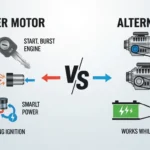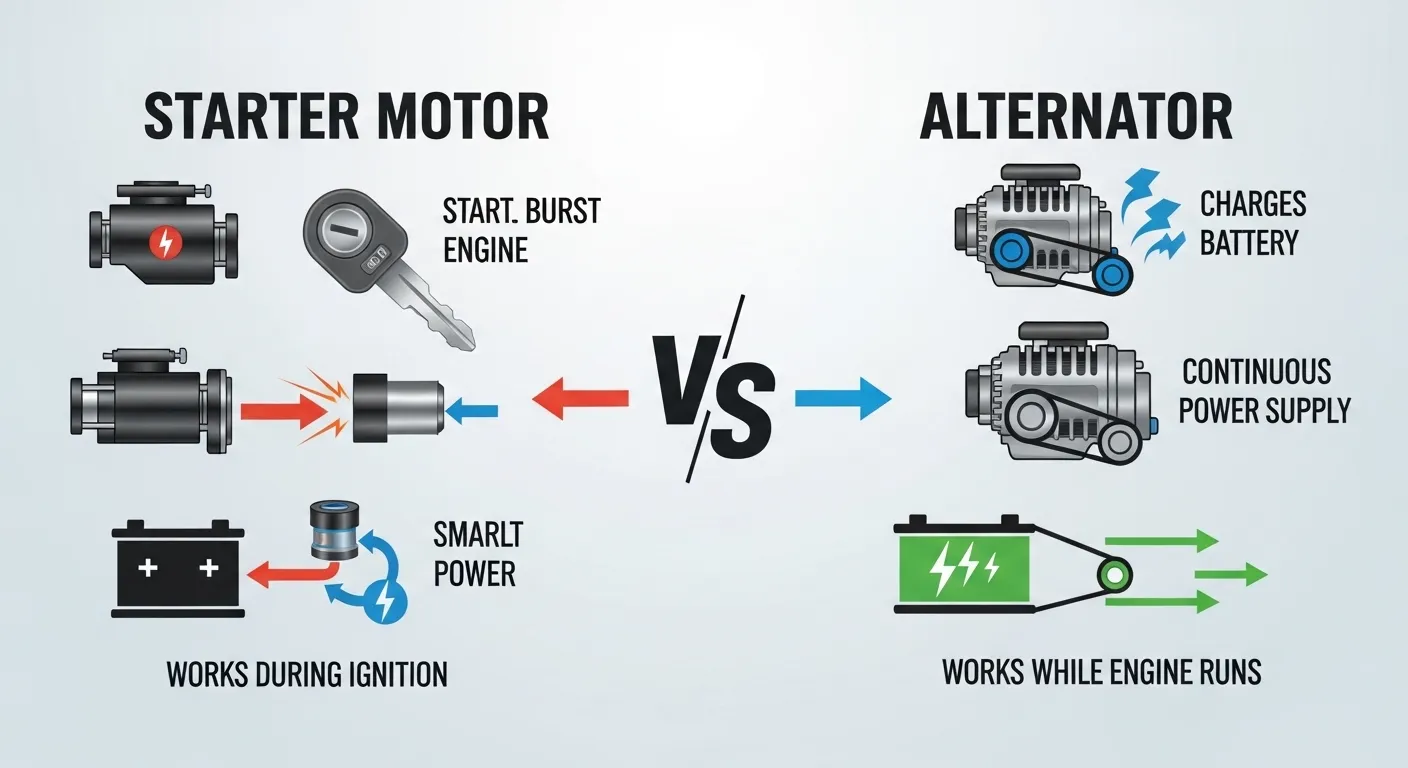
A starter and an alternator are both essential car components, but the starter starts the engine, while the alternator generates electricity to keep the car running.
Understanding the difference between starter and alternator is important for every car owner and learner. Imagine turning your car key or pressing the start button—the engine comes to life instantly. Behind this simple action are two crucial components working together.
The difference between starter and alternator lies in their roles. The starter is responsible for initiating the engine’s operation, while the alternator keeps the battery charged and powers electrical systems once the engine is running. Learning the difference between starter and alternator helps you diagnose common car problems and maintain your vehicle better. By understanding the difference between starter and alternator, you can avoid breakdowns and make informed repair decisions.
Pronunciation
Starter
US: /ˈstɑːrtər/
Alternator
US: /ˈɔːltərˌneɪtər/
Key Difference Between the Both
The main difference between starter and alternator is that the starter is used to start the engine, while the alternator generates electricity to power the car and recharge the battery.
Why Is Their Difference Necessary to Know for Learners and Experts?
Knowing the difference between starter and alternator is essential for drivers, mechanics, and automotive students. For beginners, it helps identify basic vehicle functions. For experts, understanding the difference between starter and alternator is crucial for diagnosing and repairing electrical issues.
In daily life, this knowledge helps avoid unnecessary expenses and ensures vehicle reliability. Misunderstanding the difference between starter and alternator can lead to incorrect repairs and wasted time.
Difference Between Starter and Alternator
1. Definition
A starter is a motor that starts the engine. An alternator is a generator that produces electricity.
Examples
Starter:
- Turns engine at ignition.
- Engages when key is turned.
Alternator:
- Generates power while driving.
- Charges battery.
2. Function
Starter initiates engine operation. Alternator supplies electrical power.
Examples
Starter:
- Cranks engine.
- Starts combustion.
Alternator:
- Powers lights.
- Runs electronics.
3. Working Time
Starter works only at the beginning. Alternator works continuously while engine runs.
Examples
Starter:
- Active for seconds.
- Stops after engine starts.
Alternator:
- Runs during driving.
- Constant operation.
4. Power Source
Starter uses battery power. Alternator generates power.
Examples
Starter:
- Draws energy from battery.
- High power usage.
Alternator:
- Produces electricity.
- Recharges battery.
5. Location
Both are located in the engine bay but in different positions.
Examples
Starter:
- Near engine base.
- Connected to flywheel.
Alternator:
- Near belts.
- Connected to engine pulley.
6. Role in Battery
Starter drains the battery. Alternator charges the battery.
Examples
Starter:
- Uses stored energy.
- Temporary usage.
Alternator:
- Restores battery charge.
- Continuous supply.
7. Type of Device
Starter is an electric motor. Alternator is a generator.
Examples
Starter:
- Converts electrical to mechanical energy.
- Rotates engine.
Alternator:
- Converts mechanical to electrical energy.
- Generates current.
8. Failure Symptoms
Starter failure prevents engine start. Alternator failure causes battery drain.
Examples
Starter:
- Clicking sound.
- Engine won’t crank.
Alternator:
- Dim lights.
- Battery warning light.
9. Energy Flow
Starter uses energy. Alternator produces energy.
Examples
Starter:
- Consumes power.
- Short-term use.
Alternator:
- Supplies power.
- Long-term use.
10. Importance
Both are essential but serve different stages.
Examples
Starter:
- Needed to start car.
- First step.
Alternator:
- Needed to keep car running.
- Continuous role.
Nature and Behaviour of Both
The starter is a short-term, high-power device used only during ignition. The alternator is a long-term, steady device that keeps the electrical system functioning.
Why People Are Confused About Their Use?
People often confuse starter and alternator because both are related to the car’s electrical system and battery. However, the key difference is that the starter starts the engine, while the alternator keeps it running.
Table Showing Difference and Similarity
| Feature | Starter | Alternator | Similarity |
| Function | Starts engine | Generates electricity | Car components |
| Operation | Short-term | Continuous | Electrical system |
| Energy | Consumes | Produces | Battery-related |
| Type | Motor | Generator | Engine parts |
| Role | Ignition | Power supply | Essential |
Which Is Better in What Situation?
Starter
The starter is essential when starting the car. Without it, the engine cannot begin operation.
Alternator
The alternator is crucial while driving, as it powers the car and keeps the battery charged.
How the Keywords Are Used in Metaphors and Similes
Examples:
- “He was the starter of the project, getting everything going.”
- “She worked like an alternator, keeping everything running smoothly.”
Connotative Meaning
Starter
Connotation: Beginning, initiation.
Example:
“He was the starter of the idea.”
Alternator
Connotation: Support, continuity.
Example:
“She acted as the alternator, maintaining progress.”
Idioms or Proverbs Related to the Words
Get the ball rolling
Example:
“He used the starter to get the ball rolling.”
Works in Literature
Starter and alternator are technical terms mainly discussed in automotive manuals and engineering texts.
Movie Names Made on the Keywords
There are no major movies directly based on starter or alternator as mechanical components.
Five Frequently Asked Questions
1. What is the main difference between starter and alternator?
The starter starts the engine, while the alternator powers the car.
2. Can a car run without an alternator?
Only for a short time until the battery drains.
3. What happens if the starter fails?
The engine will not start.
4. Which is more expensive to repair?
It depends, but alternators are often costlier.
5. Do both affect the battery?
Yes, one uses it and the other charges it.
How Both Are Useful for Surroundings
Both starter and alternator ensure smooth vehicle operation, which supports transportation and daily life activities.
Final Words for the Both
Starter and alternator are essential components with different roles in a vehicle’s functioning. Understanding the difference between a starter and an alternator helps you diagnose common car issues more easily. If your car won’t start, the problem could be the starter. If your battery keeps dying, the alternator might be the culprit. Both components are vital, one starts the journey, and the other keeps it going.
Conclusion
The difference between starter and alternator lies in their function and timing. The starter is responsible for starting the engine, while the alternator generates electricity to keep the car running and the battery charged. Understanding the difference between starter and alternator helps in maintaining vehicles and diagnosing problems effectively. By learning the difference between starter and alternator, you can ensure better performance and avoid unexpected breakdowns.

I’m Shabbir Hussain, a professional content writer who specializes in clear and authentic comparisons between similar terms. I write concise, research-based, and reader-friendly content that turns complex language into simple explanations. Through Mysynonyms.com, I help readers strengthen their vocabulary and clearly understand word differences.