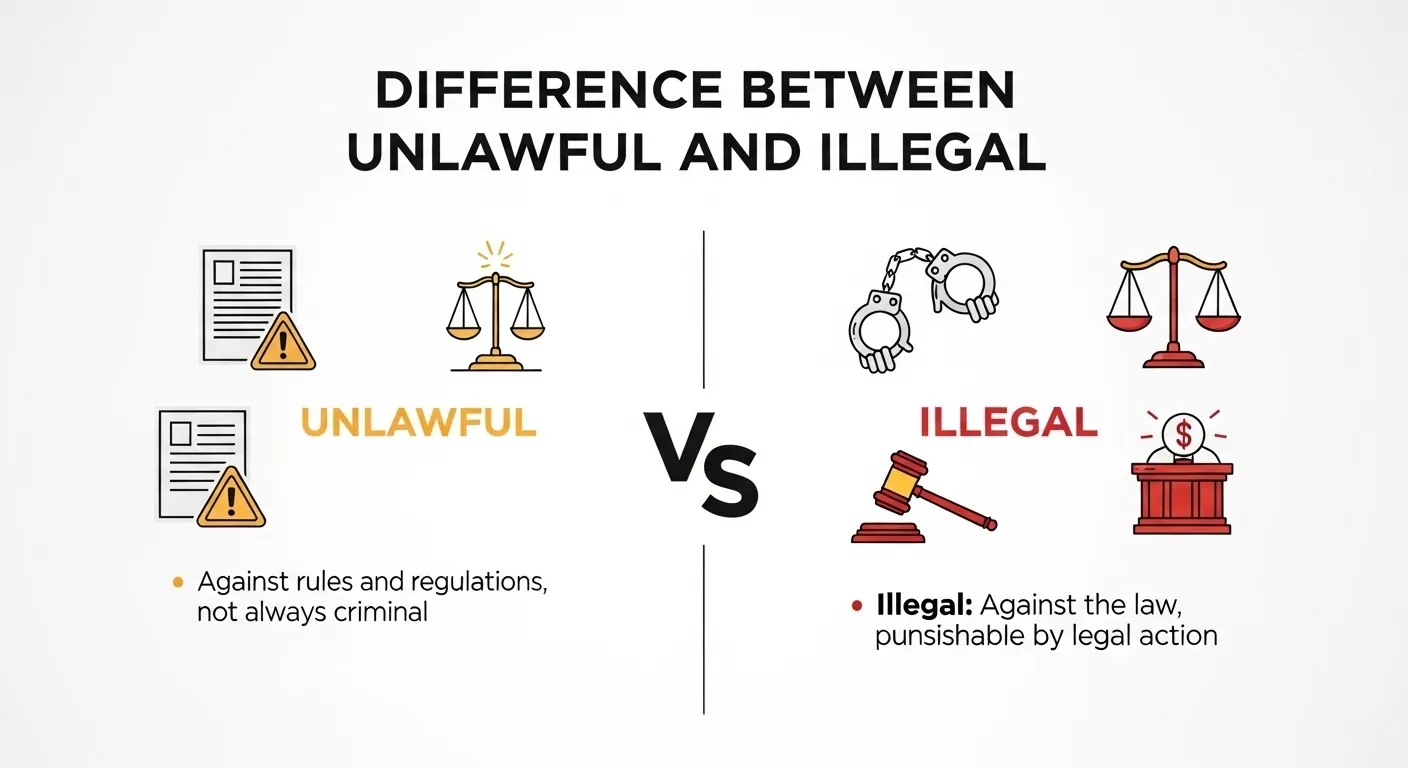
Unlawful and illegal both refer to actions against the law, but “illegal” clearly means forbidden by law, while “unlawful” is broader and may include actions not strictly permitted or regulated.
Understanding the difference between unlawful and illegal is important in legal, academic, and everyday contexts. Imagine reading a rule or law, some actions are strictly banned, while others may simply not be permitted under certain circumstances.
The difference between unlawful and illegal lies in their scope and usage. “Illegal” is a direct and strong term used for actions that are clearly against the law, while “unlawful” is a broader legal term that can include actions not authorized by law but not always criminal. Learning the difference between unlawful and illegal helps avoid confusion in legal writing and communication. By understanding the difference between unlawful and illegal, you can use these terms more accurately in both formal and informal settings.
Pronunciation
Unlawful
US: /ʌnˈlɔːfəl/
Illegal
US: /ɪˈliːɡəl/
Key Difference Between the Both
The main difference between unlawful and illegal is that “illegal” refers to something explicitly prohibited by law, while “unlawful” refers to something not allowed by law, which may or may not be a criminal offense.
Why Is Their Difference Necessary to Know for Learners and Experts?
Knowing the difference between unlawful and illegal is essential for students, lawyers, and professionals. For learners, it improves vocabulary and understanding of legal language. For experts, understanding the difference between unlawful and illegal ensures precise legal interpretation.
In society, laws guide behavior and justice. Misunderstanding the difference between unlawful and illegal can lead to incorrect assumptions about legal consequences and responsibilities.
Difference Between Unlawful and Illegal
1. Definition
Illegal means forbidden by law. Unlawful means not permitted by law.
Examples
Illegal:
- Theft.
- Drug trafficking.
Unlawful:
- Breach of contract.
- Unauthorized entry.
2. Severity
Illegal actions are often criminal. Unlawful actions may be less severe.
Examples
Illegal:
- Robbery.
- Fraud.
Unlawful:
- Civil violations.
- Minor infractions.
3. Usage
Illegal is commonly used in everyday language. Unlawful is often used in legal contexts.
Examples
Illegal:
- Illegal parking.
- Illegal activities.
Unlawful:
- Unlawful assembly.
- Unlawful conduct.
4. Scope
Illegal is more specific. Unlawful is broader.
Examples
Illegal:
- Clearly banned acts.
- Criminal offenses.
Unlawful:
- Includes illegal acts.
- Also includes non-criminal violations.
5. Legal Context
Illegal is used in criminal law. Unlawful can be used in civil and criminal law.
Examples
Illegal:
- Criminal charges.
- Penal code violations.
Unlawful:
- Civil disputes.
- Legal breaches.
6. Formality
Illegal is less formal. Unlawful is more formal.
Examples
Illegal:
- Common speech.
- Media use.
Unlawful:
- Legal documents.
- Court language.
7. Consequences
Illegal acts lead to penalties or punishment. Unlawful acts may lead to legal consequences or remedies.
Examples
Illegal:
- Jail time.
- Fines.
Unlawful:
- Lawsuits.
- Compensation.
8. Clarity
Illegal has a clear meaning. Unlawful can be context-dependent.
Examples
Illegal:
- Clearly prohibited.
- Direct meaning.
Unlawful:
- Depends on situation.
- Broader interpretation.
9. Frequency of Use
Illegal is more commonly used. Unlawful is less common in daily speech.
Examples
Illegal:
- Everyday conversations.
- News reports.
Unlawful:
- Legal discussions.
- Formal writing.
10. Relationship
All illegal acts are unlawful, but not all unlawful acts are illegal.
Examples
Illegal:
- Always unlawful.
- Criminal.
Unlawful:
- May not be criminal.
- Broader category.
Nature and Behaviour of Both
Illegal actions are strictly prohibited and usually punishable by law. Unlawful actions are not allowed but may fall under a wider legal interpretation, including civil matters.
Why People Are Confused About Their Use?
People often confuse unlawful and illegal because both refer to actions against the law. However, the key difference is that illegal is more specific and strict, while unlawful is broader.
Table Showing Difference and Similarity
| Feature | Illegal | Unlawful | Similarity |
| Meaning | Forbidden | Not permitted | Against law |
| Scope | Narrow | Broad | Legal terms |
| Use | Common | Formal | Related concepts |
| Severity | Higher | Varies | Legal consequences |
| Context | Criminal | Civil & criminal | Law-related |
Which Is Better in What Situation?
Illegal
Use “illegal” when referring to clearly prohibited actions, especially in everyday language or criminal context.
Unlawful
Use “unlawful” in formal or legal contexts when describing actions not permitted by law, including civil matters.
How the Keywords Are Used in Metaphors and Similes
Examples:
- “His actions felt illegal, crossing every boundary.”
- “The decision seemed unlawful, going against accepted rules.”
Connotative Meaning
Illegal
Connotation: Strong negativity, crime.
Example:
“It was an illegal move—clearly wrong.”
Unlawful
Connotation: Formal, improper.
Example:
“The act was unlawful but not criminal.”
Idioms or Proverbs Related to the Words
Against the law
Example:
“What he did was against the law—completely illegal.”
Works in Literature
Unlawful and illegal are widely used in legal texts, court cases, and academic writings on law and governance.
Movie Names Made on the Keywords
- Lawless (2012, USA) – explores illegal activities during prohibition
Five Frequently Asked Questions
1. What is the main difference between unlawful and illegal?
Illegal means strictly forbidden by law, while unlawful is broader and includes actions not permitted.
2. Are all unlawful acts illegal?
No, but all illegal acts are unlawful.
3. Which is more serious?
Illegal is usually more serious.
4. Which is more commonly used?
Illegal is more common.
5. Can unlawful actions be legal?
No, but they may not always be criminal.
How Both Are Useful for Surroundings
Understanding these terms helps people follow laws, communicate clearly, and maintain order in society.
Final Words for the Both
Illegal and unlawful are closely related but differ in scope, usage, and severity.
Conclusion
The difference between unlawful and illegal lies in their scope and application. Illegal refers to actions clearly forbidden by law, usually involving criminal consequences, while unlawful is a broader term that includes actions not permitted by law, whether civil or criminal. Understanding the difference between unlawful and illegal helps improve legal clarity and communication. By learning the difference between unlawful and illegal, individuals can use these terms accurately in both formal and everyday contexts.

I’m Shabbir Hussain, a professional content writer who specializes in clear and authentic comparisons between similar terms. I write concise, research-based, and reader-friendly content that turns complex language into simple explanations. Through Mysynonyms.com, I help readers strengthen their vocabulary and clearly understand word differences.