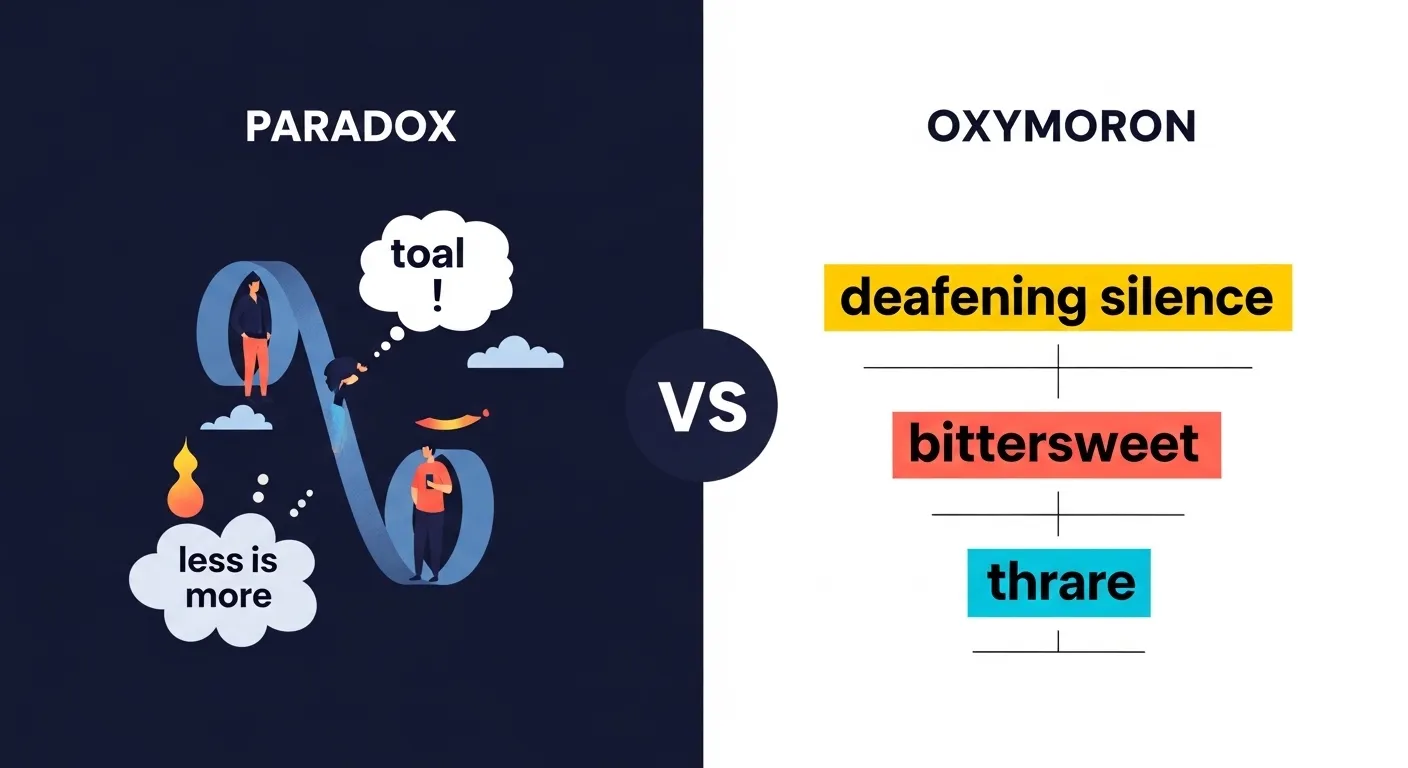
Paradox and oxymoron both involve contradictions, but a paradox is a full statement or idea that seems contradictory yet reveals a deeper truth, while an oxymoron is a combination of two opposite words placed side by side.
Understanding the difference between paradox and oxymoron can greatly improve your writing and comprehension skills. Imagine reading a sentence like “less is more”—it sounds confusing at first but actually carries a deeper meaning. This is a paradox. Now consider a phrase like “deafening silence,” where two opposite words are used together—this is an oxymoron.
The difference between paradox and oxymoron lies in their structure and purpose. Both are commonly used in literature, speeches, and everyday language to create emphasis or provoke thought. While they may seem similar because both involve contradiction, they function in different ways. Learning the difference between paradox and oxymoron helps writers express complex ideas creatively and helps readers better interpret meaning. Mastering the difference between paradox and oxymoron also enhances vocabulary and communication skills.
Pronunciation
Paradox
US: /ˈpærədɒks/
UK: /ˈpærədɒks/
Oxymoron
US: /ˌɒksɪˈmɔːrɒn/
UK: /ˌɒksɪˈmɔːrɒn/
Key Difference Between the Both
The main difference between paradox and oxymoron is that a paradox is a complete statement that appears self-contradictory but reveals a truth, while an oxymoron is a pair of contradictory words used together for effect.
Why Is Their Difference Necessary to Know for Learners and Experts?
Knowing the difference between paradox and oxymoron is important for students, writers, and language enthusiasts. For learners, it helps in understanding literary devices more clearly. For experts, it enhances the ability to analyze texts and use language creatively.
In real life, these figures of speech are used in advertising, storytelling, and speeches to make ideas more memorable. Understanding the difference between paradox and oxymoron allows individuals to communicate more effectively and appreciate deeper meanings in language.
Difference Between Paradox and Oxymoron
1. Definition
A paradox is a statement that seems contradictory but reveals a deeper truth. An oxymoron is a phrase that combines two opposite or contradictory words.
Examples
Paradox:
- “The only constant is change.”
- “Less is more.”
Oxymoron:
- “Bittersweet”
- “Living dead”
2. Structure
A paradox is usually a full sentence or idea. An oxymoron is typically a short phrase of two words.
Examples
Paradox:
- “You must be cruel to be kind.”
- “I know that I know nothing.”
Oxymoron:
- “Jumbo shrimp”
- “Open secret”
3. Purpose
A paradox is used to provoke thought and reveal truth. An oxymoron is used for stylistic effect and emphasis.
Examples
Paradox:
- Encourages deeper thinking.
- Highlights complex truths.
Oxymoron:
- Adds dramatic effect.
- Makes language more vivid.
4. Meaning
A paradox has a hidden meaning behind the contradiction. An oxymoron creates meaning through contrast.
Examples
Paradox:
- “The more you learn, the less you know.”
- Suggests knowledge reveals complexity.
Oxymoron:
- “Awfully good”
- Suggests something is very good.
5. Length
A paradox is longer and more detailed. An oxymoron is short and concise.
Examples
Paradox:
- A full philosophical statement.
- Often appears in essays or speeches.
Oxymoron:
- Two-word combinations.
- Common in everyday language.
6. Usage in Literature
Paradox is often used in philosophical or deep writing. Oxymoron is used in poetry and descriptive writing.
Examples
Paradox:
- Found in philosophical texts.
- Used in speeches.
Oxymoron:
- Found in poems.
- Used in creative writing.
7. Complexity
Paradox is more complex and requires interpretation. Oxymoron is simpler and easy to understand.
Examples
Paradox:
- Needs thinking to understand.
- May seem confusing at first.
Oxymoron:
- Easy to recognize.
- Clear contrast between words.
8. Logical Nature
A paradox appears illogical but may be true. An oxymoron is logically contradictory but stylistically meaningful.
Examples
Paradox:
- “This statement is false.”
- Challenges logic.
Oxymoron:
- “Virtual reality”
- Combines opposites creatively.
9. Common Usage
Paradox is less common in daily speech. Oxymoron is frequently used in everyday language.
Examples
Paradox:
- Used in philosophy and debates.
- Appears in complex discussions.
Oxymoron:
- Used in casual conversations.
- Common in media and ads.
10. Impact on Reader
Paradox makes the reader think deeply. Oxymoron creates a quick, striking effect.
Examples
Paradox:
- Encourages reflection.
- Leaves a lasting impression.
Oxymoron:
- Grabs attention instantly.
- Enhances expression.
Nature and Behaviour of Both
Paradox and oxymoron both rely on contradiction, but they behave differently. A paradox challenges logic to reveal truth, while an oxymoron uses contrast for stylistic expression.
Why People Are Confused About Their Use?
People often confuse paradox and oxymoron because both involve opposites or contradictions. However, the key difference is that a paradox is a full idea with deeper meaning, whereas an oxymoron is simply a pair of contrasting words.
Table Showing Difference and Similarity
| Feature | Paradox | Oxymoron | Similarity |
| Definition | Contradictory statement with truth | Contradictory word pair | Both involve contradiction |
| Structure | Sentence or idea | Two words | Both are figures of speech |
| Purpose | Reveal deeper meaning | Add style and emphasis | Enhance expression |
| Complexity | High | Low | Both creative devices |
| Usage | Philosophy, literature | Poetry, daily language | Used in writing |
Which Is Better in What Situation?
Paradox
Paradox is better when you want to express a deep or complex idea that makes the reader think.
Oxymoron
Oxymoron is better when you want to create a strong, quick impression or add style to your writing.
How the Keywords Are Used in Metaphors and Similes
Examples:
- “His life was a paradox, full of contradictions yet meaningful.”
- “The moment felt like an oxymoron—painfully beautiful.”
Connotative Meaning
Paradox
Connotation: Thought-provoking and intellectual.
Example:
“Her statement was a paradox that made everyone think.”
Oxymoron
Connotation: Creative and expressive.
Example:
“The phrase ‘sweet sorrow’ is a classic oxymoron.”
Idioms or Proverbs Related to the Words
Less is more
Example:
“In design, less is more.”
Truth is stranger than fiction
Example:
“His story proved that truth is stranger than fiction.”
Works in Literature
- Hamlet – Tragedy by William Shakespeare (uses paradoxes)
- Romeo and Juliet – Tragedy by William Shakespeare (uses oxymorons like “loving hate”)
- Animal Farm – Novel by George Orwell (contains paradoxical ideas)
Movie Names Made on the Keywords
- The Paradox – Various films exploring time and logic
- Oxymoron – Independent films using contrasting themes
- Inception – 2010 (contains paradox-like ideas)
Five Frequently Asked Questions
1. What is the main difference between paradox and oxymoron?
A paradox is a full contradictory statement with meaning, while an oxymoron is a pair of opposite words.
2. Is “deafening silence” a paradox or oxymoron?
It is an oxymoron.
3. Can a paradox be true?
Yes, many paradoxes reveal deeper truths.
4. Are oxymorons used in daily language?
Yes, they are very common.
5. Why are paradoxes confusing?
Because they appear contradictory but require deeper thinking to understand.
How Both Are Useful for Surroundings
Paradox and oxymoron help people express complex emotions and ideas in creative ways. They make communication more engaging and meaningful.
Final Words for the Both
Both paradox and oxymoron are powerful language tools. While they share the idea of contradiction, they serve different purposes in writing and communication.
Conclusion
The difference between paradox and oxymoron lies in their structure and meaning. A paradox is a complete statement that appears contradictory but reveals a deeper truth, while an oxymoron is a pair of opposite words used together for stylistic effect. Understanding the difference between paradox and oxymoron helps improve writing, reading, and analytical skills. By mastering the difference between paradox and oxymoron, learners and writers can use language more creatively and effectively.

I’m Shabbir Hussain, a professional content writer who specializes in clear and authentic comparisons between similar terms. I write concise, research-based, and reader-friendly content that turns complex language into simple explanations. Through Mysynonyms.com, I help readers strengthen their vocabulary and clearly understand word differences.