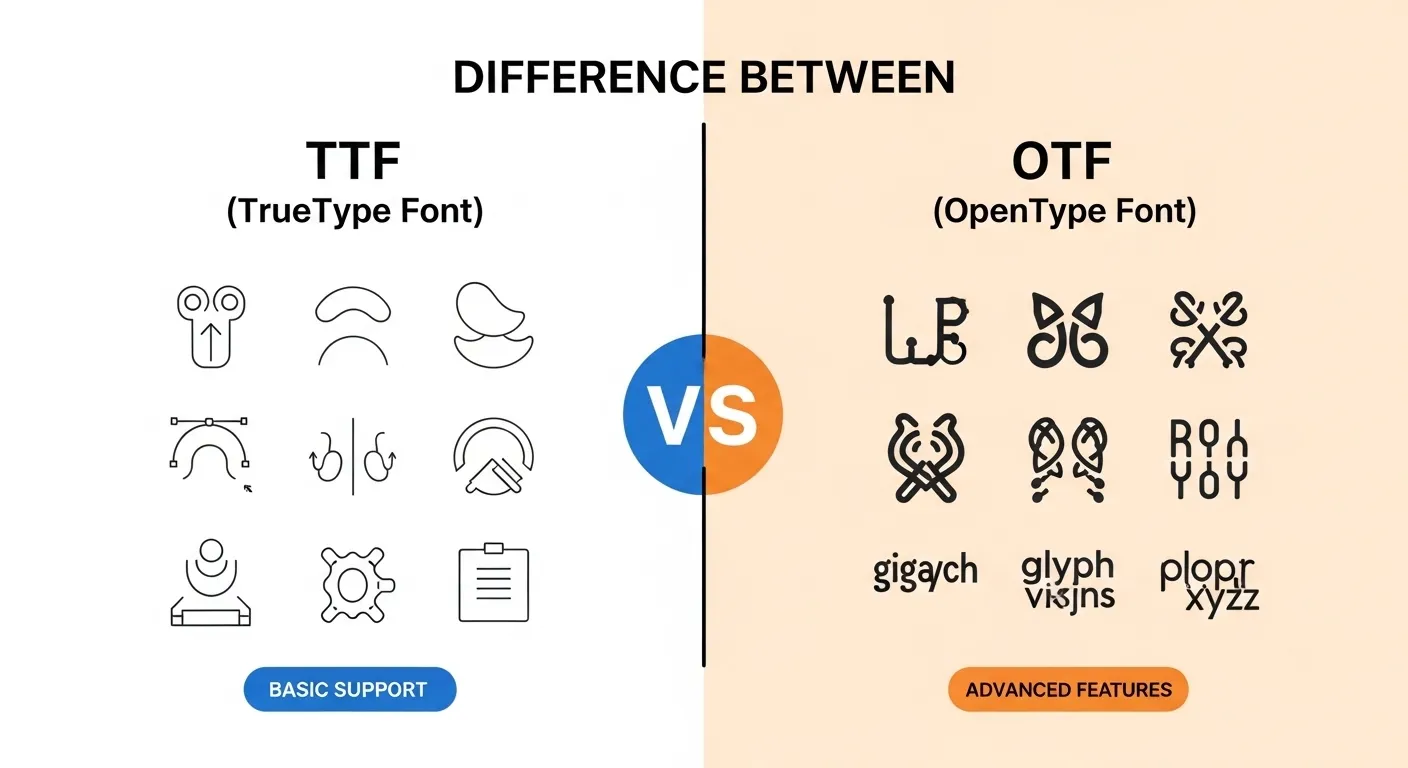
TTF (TrueType Font) and OTF (OpenType Font) are both font file formats, but TTF focuses on basic font rendering while OTF offers more advanced typographic features and flexibility.
Understanding the difference between TTF and OTF is important for designers, developers, and anyone working with digital text. Imagine you’re designing a logo or creating a website, and you need a font that looks clean, professional, and flexible. You might come across TTF and OTF files and wonder which one to choose.
The difference between TTF and OTF lies in their structure, capabilities, and usage. While both formats are widely supported across operating systems, they serve slightly different purposes. TTF is older and simpler, while OTF is more modern and feature-rich. Knowing the difference between TTF and OTF helps you select the right font format for your project, whether it’s for print, web design, or branding. By learning the difference between TTF and OTF, you can improve both the visual quality and functionality of your typography.
Pronunciation
TTF (TrueType Font)
US: /ˌtiː tiː ˈɛf/
OTF (OpenType Font)
US: /ˌoʊ tiː ˈɛf/
Key Difference Between the Both
The main difference between TTF and OTF is that TTF uses simpler font technology with basic glyph support, while OTF includes advanced typographic features like ligatures, alternate characters, and extended character sets.
Why Is Their Difference Necessary to Know for Learners and Experts?
Knowing the difference between TTF and OTF is essential for graphic designers, web developers, and typographers. For beginners, it helps in choosing the right font format for everyday use. For professionals, understanding the difference between TTF and OTF allows better control over typography, especially in branding and publishing.
In real-world applications, using the right font format can affect readability, design quality, and performance. Therefore, understanding the difference between TTF and OTF ensures better results in both digital and print media.
Difference Between TTF and OTF
1. Full Form
TTF stands for TrueType Font, while OTF stands for OpenType Font.
Examples
TTF:
- Arial.ttf
- TimesNewRoman.ttf
OTF:
- AdobeGaramond.otf
- HelveticaNeue.otf
2. Development
TTF was developed earlier, while OTF is a more advanced format developed later.
Examples
TTF:
- Created by Apple and Microsoft.
- Designed for basic font rendering.
OTF:
- Developed by Microsoft and Adobe.
- Built as an improved version of TTF.
3. Features
TTF offers basic font features, while OTF includes advanced typographic capabilities.
Examples
TTF:
- Standard characters.
- Limited design features.
OTF:
- Ligatures (e.g., “fi”, “fl”).
- Alternate glyphs and stylistic sets.
4. File Structure
TTF uses quadratic Bézier curves, while OTF uses cubic Bézier curves.
Examples
TTF:
- Simpler curve system.
- Easier rendering.
OTF:
- More complex curves.
- Better precision in design.
5. Typography Support
OTF supports advanced typography, while TTF has limited support.
Examples
TTF:
- Basic text formatting.
- Suitable for simple documents.
OTF:
- Advanced text styling.
- Used in professional design.
6. File Size
TTF files are usually slightly larger due to simpler compression, while OTF files are often more optimized.
Examples
TTF:
- Larger file size in some cases.
- Simpler structure.
OTF:
- Efficient storage.
- Can include more data.
7. Compatibility
Both formats are widely supported, but TTF has slightly broader compatibility with older systems.
Examples
TTF:
- Works on almost all devices.
- Supported in older software.
OTF:
- Supported in modern systems.
- Best for updated applications.
8. Usage in Design
TTF is commonly used for general purposes, while OTF is preferred by designers.
Examples
TTF:
- Used in basic documents.
- Suitable for everyday text.
OTF:
- Used in branding and typography.
- Preferred in professional design tools.
9. Web Usage
Both can be used on the web, but web-specific formats like WOFF are more common.
Examples
TTF:
- Can be converted to web fonts.
- Used in simple web projects.
OTF:
- Also convertible to web formats.
- Preferred for advanced typography.
10. Flexibility
OTF is more flexible and powerful, while TTF is simpler and more straightforward.
Examples
TTF:
- Easy to use.
- Limited customization.
OTF:
- Highly customizable.
- Supports multiple features in one file.
Nature and Behaviour of Both
TTF is simple, reliable, and widely compatible, making it ideal for general use. OTF, on the other hand, is advanced and feature-rich, making it suitable for professional typography and design projects.
Why People Are Confused About Their Use?
People often confuse because both are font file formats that look identical when used in documents. The difference is mostly behind the scenes, in their features and capabilities.
Table Showing Difference and Similarity
| Feature | TTF | OTF | Similarity |
| Full form | TrueType Font | OpenType Font | Both are font formats |
| Features | Basic | Advanced | Used for text display |
| Curves | Quadratic | Cubic | Define font shapes |
| Compatibility | Very high | High | Work on most systems |
| Usage | General use | Professional design | Used in typography |
Which Is Better in What Situation?
TTF
TTF is better for simple projects, general use, and maximum compatibility across devices and older software.
OTF
OTF is better for professional design work, branding, and projects that require advanced typography features.
How the Keywords Are Used in Metaphors and Similes
Examples:
- “His design toolkit was as basic as a TTF font.”
- “Her typography skills were as refined as an OTF font.”
Connotative Meaning
TTF
Connotation: Simple, reliable, and basic.
Example:
“TTF fonts are easy to use for everyday tasks.”
OTF
Connotation: Advanced, professional, and flexible.
Example:
“OTF fonts provide creative freedom for designers.”
Idioms or Proverbs Related to the Words
The devil is in the details
Example:
“In typography, the devil is in the details, just like choosing between TTF and OTF.”
Works in Literature
These are technical terms and are not directly used in classical literature. However, they are widely discussed in design guides and typography manuals.
Five Frequently Asked Questions
1. What is the main difference between TTF and OTF?
TTF is simpler, while OTF offers advanced typographic features.
2. Which is better for design work?
OTF is generally better for professional design.
3. Are TTF and OTF interchangeable?
In many cases, yes, but OTF offers more features.
4. Which format is smaller?
OTF is often more optimized, but it depends on the font.
5. Can both be used on websites?
Yes, but they are usually converted to web font formats.
How Both Are Useful for Surroundings
TTF and OTF fonts help improve readability and visual communication in digital and print environments. They play a key role in branding, education, and media.
Final Words for the Both
Both TTF and OTF are essential font formats. While TTF offers simplicity and compatibility, OTF provides advanced features and flexibility.
Conclusion
The difference between TTF and OTF lies in their features, structure, and usage. TTF is a simpler, widely compatible font format, while OTF offers advanced typographic capabilities and greater flexibility. Understanding the difference between TTF and OTF helps designers, developers, and users choose the right format for their needs. By learning the difference between TTF and OTF, you can enhance both the functionality and aesthetics of your typography projects.

I’m Shabbir Hussain, a professional content writer who specializes in clear and authentic comparisons between similar terms. I write concise, research-based, and reader-friendly content that turns complex language into simple explanations. Through Mysynonyms.com, I help readers strengthen their vocabulary and clearly understand word differences.