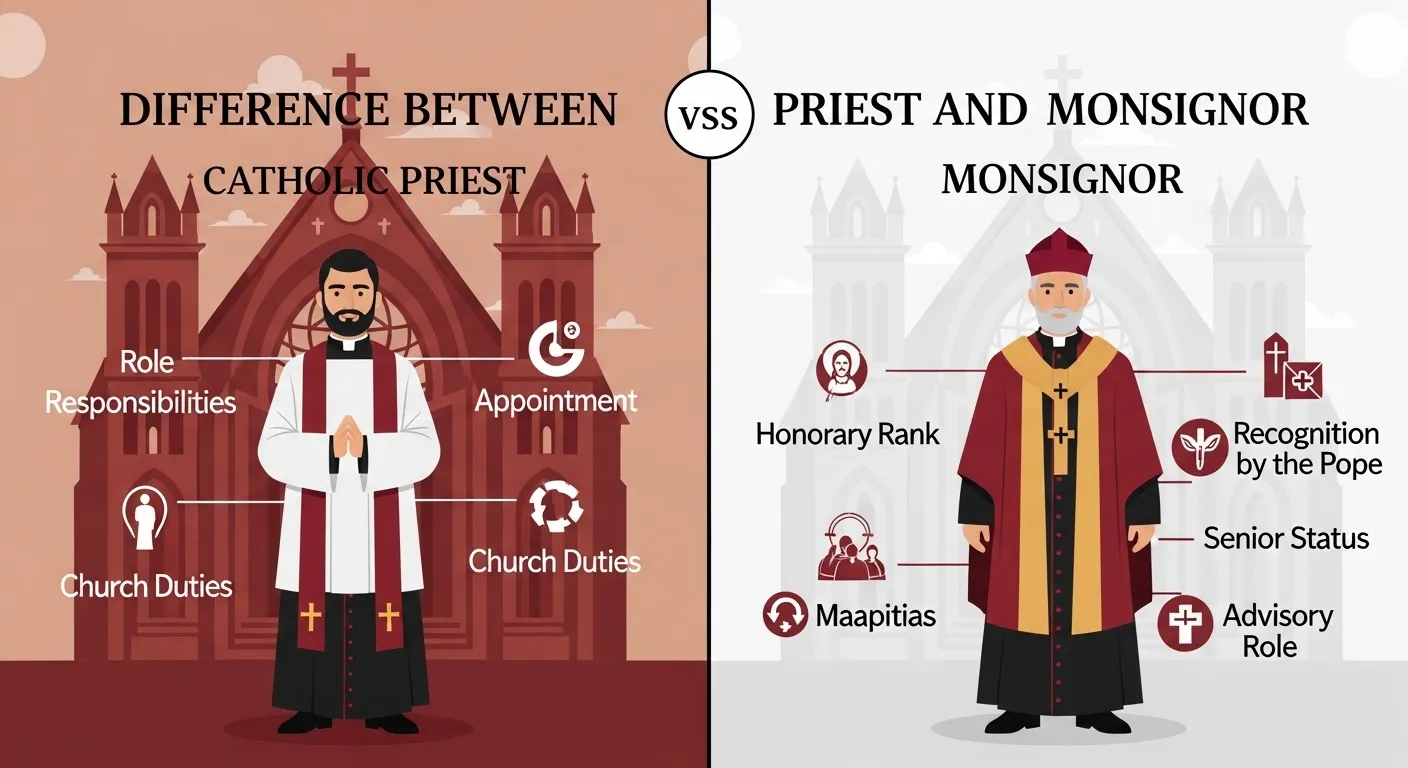
A priest is an ordained minister who performs sacraments and leads a parish, while a monsignor is a priest who receives an honorary title from the Pope for distinguished service.
Understanding the difference between priest and monsignor is important for anyone interested in the structure of the Catholic Church. Imagine attending a church ceremony where a clergyman leads prayers, performs sacraments, and guides the community spiritually. This person is usually a priest, the fundamental spiritual leader in many Christian communities. However, sometimes people hear the title monsignor and wonder how it differs from a priest.
The difference between priest and monsignor lies mainly in recognition and status within the church hierarchy. While both serve the Church and the community, a monsignor is actually a priest who has been given a special honorary title by the Pope for remarkable service.
Learning the difference between priest and monsignor helps believers, students, and researchers understand the traditions and organizational system of the Church. By exploring the difference between priest and monsignor, we gain deeper insight into how religious leadership and recognition function within Catholic society.
Pronunciation
Priest
US: /priːst/
UK: /priːst/
Monsignor
US: /ˌmɑːnˈsɪnjər/
UK: /ˌmɒnˈsɪnjə/
Although these two titles are related, their roles and recognition differ. Let us explore the difference between priest and monsignor in detail.
Key Difference Between the Both
The main difference between priest and monsignor is that a priest is ordained to serve the Church and perform religious duties, while a monsignor is a priest who receives an honorary title from the Pope for outstanding service.
Why Is Their Difference Necessary to Know for Learners and Experts?
Knowing the difference between priest and monsignor is helpful for students of theology, historians, and members of the Church. For learners, it clarifies how religious leadership works and how clergy members progress in recognition. For experts and scholars, the distinction helps in understanding historical documents, church governance, and religious traditions.
In society, clergy members often play important roles in guiding communities, supporting charity work, and maintaining moral values. Recognizing the difference between priest and monsignor helps people appreciate the dedication of priests and the special honor given to monsignors for their exceptional contributions to the Church.
Difference Between Priest and Monsignor
1. Definition
A priest is an ordained religious leader who performs sacraments, teaches faith, and leads a parish community. A monsignor is a priest who receives a special honorary title from the Pope.
Examples
Priest:
- Father Joseph celebrates mass every Sunday.
- A priest conducts weddings and baptisms.
Monsignor:
- Monsignor Thomas received recognition for his long service.
- The Pope awarded Father Michael the title of monsignor.
2. Rank in the Church
Priests form the basic level of clergy leadership in the Catholic Church. Monsignor is a title that gives special recognition among priests.
Examples
Priest:
- A newly ordained minister becomes a priest.
- Parish leaders are usually priests.
Monsignor:
- A monsignor may assist the bishop in ceremonies.
- Monsignors often hold senior positions in dioceses.
3. Method of Appointment
A priest becomes a priest through religious training and ordination. A monsignor receives the title through papal recognition.
Examples
Priest:
- John completed seminary training and was ordained as a priest.
- Many priests serve small parishes.
Monsignor:
- Father Andrew was granted the title monsignor by the Pope.
- The bishop recommended a priest for the monsignor title.
4. Responsibilities
Priests mainly serve local communities through spiritual guidance and sacraments. Monsignors may also take on advisory or administrative roles.
Examples
Priest:
- A priest counsels families and leads prayer services.
- Priests guide youth programs in the parish.
Monsignor:
- A monsignor may manage diocesan programs.
- Monsignors sometimes represent the Church at official events.
5. Form of Address
Priests are addressed as “Father.” Monsignors are addressed as “Monsignor.”
Examples
Priest:
- “Good morning, Father Daniel.”
- Parishioners greet their priest after mass.
Monsignor:
- “Thank you, Monsignor Peter.”
- The community honors Monsignor John at a ceremony.
6. Experience Level
Priests can be newly ordained or experienced. Monsignors are usually senior priests with many years of service.
Examples
Priest:
- A priest may start serving immediately after ordination.
- Young priests often assist senior clergy.
Monsignor:
- Monsignors usually have decades of service.
- Senior priests may be recognized as monsignors.
7. Attire
Priests usually wear standard clerical clothing. Monsignors may wear special attire indicating their honorary title.
Examples
Priest:
- A priest wears a black cassock and collar.
- Priests often dress simply for daily duties.
Monsignor:
- A monsignor may wear a cassock with purple piping.
- Special attire is used during official ceremonies.
8. Recognition
Priests are respected for their role in spiritual leadership. Monsignors receive additional honor for their service.
Examples
Priest:
- Parish members appreciate their priest’s guidance.
- Priests are recognized for community service.
Monsignor:
- Monsignors are honored at special church events.
- The title reflects distinguished contributions.
9. Authority
Priests have authority to perform sacraments and guide parish life. Monsignors usually have the same sacramental authority but greater ceremonial recognition.
Examples
Priest:
- A priest administers confession and communion.
- Priests lead regular worship services.
Monsignor:
- A monsignor performs the same sacraments.
- Monsignors may lead important diocesan ceremonies.
10. Purpose of Title
Priesthood focuses on spiritual service and pastoral care. The title of monsignor highlights distinguished service and dedication.
Examples
Priest:
- Priests focus on daily parish activities.
- A priest supports families and individuals spiritually.
Monsignor:
- Monsignors are honored for decades of service.
- The title recognizes exceptional leadership.
Nature and Behaviour of Both
Priests are known for compassion, humility, and dedication to serving people spiritually. They guide communities, support individuals in times of need, and provide moral teachings.
Monsignors share the same spiritual qualities but often display leadership and experience gained from years of service. They are respected figures who represent dedication and commitment within the Church.
Why People Are Confused About Their Use?
People often confuse priests and monsignors because both perform similar religious duties. In many churches, monsignors continue performing the same tasks as priests, such as leading mass or counseling parishioners. Since both wear clerical clothing and serve the community in similar ways, the honorary distinction may not always be obvious.
Table Showing Difference and Similarity
| Feature | Priest | Monsignor | Similarity |
| Meaning | Ordained minister | Honored priest | Both serve the Church |
| Appointment | Through ordination | Title granted by the Pope | Both require dedication |
| Role | Spiritual leadership | Recognition and advisory roles | Both guide communities |
| Address | Father | Monsignor | Both respected clergy |
| Authority | Performs sacraments | Same sacramental authority | Both lead religious services |
Which Is Better in What Situation?
Priest
Priests are essential for everyday religious life. They conduct mass, administer sacraments, and provide guidance to parishioners. In most situations involving regular worship, counseling, and community support, priests are the primary spiritual leaders.
Monsignor
Monsignors are especially valuable in administrative, ceremonial, or advisory roles within the Church. Their long experience allows them to guide important programs, assist bishops, and represent the Church during special events or ceremonies.
How the Keywords Are Used in Metaphors and Similes
Sometimes the words are used metaphorically to describe guidance or respect.
Examples:
- “He became the priest of knowledge for his students.”
- “Her dedication to charity made her respected like a monsignor in the community.”
Connotative Meaning
Priest
Connotation: Mostly positive or neutral.
Example: “The priest’s advice brought peace to the troubled family.”
Monsignor
Connotation: Strongly positive, indicating honor and recognition.
Example: “The monsignor was admired for his lifetime of service.”
Idioms or Proverbs Related to the Words
Holy man
Example:
“The villagers respected the priest as a holy man who guided them.”
Take stock of
Example:
“Before making a decision, he took stock of the situation.”
Works in Literature
- Monsignor Quixote – Novel, Graham Greene, 1982
- The Power and the Glory – Novel about a priest, Graham Greene, 1940
- Diary of a Country Priest – Novel, Georges Bernanos, 1936
Movie Names Made on the Keywords
- Priest – 2011, United States
- The Priest – 2021, India
- Monsignor – 1982, United States
Five Frequently Asked Questions
1. Is a monsignor higher than a priest?
Yes, but only as an honorary title, not a higher ordination.
2. Can any priest become a monsignor?
Yes, but only if the Pope grants the honorary title.
3. Do monsignors perform the same duties as priests?
Yes, they usually perform the same religious duties.
4. How should people address a monsignor?
They should address him as “Monsignor.”
5. Is the title monsignor common?
No, it is given only to selected priests who have provided distinguished service.
How Both Are Useful for Surroundings
Priests and monsignors contribute to the well-being of society by promoting moral values, offering guidance, and supporting charitable activities. Their presence strengthens communities by encouraging compassion, cooperation, and spiritual development.
Final Words for the Both
Priests represent the foundation of spiritual leadership in the Catholic Church. Monsignors symbolize honor and recognition for exceptional dedication. Both play valuable roles in guiding faith communities.
Conclusion
The difference between priest and monsignor mainly lies in recognition and honorary status. A priest is an ordained minister responsible for performing sacraments and guiding the community spiritually. A monsignor, however, is a priest who has received a special honorary title from the Pope for distinguished service. Understanding the difference between priest and monsignor helps people appreciate the structure and traditions of the Church. Both positions contribute greatly to spiritual leadership, social support, and community development. By recognising the difference between priest and monsignor, we gain respect for the dedication and commitment of clergy members who serve society and faith communities.
I’m Shabbir Hussain, a professional content writer who specializes in clear and authentic comparisons between similar terms. I write concise, research-based, and reader-friendly content that turns complex language into simple explanations. Through Mysynonyms.com, I help readers strengthen their vocabulary and clearly understand word differences.