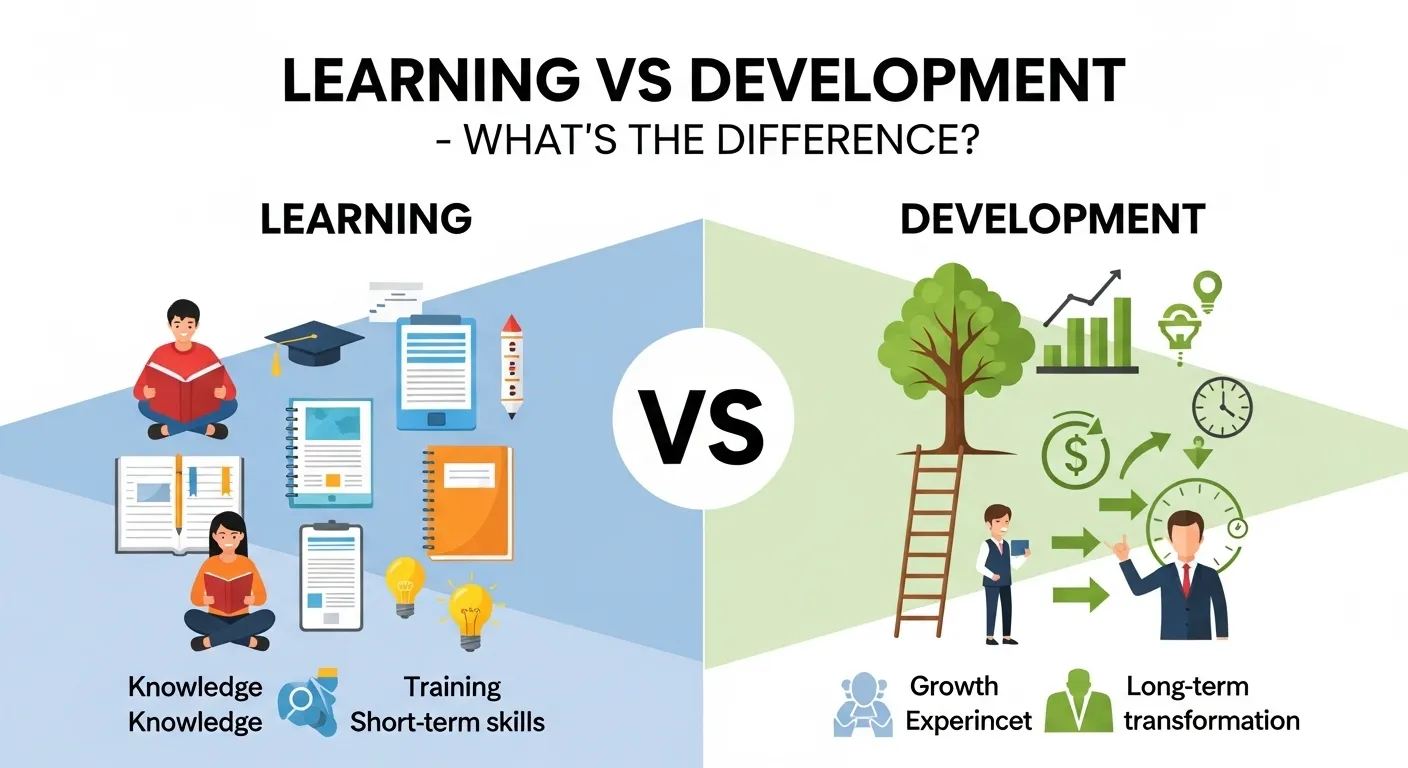
A young employee joins a company and starts learning how to use new software. At first, the process is slow, but over time the employee becomes more skilled and confident. This simple situation clearly shows the difference between learning and development. Learning happens when someone gains knowledge or skills, while development refers to the overall growth that occurs over time.
Understanding the difference between learning and development is important in education, workplaces, and personal life. Many people often mix these two terms because they are closely connected. However, the difference between learning and development lies in their scope and impact. Learning focuses on acquiring specific knowledge, while development refers to broader improvement in abilities, character, and potential. Recognizing the difference between learning and development helps teachers, professionals, and students apply the right strategies for growth and success.
Key Difference Between Learning and Development
Learning is the process of gaining knowledge, skills, or information, usually through study, experience, or teaching. Development, on the other hand, is the overall growth and progress of a person over time, including physical, emotional, intellectual, and professional aspects.
Why Knowing Their Difference Is Important in Society
Understanding the difference helps educators design better teaching methods, helps companies train employees effectively, and helps individuals track their personal progress. In society, learning builds knowledge, while development shapes capable and mature individuals. Schools focus on learning subjects, while development programs aim to improve personality, leadership, and emotional intelligence. When people understand this difference, they can focus on both gaining knowledge and improving themselves as a whole.
Pronunciation
Learning
- US: /ˈlɝː.nɪŋ/
- UK: /ˈlɜː.nɪŋ/
Development
- US: /dɪˈvel.əp.mənt/
- UK: /dɪˈvel.əp.mənt/
These two terms often work together, but they are not identical concepts. To understand the more clearly, let us explore their distinctions in detail.
Difference Between Learning and Development
1. Meaning
Learning refers to gaining knowledge or skills through study or experience. Development refers to overall growth and improvement.
Examples of Learning
- A student learns a new math formula.
- A worker learns how to operate a machine.
Examples of Development
- A child gradually develops problem-solving skills.
- An employee develops leadership abilities over time.
2. Scope
Learning is narrow and focused on specific knowledge. Development is broader and covers multiple aspects of growth.
Learning Examples
- Learning vocabulary in a language class.
- Learning how to cook a new recipe.
Development Examples
- Developing communication skills.
- Developing emotional maturity.
3. Time Period
Learning can happen quickly or in short sessions. Development usually takes a long time.
Learning Examples
- Learning a software shortcut in one hour.
- Learning a historical fact in class.
Development Examples
- Developing critical thinking over years of study.
- Developing a professional career over time.
4. Focus
Learning focuses on knowledge or skills. Development focuses on overall personal growth.
Learning Examples
- Learning grammar rules.
- Learning how to ride a bicycle.
Development Examples
- Developing discipline.
- Developing confidence.
5. Measurement
Learning can be measured through tests or assessments. Development is measured through long-term changes.
Learning Examples
- Passing a language exam.
- Completing a training course.
Development Examples
- Becoming a better leader over time.
- Improving emotional intelligence.
6. Nature
Learning is often structured and guided. Development may happen naturally with experience.
Learning Examples
- Attending a classroom lecture.
- Watching a tutorial video.
Development Examples
- Becoming more patient with age.
- Growing professionally through work experience.
7. Goal
Learning aims to acquire knowledge. Development aims to achieve maturity and capability.
Learning Examples
- Learning programming basics.
- Learning a new language.
Development Examples
- Becoming a skilled programmer.
- Becoming fluent in a language.
8. Environment
Learning often occurs in schools, training centers, or courses. Development can occur anywhere in life.
Learning Examples
- Online courses.
- School lessons.
Development Examples
- Personal experiences.
- Workplace challenges.
9. Process
Learning is usually intentional. Development may occur both intentionally and naturally.
Learning Examples
- Studying for exams.
- Practicing a musical instrument.
Development Examples
- Developing patience through life experiences.
- Developing maturity through responsibilities.
10. Outcome
Learning results in knowledge acquisition. Development results in overall improvement.
Learning Examples
- Understanding a scientific concept.
- Learning a technical skill.
Development Examples
- Becoming a well-rounded professional.
- Becoming emotionally balanced.
Nature and Behaviour
Learning
- Knowledge-based
- Short-term or immediate
- Focused and measurable
- Often guided by teachers or trainers
Development
- Growth-based
- Long-term process
- Broad and complex
- Influenced by life experiences
Why People Are Confused About Their Use
People often confuse learning and development because learning contributes to development. When someone learns new knowledge repeatedly, it gradually leads to personal or professional development. For example, learning management skills can eventually lead to leadership development. Because they happen together and support each other, many people assume they are the same, even though learning is only one part of the development process.
Table Showing Difference and Similarity
| Aspect | Learning | Development | Similarity |
| Meaning | Gaining knowledge or skills | Overall growth | Both involve improvement |
| Time | Short-term | Long-term | Both require effort |
| Scope | Specific | Broad | Both affect personal progress |
| Focus | Knowledge | Growth | Both help success |
| Measurement | Tests or results | Long-term behavior change | Both show progress |
Which Is Better in What Situation?
Learning
Learning is better when someone needs to quickly gain knowledge or skills. For example, students preparing for exams or employees learning a new tool benefit from focused learning. Learning helps people adapt quickly to new situations and acquire specific abilities required for tasks.
Development
Development is better when the goal is long-term improvement. Leadership training, personality growth, and career progress require development. Unlike simple learning, development focuses on shaping attitudes, behavior, and capabilities over time.
Use in Metaphors and Similes
Learning
- “Learning is like opening a new door of knowledge.”
- “Her mind absorbed information like a sponge.”
Development
- “Personal development is like planting a tree that grows stronger each year.”
- “His career developed like a river slowly widening over time.”
Connotative Meaning
Learning
Positive: gaining wisdom and knowledge
Example: Continuous learning leads to success.
Neutral: simple acquisition of information
Example: Learning facts for an exam.
Negative: sometimes associated with academic pressure
Example: Forced learning may reduce curiosity.
Development
Positive: growth and progress
Example: Personal development improves confidence.
Neutral: natural change over time
Example: Child development stages.
Negative: sometimes used for over-expansion
Example: Rapid urban development may harm nature.
Idioms or Proverbs Related to the Words
“Live and learn”
Meaning: You gain knowledge through experience.
Example: I never knew cooking was so difficult, live and learn.
“You learn something new every day”
Example: After meeting people from different cultures, I truly learned something new every day.
“Rome wasn’t built in a day” (related to development)
Example: Skills develop slowly; Rome wasn’t built in a day.
Works in Literature Related to Learning and Development
- “Educated” – Memoir by Tara Westover (2018)
- “Great Expectations” – Novel by Charles Dickens (1861)
- “Jane Eyre” – Novel by Charlotte Brontë (1847)
Movies Related to Learning or Development
- The Karate Kid – 1984 – USA
- Dead Poets Society – 1989 – USA
- Good Will Hunting – 1997 – USA
- The Pursuit of Happyness – 2006 – USA
Frequently Asked Questions
1. What is the main difference between learning and development?
Learning focuses on gaining knowledge or skills, while development refers to overall growth over time.
2. Can development happen without learning?
Development usually includes learning, but it may also occur through experiences and maturity.
3. Is learning part of development?
Yes, learning is one of the key processes that contribute to development.
4. Which happens first, learning or development?
Learning often happens first and gradually leads to development.
5. Why are these concepts important in education?
They help teachers design methods that promote both knowledge acquisition and overall student growth.
How Both Are Useful for Surroundings
Learning helps individuals acquire knowledge that benefits society, such as scientific discoveries or professional skills. Development shapes responsible citizens, leaders, and innovators who contribute positively to communities. Together, they help societies progress through education, innovation, and personal growth.
Final Words for Learning and Development
Learning builds knowledge, while development builds character and capability. Both are essential for personal success and societal progress.
Conclusion
Understanding the difference between learning and development helps individuals recognise how knowledge and growth interact. The first one focuses on acquiring specific information or skills, while development represents the broader process of becoming more capable and mature over time. Although these concepts are different, they support each other closely. Learning provides the foundation, and development transforms that knowledge into lasting improvement. In education, careers, and personal life, balancing both learning and development leads to meaningful progress and success. By appreciating their unique roles, individuals and organisations can create better opportunities for continuous growth.

I’m Shabbir Hussain, a professional content writer who specializes in clear and authentic comparisons between similar terms. I write concise, research-based, and reader-friendly content that turns complex language into simple explanations. Through Mysynonyms.com, I help readers strengthen their vocabulary and clearly understand word differences.