Have you ever been searching for the perfect word and wished there was a single term that could cover absolutely everything? Whether you’re writing an essay, creating content, or simply trying to express a broad idea, using the right vocabulary can make your message more powerful and engaging. That’s where understanding synonyms for everything becomes incredibly useful.
Imagine a friend asking, “Did you pack everything for the trip?” Instead of saying “everything,” you might say “all items,” “the whole lot,” or “all things.” These alternatives can make your communication more varied and precise.
The word everything means all things, all items, or the complete amount of something. It is commonly used when talking about possessions, tasks, information, experiences, or situations. Students can use synonyms for everything to improve essays, bloggers can create more engaging content, content writers can avoid repetitive language, and everyday English users can communicate more effectively.
By learning these synonyms for everything, you can strengthen your vocabulary and choose the most suitable word or phrase for different contexts. Whether you are writing, speaking, or studying, these alternatives will help you express yourself with greater confidence.
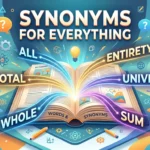
✨ Top 5 Synonyms for Everything ✨
- All
- All Things
- The Whole
- Entirety
- Totality
✨ Next 5 Synonyms for Everything ✨
- Whole Lot
- Whole Thing
- Complete Set
- Full Amount
- Entire Collection
Pronunciation of “Everything”
Phonetic Spelling: EV-ree-thing
IPA: /ˈev.ri.θɪŋ/
Simple Breakdown: ev + ry + thing
Syllables of “Everything”
Syllable Breakdown: ev-er-y-thing
Number of Syllables: 4
Simple Explanation: The word everything has four syllables: ev, er, y, and thing.
List of 50 Synonyms for Everything
All
Meaning
The complete amount of something.
Examples
- All the books are here.
- She shared all her ideas.
All Things
Meaning
Every item or matter.
Examples
- He considered all things carefully.
- All things were ready for the event.
The Whole
Meaning
The complete thing.
Examples
- I read the whole book.
- She explained the whole story.
Entirety
Meaning
The full amount or whole.
Examples
- We viewed the project in its entirety.
- The entirety of the plan was approved.
Totality
Meaning
The complete state of something.
Examples
- Consider the totality of the facts.
- The totality of evidence was reviewed.
Whole Lot
Meaning
Everything in a group.
Examples
- He bought the whole lot.
- We packed the whole lot.
Whole Thing
Meaning
The complete matter or object.
Examples
- I watched the whole thing.
- She understood the whole thing.
Complete Set
Meaning
All items together.
Examples
- He owns the complete set.
- We collected the complete set.
Full Amount
Meaning
The entire quantity.
Examples
- She paid the full amount.
- The full amount was received.
Entire Collection
Meaning
All items gathered together.
Examples
- The museum displayed the entire collection.
- He sold the entire collection.
Every Item
Meaning
Each thing without exception.
Examples
- Every item was checked.
- She packed every item carefully.
Every Single Thing
Meaning
Absolutely all things.
Examples
- He remembered every single thing.
- We cleaned every single thing.
The Lot
Meaning
All people or things together.
Examples
- I’ll take the lot.
- They bought the lot.
All There Is
Meaning
The complete amount available.
Examples
- That is all there is.
- We shared all there is to know.
Entire Package
Meaning
The whole group of items or features.
Examples
- She received the entire package.
- The deal included the entire package.
Aggregate
Meaning
The total amount combined.
Examples
- The aggregate was impressive.
- We calculated the aggregate.
Sum Total
Meaning
The complete amount.
Examples
- The sum total was surprising.
- This represents the sum total.
Full Set
Meaning
A complete group of items.
Examples
- He owns the full set.
- We purchased the full set.
Entire Stock
Meaning
All available items.
Examples
- The store sold its entire stock.
- We reviewed the entire stock.
Complete Lot
Meaning
The whole group of things.
Examples
- She bought the complete lot.
- The complete lot was delivered.
Every Bit
Meaning
All parts of something.
Examples
- I enjoyed every bit of it.
- She used every bit available.
Every Detail
Meaning
All pieces of information.
Examples
- He explained every detail.
- We checked every detail.
Every Aspect
Meaning
All parts or features.
Examples
- They studied every aspect.
- We discussed every aspect.
Every Element
Meaning
All components of something.
Examples
- The design includes every element.
- She reviewed every element.
Every Part
Meaning
Each section of something.
Examples
- He repaired every part.
- We examined every part.
Every Component
Meaning
Each part that makes up something.
Examples
- Every component was tested.
- She checked every component carefully.
Every Piece
Meaning
All individual parts.
Examples
- He collected every piece.
- We examined every piece closely.
Every Matter
Meaning
All issues or subjects.
Examples
- They discussed every matter.
- She handled every matter professionally.
Every Object
Meaning
All physical things.
Examples
- Every object was labeled.
- He packed every object safely.
Every Possession
Meaning
All things someone owns.
Examples
- She sold every possession.
- He packed every possession before moving.
The Entire Amount
Meaning
The complete quantity.
Examples
- The entire amount was donated.
- We received the entire amount.
The Entire Group
Meaning
All members together.
Examples
- The entire group attended.
- We thanked the entire group.
The Full Collection
Meaning
All collected items together.
Examples
- The library displayed the full collection.
- He purchased the full collection.
The Complete Picture
Meaning
All information about a situation.
Examples
- We need the complete picture.
- She explained the complete picture.
The Whole Package
Meaning
Everything included together.
Examples
- The offer included the whole package.
- He wanted the whole package.
All Available Items
Meaning
Every item that can be used or purchased.
Examples
- The store sold all available items.
- We reviewed all available items.
All Possessions
Meaning
Everything someone owns.
Examples
- He donated all possessions.
- She moved with all possessions.
All Resources
Meaning
Every available supply or tool.
Examples
- The team used all resources.
- We gathered all resources quickly.
All Contents
Meaning
Everything inside something.
Examples
- Please remove all contents.
- The box held all contents safely.
All Materials
Meaning
Every material or supply.
Examples
- Bring all materials tomorrow.
- The project required all materials.
The Entire Range
Meaning
The full variety of something.
Examples
- The shop offers the entire range.
- We explored the entire range.
The Full Scope
Meaning
The complete extent of something.
Examples
- They understood the full scope.
- We examined the full scope carefully.
The Total Sum
Meaning
The complete amount combined.
Examples
- The total sum was recorded.
- He paid the total sum.
The Complete Assortment
Meaning
A full selection of items.
Examples
- The store displayed the complete assortment.
- We ordered the complete assortment.
The Entire Inventory
Meaning
All goods or items in stock.
Examples
- They counted the entire inventory.
- The entire inventory was sold.
The Entire Bundle
Meaning
All items packaged together.
Examples
- She bought the entire bundle.
- We received the entire bundle.
The Whole Collection
Meaning
Every item in a collection.
Examples
- He donated the whole collection.
- The museum displayed the whole collection.
The Complete Group
Meaning
All members together.
Examples
- The complete group participated.
- We photographed the complete group.
Every Last Thing
Meaning
Absolutely everything without exception.
Examples
- She packed every last thing.
- He remembered every last thing.
The Entire Works
Meaning
Everything included or available.
Examples
- We ordered the entire works.
- The package contained the entire works.
5 Most Common Antonyms for “Everything”
The word everything refers to all things, all people, or the entirety of what exists or is being considered. Its antonyms describe the absence of things, a limited amount, or a lack of inclusion.
1. Nothing
Meaning: Not anything; the complete absence of something.
Explanation: Nothing is the direct opposite of everything, indicating that no things or items exist or are included.
2. None
Meaning: Not any of a group or amount.
Explanation: None refers to the absence of all members, items, or possibilities being considered.
3. Nobody
Meaning: No person; not a single individual.
Explanation: While everything can include all people and things, nobody specifically refers to the absence of people.
4. Few
Meaning: A small number of people or things.
Explanation: Few contrasts with everything by indicating only a limited quantity rather than the whole.
5. Partially
Meaning: Only in part; not completely.
Explanation: Partially suggests that only some aspects are included, rather than everything.
Quick Summary
The most common antonyms for everything are nothing, none, nobody, few, and partially. While everything refers to the whole or entirety of something, these words emphasize absence, limitation, or incomplete inclusion.
Conclusion
Finding the right synonyms for everything can significantly improve the way you communicate, whether you’re writing an academic paper, crafting professional emails, creating content, or simply expanding your vocabulary. While words like all, every item, the whole thing, the entirety, and all-inclusive may seem similar, each carries its own tone and context. Choosing the most appropriate alternative helps make your writing more precise, engaging, and easier for readers to understand.
Learning synonyms for everything can make your writing more varied, clear, and engaging. Instead of repeating the word everything, you can use alternatives such as all, entirety, totality, whole package, and complete set depending on the situation.
A strong vocabulary helps students write better essays, bloggers create richer content, and professionals communicate more effectively. Using different expressions also improves readability and keeps your audience interested.
Practice these synonyms for everything in emails, school assignments, articles, and everyday conversations. The more you use them, the easier it will become to express ideas naturally and confidently.
FAQ About Synonyms for Everything
What are the most common synonyms for everything?
Some common synonyms for everything include all, entirety, totality, whole thing, and complete set.
Is “all” a synonym for everything?
Yes, all is one of the closest and most commonly used synonyms for everything.
Which synonym for everything is best for formal writing?
Words such as entirety, totality, aggregate, and sum total are often suitable for formal and academic writing.
Can I use “whole package” instead of everything?
Yes, whole package can be used when referring to all parts, features, or items included together.
Why should I learn synonyms for everything?
Learning synonyms improves vocabulary, reduces repetition, and helps make writing and speaking more effective and engaging.

I’m Shabbir Hussain, a professional content writer who specializes in clear and authentic comparisons between similar terms. I write concise, research-based, and reader-friendly content that turns complex language into simple explanations. Through Mysynonyms.com, I help readers strengthen their vocabulary and clearly understand word differences.