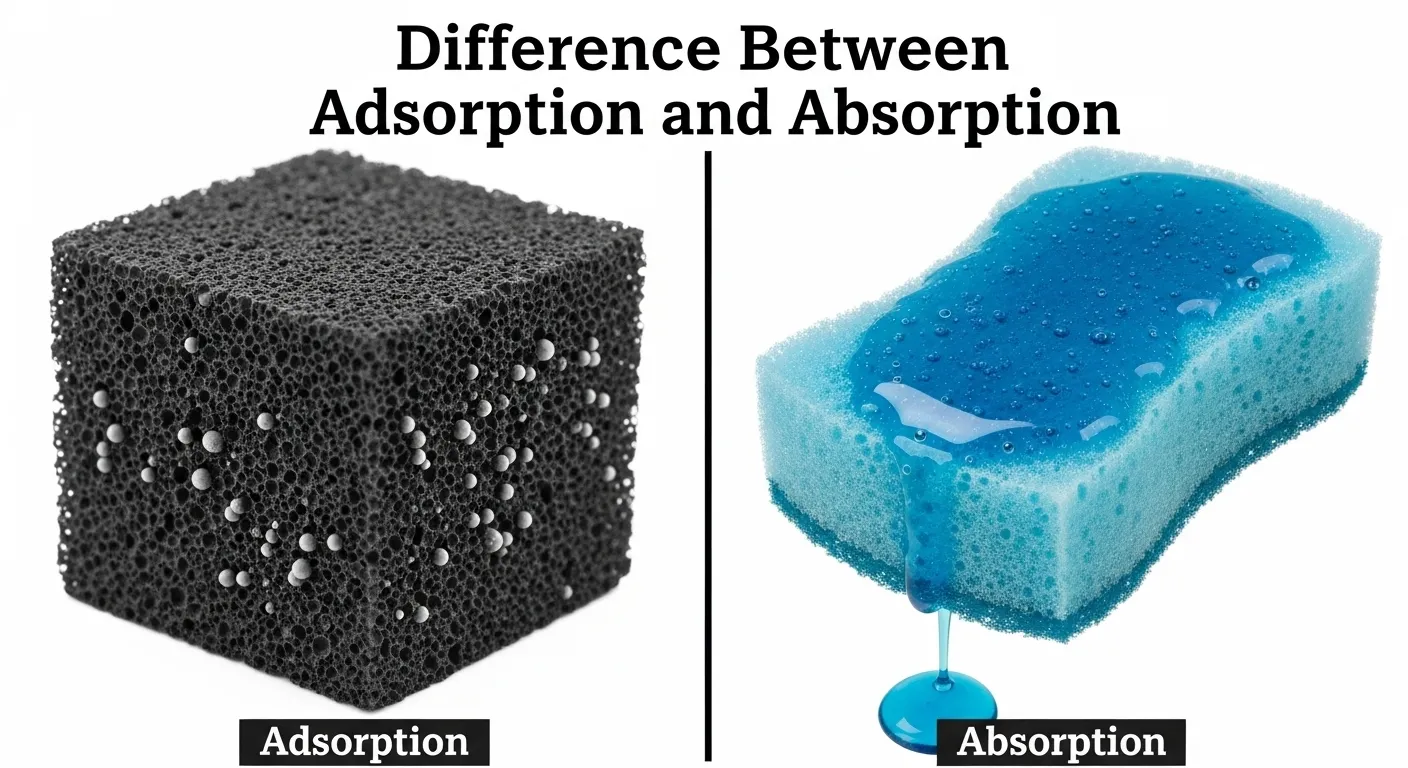
The difference between adsorption and absorption often confuses students, scientists, and everyday readers because both terms describe how substances interact with another material. Imagine spilling water on a sponge and sprinkling dust on a sticky tape. The sponge absorbs water because the liquid moves inside its structure. On the other hand, the dust adsorbs onto the sticky tape because it stays only on the surface.
Understanding the difference between adsorption and absorption becomes easier when we think about how materials behave in daily life. In chemistry and physics, these processes explain how gases, liquids, and solids interact. Scientists, engineers, and environmental experts often rely on this concept to design filters, medicines, and purification systems. When people learn the difference between adsorption and absorption, they gain insight into many natural and industrial processes. Therefore, recognizing the difference between adsorption and absorption is essential for both academic learning and real-world applications.
Key Difference Between the Both
The primary difference is simple:
- Absorption occurs when a substance is completely dissolved or distributed throughout another material.
- Adsorption occurs when particles attach only to the surface of another substance.
For example, water entering a sponge is absorption, while gas sticking to charcoal is adsorption.
Why Their Difference is Important for Learners and Experts
Understanding the difference between adsorption and absorption helps people explain many natural and industrial processes. For learners, it improves scientific vocabulary and strengthens knowledge of chemistry and environmental science. Experts use this knowledge in fields like medicine, water purification, and material science.
For instance, adsorption helps remove harmful gases from the air using activated carbon filters. Absorption is used in medical treatments, where medicines are absorbed into the bloodstream. In society, these processes support technologies that purify water, control pollution, and improve health. Therefore, recognizing the difference between adsorption and absorption benefits both education and technological development.
Pronunciation of Both Words
| Word | US Pronunciation | UK Pronunciation |
| Adsorption | /ədˈsɔːrpʃən/ | /ədˈsɔːpʃən/ |
| Absorption | /əbˈzɔːrpʃən/ | /əbˈzɔːpʃən/ |
Linking Hook to the Main Discussion
Now that we understand their basic meanings, let’s explore the difference between adsorption and absorption in greater detail by examining their characteristics, behavior, and real-world examples.
Difference Between Adsorption and Absorption
1. Location of the Process
- Adsorption: Happens on the surface of a material.
Example 1: Dust particles sticking to a glass surface.
Example 2: Gas molecules attaching to activated charcoal. - Absorption: Happens throughout the entire substance.
Example 1: Water soaking into a sponge.
Example 2: Ink spreading inside blotting paper.
2. Distribution of Particles
- Adsorption: Particles remain concentrated on the surface.
Example 1: Paint sticking to a wall surface.
Example 2: Smoke particles attaching to air filters. - Absorption: Particles spread evenly inside the material.
Example 1: Sugar dissolving in water.
Example 2: Medicine entering the bloodstream.
3. Rate of Process
- Adsorption: Occurs rapidly at first and slows later.
Example 1: Gas attaching quickly to charcoal initially.
Example 2: Odor removal using air purifiers. - Absorption: Occurs at a steady rate.
Example 1: Water slowly soaking into soil.
Example 2: A sponge gradually filling with water.
4. Heat Change
- Adsorption: Usually releases heat.
Example 1: Gas adsorption on metal surfaces.
Example 2: Chemical adsorption in catalysts. - Absorption: May absorb or release heat depending on the reaction.
Example 1: Salt dissolving in water.
Example 2: Certain gases dissolving in liquids.
5. Concentration Gradient
- Adsorption: Highest concentration is on the surface.
Example 1: Activated carbon capturing pollutants.
Example 2: Dust sticking to sticky tape. - Absorption: Concentration spreads throughout the material.
Example 1: Water spreading in cotton.
Example 2: Liquid soaking into wood.
6. Temperature Effect
- Adsorption: Decreases with higher temperature.
Example 1: Gas adsorption on charcoal reducing with heat.
Example 2: Reduced adsorption in heated filters. - Absorption: Often increases with higher temperature.
Example 1: Liquids dissolving faster in warm water.
Example 2: Chemical solutions absorbing gases faster.
7. Nature of Interaction
- Adsorption: Usually a surface physical or chemical interaction.
Example 1: Catalytic reactions on metal surfaces.
Example 2: Gas purification systems. - Absorption: Usually involves dissolving or mixing.
Example 1: Ink absorbed by paper.
Example 2: Water absorbed by soil.
8. Surface Area Importance
- Adsorption: Larger surface area increases adsorption.
Example 1: Powdered charcoal adsorbs more gas.
Example 2: Porous filters capturing pollutants. - Absorption: Surface area has less impact.
Example 1: Sponge absorbing water regardless of surface texture.
Example 2: Liquids mixing inside solutions.
9. Industrial Use
- Adsorption: Used in purification and filtration.
Example 1: Air purifiers removing gases.
Example 2: Water treatment systems. - Absorption: Used in chemical processing.
Example 1: Gas absorption in chemical plants.
Example 2: Medical drug absorption.
10. Reversibility
- Adsorption: Often reversible.
Example 1: Gas released from charcoal when heated.
Example 2: Filters cleaned and reused. - Absorption: Often harder to reverse.
Example 1: Dye absorbed by fabric.
Example 2: Water absorbed in wood.
Nature and Behaviour of Both
Adsorption:
Adsorption mainly depends on surface forces. Materials with porous or rough surfaces show stronger adsorption because they provide more space for particles to attach.
Absorption:
Absorption involves the penetration of one substance into the bulk of another. The absorbed material becomes evenly distributed within the absorbing substance.
Why People Are Confused About Their Use
People confuse these words because their spellings and pronunciations are similar. Both also describe the interaction between substances. In everyday language, people often use “absorb” when they actually mean “adsorb,” especially when discussing filters, pollution control, or chemical reactions.
Table Showing Difference and Similarity
| Feature | Adsorption | Absorption |
| Process Location | Surface only | Entire substance |
| Particle Distribution | On surface | Throughout the material |
| Speed | Fast initially | Gradual and steady |
| Heat Change | Usually releases heat | May absorb or release heat |
| Surface Area Effect | Highly important | Less important |
| Examples | Gas on charcoal | Water in sponge |
| Industrial Use | Filtration, catalysis | Chemical processing |
Which is Better in What Situation?
Adsorption in practical use
Adsorption is more useful when we want to capture substances from air or liquids without letting them penetrate deeply. For example, activated carbon filters adsorb harmful gases and odors. This makes adsorption ideal for purification systems, environmental protection, and industrial catalysts.
Absorption in practical use
Absorption is better when substances need to mix or dissolve completely. For instance, in medicine, nutrients and drugs must be absorbed into the bloodstream to affect the body. Similarly, plants absorb water from soil through their roots. In such cases, absorption ensures the substance spreads throughout the material.
Use in Metaphors and Similes
- “His mind absorbed knowledge like a sponge absorbs water.”
- “The audience adsorbed every word of the speaker like dust sticking to glue.”
- “Children absorb habits like dry soil absorbs rain.”
Connotative Meanings
Adsorption
- Neutral / Scientific
Example: Scientists studied the adsorption of gases on metal surfaces.
Absorption
- Positive
Example: She absorbed new ideas quickly. - Neutral
Example: The sponge absorbed the spilled water.
Idioms or Proverbs Related to the Words
Absorb like a sponge
Meaning: Learn or take in information very quickly.
Example: The young student absorbed knowledge like a sponge.
Take something in (related concept)
Meaning: Understand or absorb information.
Example: It took him time to take in the new idea.
Works in Literature Mentioning the Concepts
- “Principles of Physical Chemistry” – Puri, Sharma & Pathania (Science textbook, 1963)
- “Adsorption by Powders and Porous Solids” – F. Rouquerol (Scientific text, 1999)
- “Physical Chemistry” – Peter Atkins (Academic textbook, 1978)
Movies Related to Scientific Concepts
Although no major films are named exactly after these processes, they appear in science-themed movies:
- “The Martian” (2015, USA) – Shows chemical processes used for survival.
- “Oppenheimer” (2023, USA/UK) – Demonstrates advanced physical chemistry concepts.
Frequently Asked Questions
1. What is the main difference between adsorption and absorption?
Adsorption occurs on the surface of a material, while absorption occurs throughout the entire material.
2. Which process happens in a sponge soaking water?
It is absorption because water enters the sponge’s internal structure.
3. Where is adsorption used in daily life?
It is used in air purifiers, water filters, and deodorizing products.
4. Why is activated charcoal good for adsorption?
Because it has a very large surface area that allows many particles to attach.
5. Can adsorption and absorption occur together?
Yes, in some cases both processes may occur simultaneously.
How Both Are Useful for the Surroundings
Adsorption helps remove pollutants from air and water. Filters containing activated carbon adsorb harmful chemicals and improve environmental quality. Absorption supports natural processes such as plants absorbing water and nutrients from soil. Both processes help maintain ecological balance and support technologies that protect the environment.
Final Words on Both
Adsorption and absorption may sound similar, but they describe different scientific phenomena. Adsorption focuses on surface interaction, while absorption involves complete penetration into a substance.
Conclusion
Understanding the difference between adsorption and absorption is essential for students, researchers, and anyone interested in science. Adsorption describes a surface process where particles attach to the outside of a material, while absorption involves substances entering and spreading throughout another material. These processes explain many natural and industrial systems, from water purification and pollution control to medicine and plant nutrition. By learning the difference between adsorption and absorption, readers can better understand how materials interact and how scientists design technologies to solve real-world problems. Recognising these distinctions improves scientific literacy and helps people appreciate the fascinating behaviour of matter in everyday life.

I’m Shabbir Hussain, a professional content writer who specializes in clear and authentic comparisons between similar terms. I write concise, research-based, and reader-friendly content that turns complex language into simple explanations. Through Mysynonyms.com, I help readers strengthen their vocabulary and clearly understand word differences.