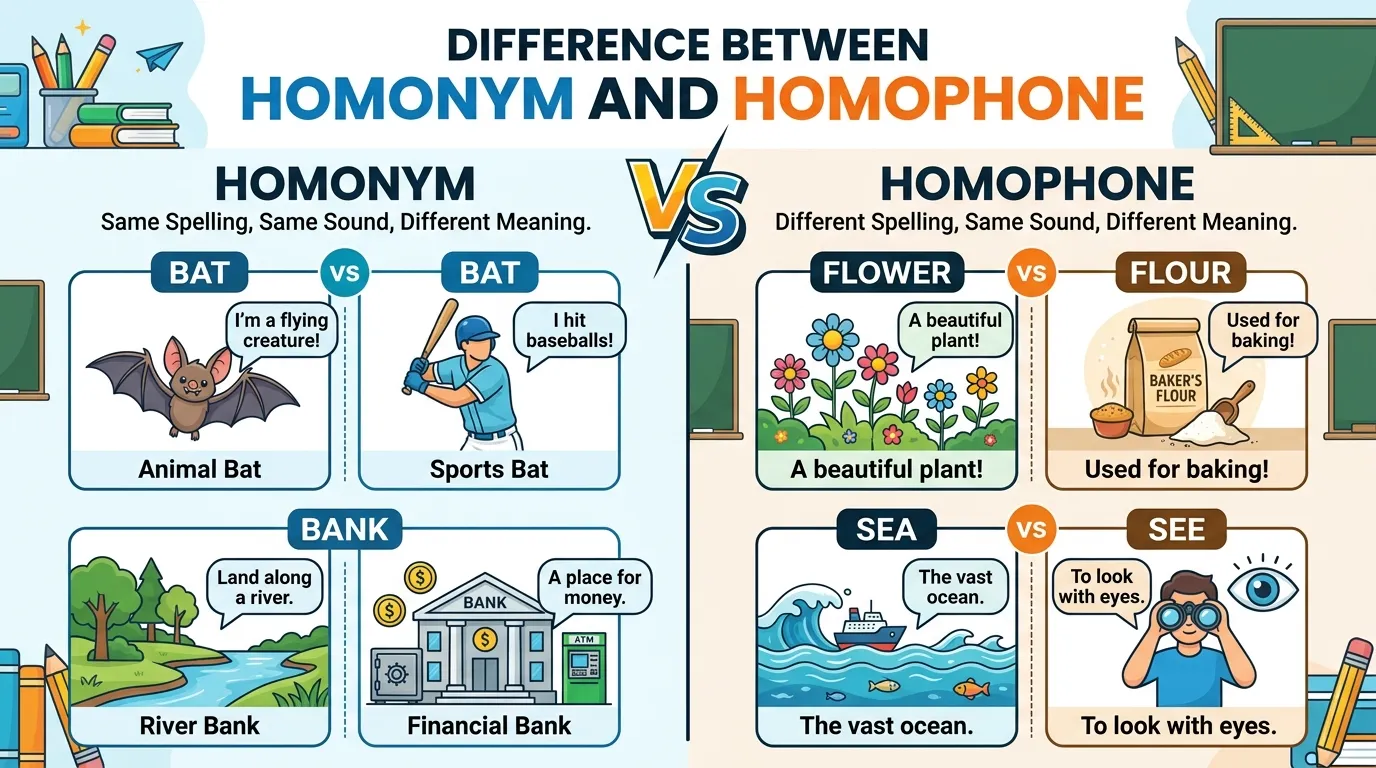
The difference between homonym and homophone is that homonyms are words that share the same spelling or pronunciation but have different meanings, while homophones are words that sound the same but usually have different spellings and meanings.
Understanding the difference between homonym and homophone is important for students, writers, language learners, and anyone studying English grammar and vocabulary. These terms are often confusing because they both involve similarities between words in pronunciation or spelling. However, the difference between homonym and homophone becomes clearer when you examine how each type of word behaves in language.
A Homonym refers to words that either share the same spelling, the same pronunciation, or both, while having different meanings. A Homophone specifically refers to words that sound alike but differ in meaning and usually spelling.
Learning the difference between homonym and homophone helps improve spelling, pronunciation, reading comprehension, and communication skills. By understanding the difference between homonym and homophone, learners can avoid common writing mistakes and better understand English word relationships.
Pronunciation
Homonym
US: /ˈhɑː.məˌnɪm/
Homophone
US: /ˈhɑː.məˌfoʊn/
Key Difference Between the Both
The main difference between homonym and homophone is that homonyms may share spelling, pronunciation, or both while having different meanings, whereas homophones specifically share pronunciation but usually differ in spelling and meaning.
Why Is Their Difference Important?
Knowing the difference between homonym and homophone is important because these concepts affect:
- Spelling accuracy
- Pronunciation understanding
- Reading comprehension
- Grammar learning
Confusing homonyms and homophones can lead to writing mistakes and misunderstanding in communication.
Understanding the difference between homonym and homophone also helps students improve vocabulary and linguistic awareness.
Difference Between Homonym and Homophone
1. Definition
Homonyms are words with the same spelling or pronunciation but different meanings.
Homophones are words that sound the same but have different meanings and spellings.
Examples
Homonym:
- Bat (animal)
- Bat (sports equipment)
Homophone:
- Two / too
- Flower / flour
2. Pronunciation
Homonyms may or may not sound the same.
Homophones always sound the same.
3. Spelling
Homonyms may share spelling.
Homophones usually have different spellings.
Examples
Homonym:
- Well (healthy)
- Well (water source)
Homophone:
- Right / write
4. Meaning
Both have different meanings despite similarities in sound or spelling.
5. Category Scope
Homonym is a broader category.
Homophone is a specific type of word relationship.
6. Writing Confusion
Homophones commonly create spelling mistakes.
Homonyms commonly create meaning confusion.
Examples
Homophone mistake:
- “Their” vs “there”
Homonym confusion:
- “Bank” (river edge vs financial institution)
7. Usage in Linguistics
Homonyms are studied in semantics and vocabulary analysis.
Homophones are often studied in pronunciation and phonetics.
8. Reading Interpretation
Homonyms require context to determine meaning.
Homophones require spelling recognition.
9. Examples in Daily English
Homonyms
- Bark (tree covering / dog sound)
- Match (contest / fire starter)
Homophones
- Sea / see
- Knight / night
10. Learning Difficulty
Homophones are often harder for spelling learners.
Homonyms are often harder for contextual understanding.
Nature and Characteristics of Both
The difference between homonym and homophone lies mainly in the relationship between sound and spelling.
Homonyms focus on identical word forms with different meanings.
Homophones focus specifically on pronunciation similarity.
Both concepts demonstrate the complexity and richness of the English language.
Why People Are Confused?
People often confuse the difference between homonym and homophone because:
- Both involve word similarity
- Both contain the prefix “homo-,” meaning “same”
- Some homonyms are also homophones
For example:
- “Bat” and “bat” are homonyms because they share spelling and pronunciation but differ in meaning.
Because of this overlap, learners may assume the two terms mean exactly the same thing.
Comparison Table
| Feature | Homonym | Homophone | Similarity |
| Main Idea | Same spelling/pronunciation | Same pronunciation | Different meanings |
| Sound | May or may not match | Always matches | Word relationships |
| Spelling | May match | Usually different | Language concepts |
| Context Importance | Very important | Important | English vocabulary |
| Example | Bark | Their/there | Linguistic study |
Types of Homonyms
Homonyms are often divided into categories:
Homographs
Words spelled the same but with different meanings.
Examples:
- Lead (metal)
- Lead (to guide)
Homophones
Words sounding the same but differing in meaning.
Examples:
- Pair / pear
This shows that homophones can actually be considered a type of homonym in broader linguistic classification.
Common Homophone Examples
Some common English homophones include:
- To / two / too
- Hear / here
- Break / brake
- Son / sun
- Whole / hole
These often create spelling confusion in writing.
Common Homonym Examples
Some common homonyms include:
- Ring (jewelry / sound)
- Fair (equal / carnival)
- Date (calendar day / romantic meeting)
These require context to understand correctly.
Advantages of Understanding Both
Learning the difference between homonym and homophone helps:
- Improve spelling accuracy
- Strengthen vocabulary
- Develop better reading comprehension
- Improve communication skills
- Reduce grammar mistakes
Educational Importance
The difference between homonym and homophone is important in language education because these concepts frequently appear in:
- Grammar lessons
- Spelling tests
- Reading exercises
- Vocabulary development
Teachers often use these word relationships to help students understand context and pronunciation.
Common Mistakes
Mistake 1: Confusing Homophones in Writing
Example:
- Writing “their” instead of “there”
Mistake 2: Misunderstanding Homonym Context
Example:
- Confusing “bark” as dog sound or tree covering without context
Which Is More Common in Daily Use?
Homophones are especially common in:
- Writing errors
- Pronunciation exercises
- Wordplay and jokes
Homonyms are common in:
- Literature
- Reading comprehension
- Contextual interpretation
Frequently Asked Questions
1. What is the main difference between homonym and homophone?
Homonyms share spelling or pronunciation, while homophones specifically share pronunciation.
2. Are all homophones homonyms?
In broader linguistic classification, yes.
3. Do homophones always have different spellings?
Usually yes.
4. Why are homophones confusing?
Because they sound identical but have different meanings and spellings.
5. Why is context important for homonyms?
Because the same word form may carry different meanings.
Real-Life Importance
Understanding the difference between homonym and homophone improves:
- Academic writing
- Reading comprehension
- Communication accuracy
- Language learning
These concepts are especially important for students, writers, editors, and English learners.
Conclusion
The difference between homonym and homophone lies mainly in spelling and pronunciation relationships. Homonyms are words that share spelling, pronunciation, or both while carrying different meanings. Homophones specifically refer to words that sound alike but usually differ in spelling and meaning.
Although these terms are closely related, understanding the difference between homonym and homophone helps learners improve spelling, vocabulary, and communication skills. By learning the difference between homonym and homophone, students and language users can better understand English word relationships and avoid common language mistakes.

I’m Shabbir Hussain, a professional content writer who specializes in clear and authentic comparisons between similar terms. I write concise, research-based, and reader-friendly content that turns complex language into simple explanations. Through Mysynonyms.com, I help readers strengthen their vocabulary and clearly understand word differences.