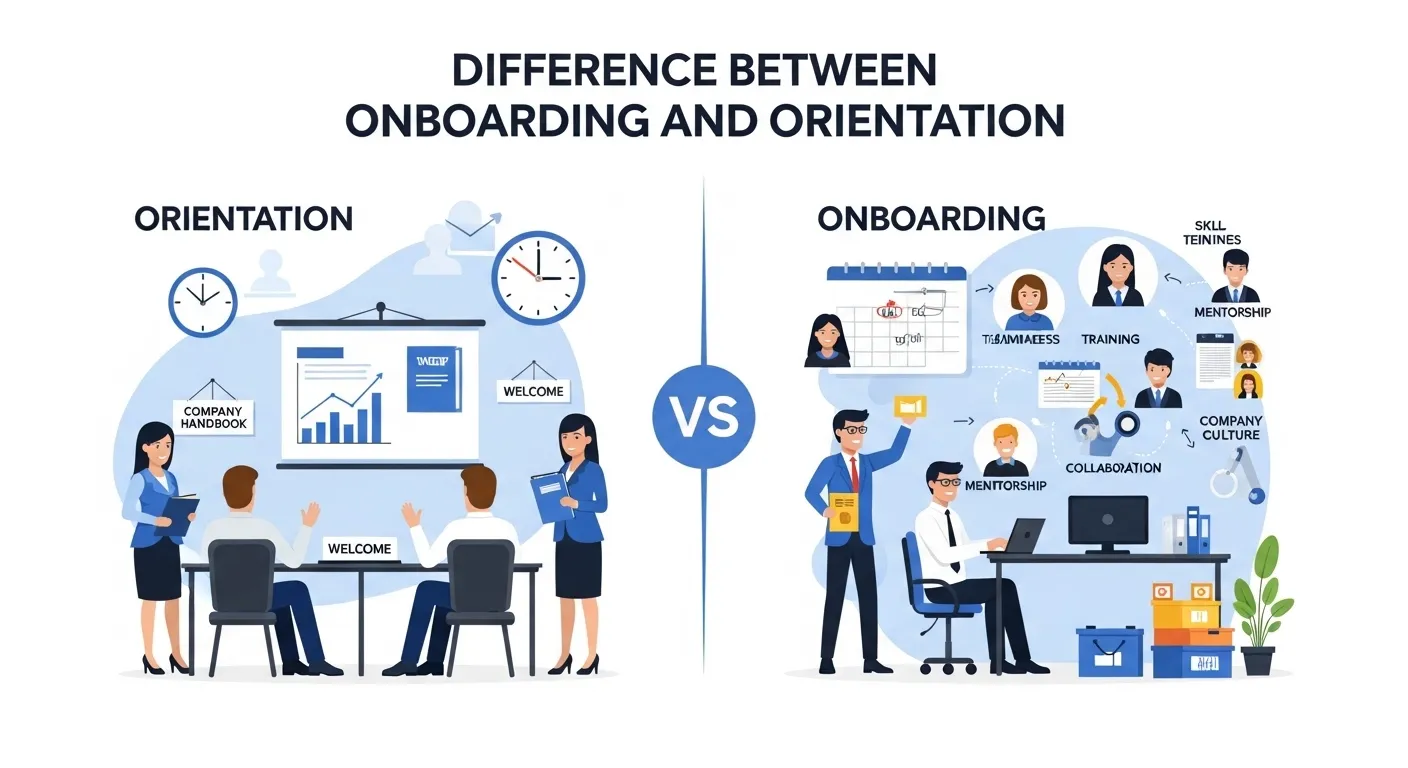
Onboarding and orientation are both part of employee integration, but orientation is a short introductory event, while onboarding is a long-term process of adapting to a new role and company.
Understanding the difference between onboarding and orientation is essential in today’s workplace, especially for employers and new employees. Imagine joining a new company, on your first day, you attend a session where you learn about policies, meet colleagues, and complete paperwork. That is orientation. But your journey doesn’t end there; over the next weeks or months, you learn your role, build relationships, and adapt to the company culture, that is onboarding.
The difference between onboarding and orientation lies in duration and purpose. Employee onboarding focuses on helping employees succeed over time, while Employee orientation provides a quick introduction to the organization. Learning the difference between onboarding and orientation helps organizations improve employee experience. By understanding the difference between onboarding and orientation, both employers and employees can achieve better productivity and satisfaction.
Pronunciation
Onboarding
US: /ˈɒnˌbɔːrdɪŋ/
Orientation
US: /ˌɔːriənˈteɪʃən/
Key Difference Between the Both
The main difference between onboarding and orientation is that orientation is a short-term introduction, while onboarding is a long-term process of employee integration and development.
Why Is Their Difference Necessary to Know for Learners and Experts?
Knowing the difference between onboarding and orientation is important for HR professionals, managers, and employees. For learners, it builds understanding of workplace processes. For experts, understanding the difference between onboarding and orientation helps in designing effective HR strategies.
In modern organizations, employee retention and performance depend heavily on proper integration. Confusing the difference between onboarding and orientation may result in poor employee experiences. Clear knowledge ensures better engagement, productivity, and organizational success.
Difference Between Onboarding and Orientation
1. Definition
Onboarding is a long-term integration process. Orientation is a short introductory program.
Examples
Onboarding:
- Training over months
- Role adaptation
Orientation:
- First-day session
- Basic introduction
2. Duration
Onboarding lasts weeks or months. Orientation lasts a few hours or days.
Examples
Onboarding:
- 30–90 days
- Ongoing process
Orientation:
- One day
- Short program
3. Purpose
Onboarding focuses on long-term success. Orientation focuses on introduction.
Examples
Onboarding:
- Skill development
- Cultural integration
Orientation:
- Policies overview
- Company introduction
4. Scope
Onboarding is broad and detailed. Orientation is limited.
Examples
Onboarding:
- Job training
- Mentorship
Orientation:
- Rules explanation
- Basic guidelines
5. Timing
Onboarding starts from day one and continues. Orientation happens at the beginning.
Examples
Onboarding:
- Continuous learning
- Gradual process
Orientation:
- Initial stage
- Starting point
6. Focus
Onboarding focuses on employee growth. Orientation focuses on information sharing.
Examples
Onboarding:
- Performance improvement
- Engagement
Orientation:
- Awareness
- Introduction
7. Interaction Level
Onboarding involves ongoing interaction. Orientation involves limited interaction.
Examples
Onboarding:
- Team meetings
- Mentoring
Orientation:
- Presentations
- Brief sessions
8. Responsibility
Onboarding involves managers and teams. Orientation is handled by HR.
Examples
Onboarding:
- Supervisor guidance
- Team support
Orientation:
- HR department
- Trainers
9. Outcome
Onboarding leads to productivity. Orientation leads to awareness.
Examples
Onboarding:
- Confident employee
- High performance
Orientation:
- Basic understanding
- Initial comfort
10. Depth of Learning
Onboarding provides deep learning. Orientation provides basic knowledge.
Examples
Onboarding:
- Detailed training
- Skill mastery
Orientation:
- General overview
- Basic knowledge
Nature and Behaviour of Both
Onboarding is continuous, evolving, and development-focused, while orientation is short, structured, and introductory in nature.
Why People Are Confused About Their Use?
People often confuse onboarding and orientation because both occur at the beginning of employment. However, orientation is just one part of the broader onboarding process.
Table Showing Difference and Similarity
| Feature | Onboarding | Orientation | Similarity |
| Duration | Long-term | Short-term | Employee integration |
| Purpose | Development | Introduction | Workplace process |
| Scope | Broad | Limited | New employee support |
| Timing | Ongoing | Initial | Starting phase |
| Outcome | Productivity | Awareness | Organizational benefit |
Which Is Better in What Situation?
Onboarding
Onboarding is better for long-term employee success. It helps employees understand their roles deeply, build relationships, and contribute effectively to the organization.
Orientation
Orientation is better for initial introduction. It provides essential information and helps employees feel comfortable on their first day.
How the Keywords Are Used in Metaphors and Similes
Examples:
- “The project onboarding took time but ensured success.”
- “The orientation phase set the direction clearly.”
Connotative Meaning
Onboarding
Connotation: Growth, integration.
Example:
“The onboarding process shaped his career.”
Orientation
Connotation: Beginning, direction.
Example:
“The orientation gave her a clear start.”
Idioms or Proverbs Related to the Words
Get on board
Example:
“It’s time for everyone to get on board with the new plan.”
Works in Literature
Onboarding and orientation are mainly discussed in business and HR management books.
Movie Names Made on the Keywords
There are no major movies specifically based on onboarding or orientation.
Five Frequently Asked Questions
1. What is the main difference between onboarding and orientation?
Onboarding is long-term, while orientation is short-term.
2. Is orientation part of onboarding?
Yes.
3. Which is more important?
Both are important for employee success.
4. How long does onboarding last?
Usually weeks to months.
5. Who conducts orientation?
HR teams.
How Both Are Useful for Surroundings
Both onboarding and orientation improve workplace efficiency, employee satisfaction, and organizational growth.
Final Words for the Both
Onboarding and orientation are essential HR processes that help employees succeed and organizations thrive.
Conclusion
The difference between onboarding and orientation lies in their duration, purpose, and depth. Orientation is a short introduction that helps employees get started, while onboarding is a long-term process that ensures growth and success. Understanding the difference between onboarding and orientation allows organizations to create better employee experiences. By learning the difference between onboarding and orientation, companies can build stronger teams and achieve long-term success.

I’m Shabbir Hussain, a professional content writer who specializes in clear and authentic comparisons between similar terms. I write concise, research-based, and reader-friendly content that turns complex language into simple explanations. Through Mysynonyms.com, I help readers strengthen their vocabulary and clearly understand word differences.