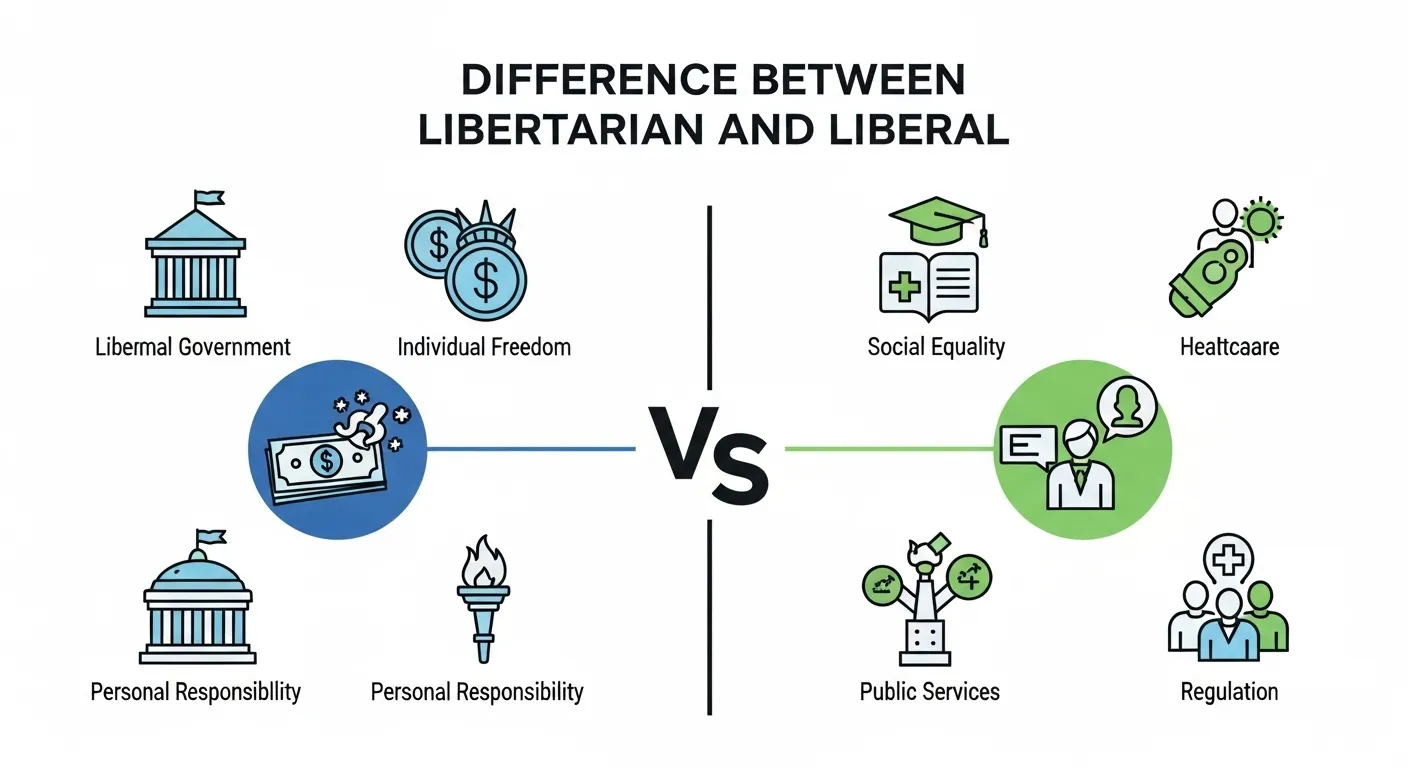
Libertarian and liberal are both political ideologies, but libertarianism emphasizes maximum individual freedom with minimal government, while liberalism supports individual rights along with an active role of government in social welfare.
Understanding the difference between libertarian and liberal is important in today’s political and social discussions. Imagine two people debating freedom, one argues that individuals should have complete control over their lives with little government interference, while the other believes freedom is important but also requires government support to ensure fairness and equality.
The difference between libertarian and liberal lies in their approach to government and individual rights. Libertarianism focuses on personal liberty, free markets, and limited government intervention.
In contrast, Liberalism supports civil rights, social justice, and a balanced role of government. Learning the difference between libertarian and liberal helps citizens understand political systems and participate more effectively in discussions. By understanding the difference between libertarian and liberal, individuals can better analyze policies, debates, and societal values.
Pronunciation
Libertarian
US: /ˌlɪbərˈtɛriən/
Liberal
US: /ˈlɪbərəl/
Key Difference Between the Both
The main difference between libertarian and liberal is that libertarians favor minimal government involvement in both economic and personal matters, while liberals support government involvement to promote equality and protect rights.
Why Is Their Difference Necessary to Know for Learners and Experts?
Knowing the difference between libertarian and liberal is important for students, voters, and policymakers. For learners, it builds political awareness. For experts, understanding the difference between libertarian and liberal helps in analyzing policies and governance models.
In society, these ideologies influence laws, economic systems, and social programs. Misunderstanding the difference between libertarian and liberal can lead to confusion in political discussions and decision-making.
Difference Between Libertarian and Liberal
1. Definition
Libertarianism is a philosophy of maximum personal freedom. Liberalism supports freedom along with social responsibility.
Examples
Libertarian:
- Minimal laws
- Individual choice
Liberal:
- Rights with regulations
- Social policies
2. Role of Government
Libertarians prefer very limited government. Liberals support an active government.
Examples
Libertarian:
- Less regulation
- Smaller government
Liberal:
- Public programs
- Government services
3. Economic Policy
Libertarians support free markets. Liberals support regulated markets.
Examples
Libertarian:
- Low taxes
- Free trade
Liberal:
- Progressive taxes
- Regulation
4. Social Issues
Both support personal freedoms, but differ in approach.
Examples
Libertarian:
- Personal choice
- Minimal laws
Liberal:
- Rights protection
- Social equality
5. Welfare Programs
Libertarians oppose most welfare programs. Liberals support them.
Examples
Libertarian:
- Private charity
- Limited aid
Liberal:
- Government welfare
- Social support
6. Regulation
Libertarians prefer minimal regulation. Liberals support necessary regulations.
Examples
Libertarian:
- Fewer rules
- Business freedom
Liberal:
- Consumer protection
- Environmental laws
7. Taxation
Libertarians favor low taxes. Liberals support higher taxes for public services.
Examples
Libertarian:
- Reduced taxes
- Individual control
Liberal:
- Public funding
- Redistribution
8. Healthcare
Libertarians prefer private healthcare. Liberals support public healthcare systems.
Examples
Libertarian:
- Market-based care
- Private insurance
Liberal:
- Government programs
- Universal access
9. Education
Libertarians support private education. Liberals support public education.
Examples
Libertarian:
- School choice
- Private institutions
Liberal:
- Public schools
- Government funding
10. Philosophy
Libertarianism is based on individual liberty. Liberalism balances liberty with equality.
Examples
Libertarian:
- Freedom first
- Limited control
Liberal:
- Equality and fairness
- Shared responsibility
Nature and Behaviour of Both
Libertarianism emphasizes independence, self-reliance, and minimal interference. Liberalism emphasizes fairness, equality, and collective responsibility alongside individual rights.
Why People Are Confused About Their Use?
People often confuse libertarian and liberal because both support individual freedoms. However, the key difference is the role of government—minimal for libertarians and active for liberals.
Table Showing Difference and Similarity
| Feature | Libertarian | Liberal | Similarity |
| Government | Minimal | Active | Support freedom |
| Economy | Free market | Regulated | Economic focus |
| Taxes | Low | Higher | Public impact |
| Welfare | Limited | Supported | Social concern |
| Philosophy | Liberty | Liberty + equality | Rights focus |
Which Is Better in What Situation?
Libertarian
Libertarian ideas are useful in situations where individual freedom and economic efficiency are priorities, such as entrepreneurship and innovation.
Liberal
Liberal ideas are better in situations requiring social support, equality, and public welfare, such as healthcare, education, and social justice.
How the Keywords Are Used in Metaphors and Similes
Examples:
- “He lived like a libertarian—independent and self-reliant.”
- “She acted like a liberal—caring about fairness and equality.”
Connotative Meaning
Libertarian
Connotation: Freedom, independence.
Example:
“It was a libertarian approach—focused on personal liberty.”
Liberal
Connotation: Fairness, compassion.
Example:
“She had a liberal mindset—supportive and inclusive.”
Idioms or Proverbs Related to the Words
Live and let live
Example:
“A libertarian often believes in ‘live and let live.’”
Works in Literature
- On Liberty (Philosophy, John Stuart Mill, 1859)
- The Road to Serfdom (Economics, Friedrich Hayek, 1944)
Movie Names Made on the Keywords
There are no major movies directly based on libertarian or liberal ideologies.
Five Frequently Asked Questions
1. What is the main difference between libertarian and liberal?
Libertarians favor minimal government, while liberals support government involvement for equality.
2. Do both support freedom?
Yes, but in different ways.
3. Which supports welfare programs?
Liberals.
4. Which prefers free markets?
Libertarians.
5. Can a person be both?
Some views may overlap.
How Both Are Useful for Surroundings
Both ideologies contribute to society by shaping policies, promoting rights, and influencing governance systems.
Final Words for the Both
Libertarianism and liberalism are important political ideologies, each offering unique perspectives on freedom and governance.
Conclusion
The difference between libertarian and liberal lies in their approach to freedom and government. Libertarians emphasise maximum individual liberty with minimal government, while liberals support individual rights along with government involvement to ensure equality and social welfare.
Understanding the difference between libertarian and liberal helps individuals engage in informed discussions and make better decisions. By learning the difference between libertarian and liberal, society can better balance freedom and responsibility.

I’m Shabbir Hussain, a professional content writer who specializes in clear and authentic comparisons between similar terms. I write concise, research-based, and reader-friendly content that turns complex language into simple explanations. Through Mysynonyms.com, I help readers strengthen their vocabulary and clearly understand word differences.