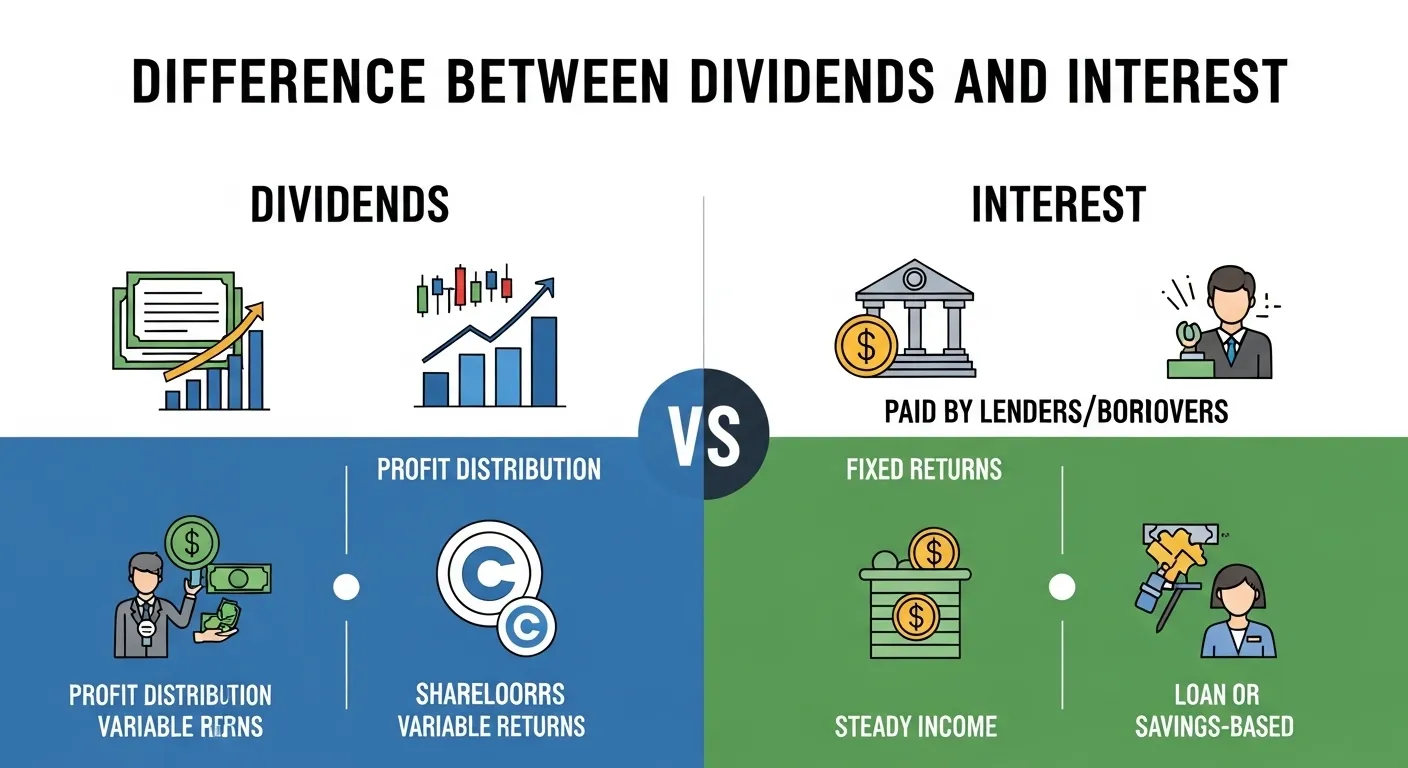
Dividends and interest are both investment earnings, but dividends come from company profits paid to shareholders, while interest is earned by lending money at a fixed rate.
Understanding the difference between dividends and interest is essential for anyone looking to grow their money wisely. Imagine you invest your savings, sometimes you receive money because a company shares its profits with you, and other times you earn money simply because you lent your funds to a bank or borrower. While both provide income, they operate in very different ways.
The difference between dividends and interest lies in their source, risk, and reliability. Dividend represents a share of earnings paid to investors who own company stock. In contrast, Interest is a fixed return earned when money is lent, such as through savings accounts or bonds. Learning the difference between dividends and interest helps individuals choose the right investment strategy. By understanding the difference between dividends and interest, you can balance risk, stability, and long-term financial growth effectively.
Pronunciation
Dividends
US: /ˈdɪvɪdɛndz/
Interest
US: /ˈɪntrəst/
Key Difference Between the Both
The main difference between dividends and interest is that dividends are variable payments based on company profits, while interest is a fixed payment agreed upon when money is lent.
Why Is Their Difference Necessary to Know for Learners and Experts?
Knowing the difference between dividends and interest is important for both beginners and financial experts. For learners, it builds a foundation in personal finance and investing. For experts, understanding the difference between dividends and interest helps in designing portfolios that balance risk and return.
In today’s economy, people rely on multiple income streams. Misunderstanding the difference between dividends and interest can lead to poor financial decisions, such as expecting guaranteed income from dividends or underestimating the growth potential of stocks. Clear knowledge of the difference between dividends and interest ensures smarter investment planning and better financial security.
Difference Between Dividends and Interest
1. Definition
Dividends are payments made by companies to shareholders from profits. Interest is payment made to lenders for the use of their money.
Examples
Dividends:
- A company distributes profits to shareholders
- Investors receive earnings from stocks
Interest:
- A bank pays interest on savings
- A borrower pays interest on a loan
2. Source of Income
Dividends come from company earnings. Interest comes from lending agreements.
Examples
Dividends:
- Corporate profits
- Business performance
Interest:
- Loans and deposits
- Financial contracts
3. Guarantee of Payment
Dividends are not guaranteed. Interest is usually guaranteed.
Examples
Dividends:
- May be reduced or skipped
- Depends on profits
Interest:
- Fixed rate agreed in advance
- Paid regularly
4. Risk Level
Dividends involve higher risk. Interest is relatively low risk.
Examples
Dividends:
- Stock market fluctuations
- Company performance
Interest:
- Stable income
- Predictable returns
5. Payment Frequency
Dividends are paid periodically. Interest is paid regularly as agreed.
Examples
Dividends:
- Quarterly payments
- Annual distributions
Interest:
- Monthly payments
- Yearly payments
6. Tax Treatment
Dividends and interest may be taxed differently depending on the country.
Examples
Dividends:
- Dividend tax rates
- Sometimes lower tax
Interest:
- Taxed as regular income
- Higher tax in some regions
7. Type of Investment
Dividends come from equity investments. Interest comes from debt investments.
Examples
Dividends:
- Stocks
- Shares
Interest:
- Bonds
- Savings accounts
8. Control Over Payment
Dividend payments depend on company decisions. Interest payments are fixed by agreement.
Examples
Dividends:
- Declared by company board
- Can change anytime
Interest:
- Set in contract
- Cannot change easily
9. Growth Potential
Dividends can increase over time. Interest usually remains constant.
Examples
Dividends:
- Growing companies increase payouts
- Higher long-term returns
Interest:
- Fixed income
- Limited growth
10. Ownership vs Lending
Dividends come from ownership. Interest comes from lending.
Examples
Dividends:
- Shareholder income
- Equity participation
Interest:
- Lender income
- Debt relationship
Nature and Behaviour of Both
Dividends are flexible and depend on business success, making them suitable for growth-oriented investors. Interest is stable and predictable, making it ideal for conservative investors seeking regular income.
Why People Are Confused About Their Use?
People often confuse dividends and interest because both are forms of passive income. However, the confusion arises because they appear similar in outcome, earning money, while their sources and risks are very different.
Table Showing Difference and Similarity
| Feature | Dividends | Interest | Similarity |
| Source | Company profits | Loans | Income |
| Risk | Higher | Lower | Investment returns |
| Guarantee | No | Yes | Financial benefit |
| Type | Equity | Debt | Passive income |
| Payment | Variable | Fixed | Regular earnings |
Which Is Better in What Situation?
Dividends
Dividends are better for investors who want long-term wealth growth and are willing to accept some risk. They are ideal for those investing in stocks and looking for both income and capital appreciation.
Interest
Interest is better for individuals seeking stability and predictable income. It is suitable for savings accounts, fixed deposits, and bonds where safety is a priority.
How the Keywords Are Used in Metaphors and Similes
Examples:
- “His patience paid dividends over time.”
- “She showed great interest in learning new skills.”
Connotative Meaning
Dividends
Connotation: Reward, benefit, return.
Example:
“Hard work always pays dividends in the future.”
Interest
Connotation: Curiosity, gain, attention.
Example:
“He took a strong interest in financial planning.”
Idioms or Proverbs Related to the Words
Pay dividends
Example:
“Investing in education will pay dividends later in life.”
Works in Literature
Dividends and interest are commonly discussed in financial and economic literature:
- The Intelligent Investor (Finance, Benjamin Graham, 1949)
- Rich Dad Poor Dad (Finance, Robert Kiyosaki, 1997)
Movie Names Made on the Keywords
There are no major movies specifically based on dividends or interest, but financial themes appear in:
- The Big Short (2015, USA)
- Wall Street (1987, USA)
Five Frequently Asked Questions
1. What is the main difference between dividends and interest?
Dividends come from company profits, while interest comes from lending money.
2. Which is safer?
Interest is generally safer and more predictable.
3. Are dividends guaranteed?
No, they depend on company performance.
4. Can an investor earn both?
Yes, by investing in both stocks and fixed-income assets.
5. Which is better for beginners?
Interest-based investments are simpler and less risky.
How Both Are Useful for Surroundings
Both dividends and interest contribute to economic growth by encouraging investment, savings, and financial stability. They help individuals build wealth and support businesses and financial institutions.
Final Words for the Both
Dividends and interest are two essential ways to earn income from investments. Each has its own advantages and serves different financial goals.
Conclusion
The difference between dividends and interest lies in their source, risk, and reliability. Dividends are earned through ownership in companies and depend on profits, while interest is earned by lending money and is usually fixed and predictable. Understanding the difference between dividends and interest allows individuals to make informed investment decisions and balance their financial strategies. By learning the difference between dividends and interest, you can achieve both stability and growth in your financial journey.

I’m Shabbir Hussain, a professional content writer who specializes in clear and authentic comparisons between similar terms. I write concise, research-based, and reader-friendly content that turns complex language into simple explanations. Through Mysynonyms.com, I help readers strengthen their vocabulary and clearly understand word differences.