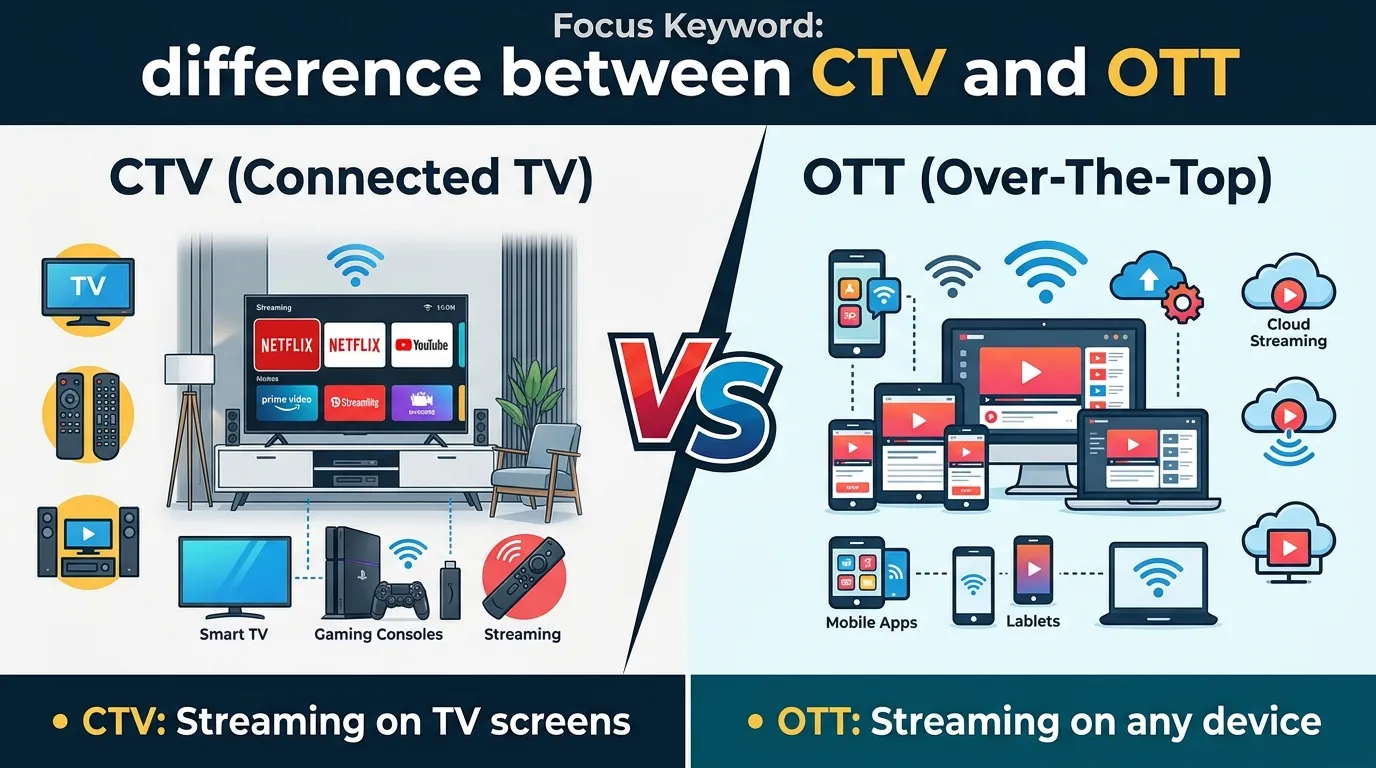
CTV and OTT are closely related in digital streaming, but OTT refers to the method of delivering content over the internet, while CTV refers to the device (like a smart TV) used to watch that content.
Understanding the difference between CTV and OTT is essential in today’s streaming-driven world. Imagine watching your favorite show on your smart TV, phone, or laptop. The internet delivers the content to you rather than traditional cable or satellite, but it does not use the same delivery method or device. This is where the difference between CTV and OTT becomes important.
The difference between CTV and OTT lies in their roles within the streaming ecosystem. Over-the-Top media service (OTT) refers to platforms that deliver video, audio, and other media directly over the internet without requiring cable or satellite providers. On the other hand, Connected TV (CTV) refers to the actual device used to access and watch that content, such as smart TVs or streaming devices.
Learning the difference between CTV and OTT helps marketers, content creators, and viewers understand how streaming works. By understanding the difference between CTV and OTT, you can better navigate digital entertainment, advertising strategies, and media consumption trends.
Pronunciation
CTV (Connected TV)
Spoken as initials: /ˌsiː.tiːˈviː/
OTT (Over-the-Top)
Spoken as initials: /ˌoʊ.tiːˈtiː/
Key Difference Between the Both
OTT delivers content over the internet, while CTV refers to the device people use to watch that content on a television screen.
Why Is Their Difference Important to Understand?
Knowing the difference between CTV and OTT is crucial for both consumers and professionals. For viewers, it clarifies how content is accessed. For advertisers and businesses, understanding the difference between CTV and OTT helps in targeting audiences more effectively.
In the digital age, where streaming dominates traditional TV, people create misunderstandings about how media is delivered and consumed if they confuse these terms. Understanding these differences ensures better decision-making in both entertainment and marketing.
Difference Between CTV and OTT
1. Definition
OTT is a content delivery method over the internet.
CTV is a device used to view that content.
Examples
OTT:
- Streaming platforms
- Online media services
CTV:
- Smart TVs
- Streaming devices
2. Function
OTT provides content.
CTV displays content.
Examples
OTT:
- Video streaming
- Audio streaming
CTV:
- Screen output
- Viewing interface
3. Technology Type
OTT is software/service-based.
CTV is hardware/device-based.
4. Accessibility
OTT can be accessed on multiple devices.
CTV is limited to television-based viewing.
Examples
OTT:
- Phones
- Tablets
CTV:
- TV screens
- Home entertainment systems
5. Examples
OTT includes platforms like Netflix, YouTube, and Amazon Prime Video.
CTV includes devices like smart TVs, Roku, and Apple TV.
6. Content Delivery
OTT delivers content via the internet directly to users.
CTV receives and displays that content.
7. User Experience
OTT focuses on content variety and accessibility.
CTV focuses on viewing experience on a large screen.
8. Advertising
OTT ads can appear across multiple devices.
CTV ads are shown specifically on TV screens.
9. Flexibility
OTT is highly flexible and mobile-friendly.
CTV is more stationary and home-based.
10. Role in Ecosystem
OTT is the service layer.
CTV is the device layer.
Nature and Relationship of Both
OTT delivers the content, while CTV provides one of the main ways to watch it. In simple terms, OTT is what you watch, and CTV is where you watch it (on a TV).
Why People Are Confused?
People often confuse with both because they are closely connected in the streaming process. When someone watches Netflix on a smart TV, both OTT and CTV are involved simultaneously. This overlap makes the difference between CTV and OTT less obvious.
Comparison Table
| Feature | OTT | CTV | Similarity |
| Type | Service | Device | Streaming ecosystem |
| Function | Delivers content | Displays content | Digital media |
| Accessibility | Multi-device | TV-based | Internet required |
| Flexibility | High | Moderate | User-focused |
| Role | Content provider | Viewing platform | Entertainment |
Which Is More Important?
OTT
OTT is essential because it provides the actual content. Without OTT services, there would be nothing to watch.
CTV
CTV enhances the viewing experience by allowing users to watch OTT content on large screens, making it ideal for home entertainment.
Real-World Example
When you open Netflix on a smart TV:
- Netflix = OTT service
- Smart TV = CTV device
This example clearly shows the difference between CTV and OTT in action.
Advantages and Limitations
OTT Advantages
- Wide content library
- Accessible anywhere
- Cost-effective compared to cable
OTT Limitations
- Requires internet
- Subscription costs
CTV Advantages
- Large-screen viewing
- Better user experience
- Ideal for families
CTV Limitations
- Limited portability
- Depends on OTT services
Future Trends
The difference between CTV and OTT will remain relevant as streaming continues to grow. OTT platforms are expanding content libraries and personalization features, while CTV devices are becoming smarter with better interfaces and integration.
Advertising is also shifting toward CTV and OTT, offering more targeted and measurable campaigns compared to traditional TV.
Frequently Asked Questions
1. What is the main difference between CTV and OTT?
OTT is the content delivery service, while CTV is the device used to watch it.
2. Is Netflix OTT or CTV?
Netflix is an OTT service.
3. Can OTT work without CTV?
Yes, OTT can be accessed on phones, tablets, and computers.
4. Is a smart TV considered CTV?
Yes.
5. Which is better?
They serve different purposes and work together.
Conclusion
The difference between CTV and OTT lies in their roles within the streaming ecosystem. OTT refers to the delivery of content over the internet, while CTV refers to the devices used to watch that content on a television screen. Understanding the difference between CTV and OTT helps users, marketers, and businesses navigate the digital media landscape more effectively.
In simple terms, OTT brings the content, and CTV brings it to your TV screen. By learning the difference, you can better understand how modern entertainment works and make smarter choices in both viewing and marketing strategies.

I’m Shabbir Hussain, a professional content writer who specializes in clear and authentic comparisons between similar terms. I write concise, research-based, and reader-friendly content that turns complex language into simple explanations. Through Mysynonyms.com, I help readers strengthen their vocabulary and clearly understand word differences.