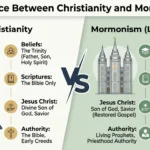
Christianity and Mormonism both center on belief in Jesus Christ, but Mormonism is a distinct movement within the broader Christian tradition with additional scriptures, doctrines, and practices.
Understanding the difference between Christianity and Mormonism can be confusing at first because both share important beliefs, such as faith in Jesus Christ, prayer, and moral living. Yet when you look more closely, you’ll find meaningful differences in scripture, theology, and church organisation.
The difference between Christianity and Mormonism largely comes down to sources of authority and certain core teachings. Christianity is a broad religion with many denominations (like Catholic, Orthodox, and Protestant traditions) that rely on the Bible as their primary scripture. Mormonism, formally associated with The Church of Jesus Christ of Latter-day Saints, accepts the Bible but also includes additional texts and teachings revealed in the 19th century. Learning the difference between Christianity and Mormonism helps you understand both shared foundations and distinct beliefs.
Key Difference Between the Both
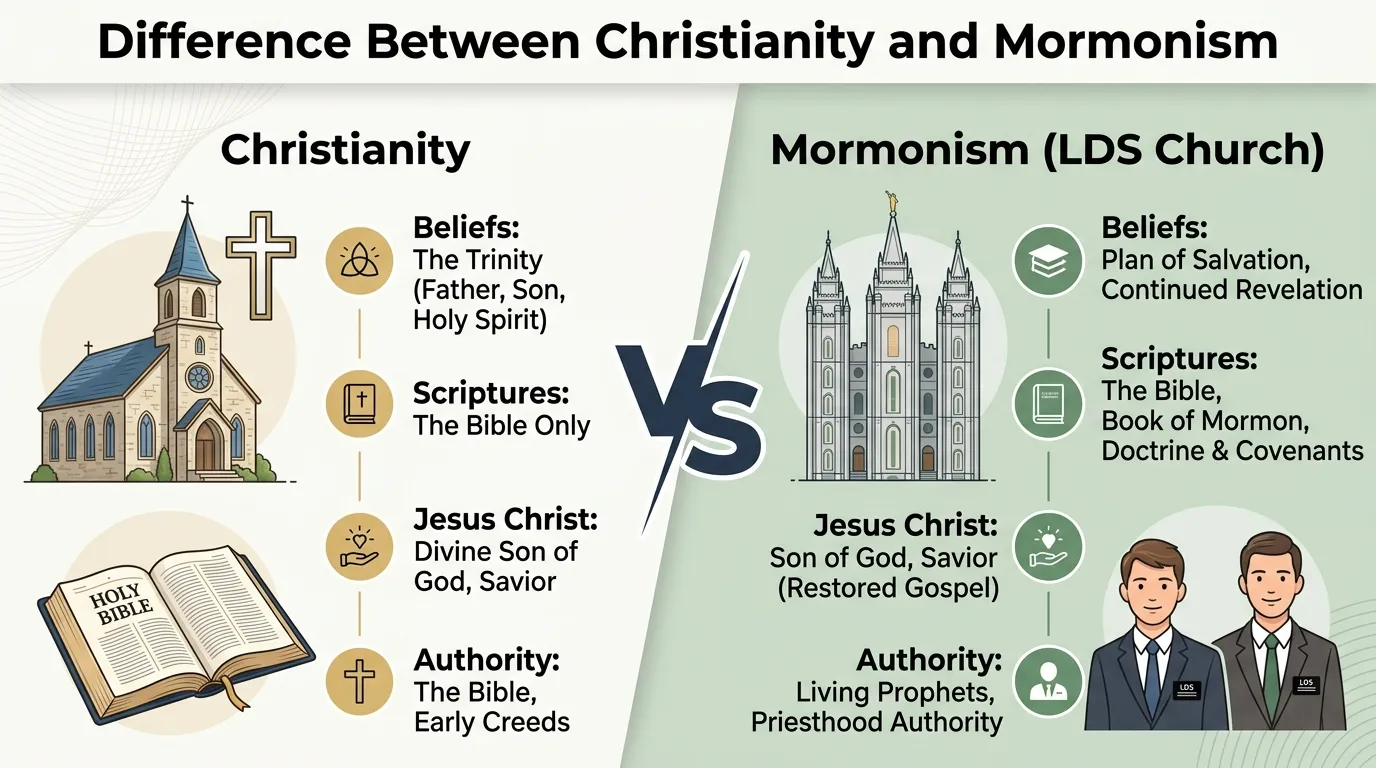
The main difference between Christianity and Mormonism is that Christianity relies solely on the Bible as its core scripture, while Mormonism includes additional sacred texts and teachings alongside the Bible.
Why Is Their Difference Important to Understand?
Knowing the difference between Christianity and Mormonism helps avoid oversimplification. While they share a belief in Jesus Christ, they interpret His nature, authority, and teachings in different ways. This understanding is useful for respectful dialogue, academic study, and personal learning.
Difference Between Christianity and Mormonism
1. Founding and Origins
Christianity began in the 1st century based on the life and teachings of Jesus Christ.
Mormonism began in the 19th century through the teachings of Joseph Smith.
2. Scriptures
Christianity primarily uses the Bible (Old and New Testaments).
Mormonism uses the Bible plus additional texts like Book of Mormon, Doctrine and Covenants, and Pearl of Great Price.
3. Concept of God
Most Christian denominations believe in the Trinity (Father, Son, Holy Spirit as one God).
Mormonism teaches that the Father, Son, and Holy Spirit are distinct beings united in purpose.
4. Authority and Revelation
Christianity generally teaches that divine revelation is complete with the Bible (though interpretations vary).
Mormonism teaches ongoing revelation through modern prophets.
5. Church Structure
Christianity includes many independent denominations with different leadership systems.
Mormonism has a centralized structure led by a prophet and apostles.
6. View of Salvation
Christianity typically teaches salvation by grace through faith (with variations among denominations).
Mormonism teaches salvation through faith in Christ, combined with obedience, ordinances, and personal effort.
7. Afterlife Beliefs
Christianity often teaches heaven and hell as primary outcomes.
Mormonism describes multiple levels of heaven and a more detailed afterlife structure.
8. Role of Jesus Christ
Both consider Jesus central, but interpretations differ.
Christianity views Jesus as eternally divine within the Trinity.
Mormonism views Jesus as the Son of God, distinct from the Father.
9. Additional Practices
Christianity practices vary widely (e.g., baptism, communion).
Mormonism includes unique practices such as temple ordinances and missionary service.
10. Geographic and Cultural Development
Christianity developed globally over centuries.
Mormonism originated in the United States and spread worldwide later.
Nature and Beliefs of Both
Both Christianity and Mormonism emphasize faith, moral living, community, and devotion to God. However, Mormonism builds on Christian foundations with additional teachings and organizational structure.
Why People Are Confused About Their Relationship?
People often confuse the two because Mormonism identifies as Christian and uses the Bible. However, differences in scripture, theology, and authority create distinctions that some Christian groups view as separate.
Comparison Table
| Feature | Christianity | Mormonism | Similarity |
| Origin | 1st century | 19th century | Based on Jesus Christ |
| Scripture | Bible only | Bible + additional texts | Religious texts |
| God | Trinity | Separate beings | Belief in God |
| Leadership | Diverse | Centralized | Organized religion |
| Salvation | Faith/grace | Faith + works | Moral living |
Which Is Followed in What Context?
Christianity
Followed worldwide in many denominations, with diverse interpretations and traditions.
Mormonism
Followed by members of the Latter-day Saint movement, with a structured global organization and unified teachings.
Common Misunderstandings
- Thinking all Christians share identical beliefs (they don’t).
- Assuming Mormonism is identical to mainstream Christianity (it has distinct doctrines).
Five Frequently Asked Questions
1. Is Mormonism part of Christianity?
Mormonism considers itself Christian, but some Christian denominations see it as distinct due to doctrinal differences.
2. Do both believe in Jesus?
Yes, both center their faith on Jesus Christ.
3. What extra book do Mormons use?
The Book of Mormon.
4. Are their beliefs about God the same?
No, especially regarding the nature of God and the Trinity.
5. Do they share any values?
Yes, faith, morality, family, and community.
Conclusion
The difference between Christianity and Mormonism lies in their origins, scriptures, beliefs about God, and religious authority. Christianity is a broad, ancient faith with many denominations, while Mormonism is a more recent movement with additional teachings and centralised leadership. Understanding the difference between Christianity and Mormonism allows for clearer, more respectful conversations and a deeper appreciation of both traditions.

I’m Shabbir Hussain, a professional content writer who specializes in clear and authentic comparisons between similar terms. I write concise, research-based, and reader-friendly content that turns complex language into simple explanations. Through Mysynonyms.com, I help readers strengthen their vocabulary and clearly understand word differences.