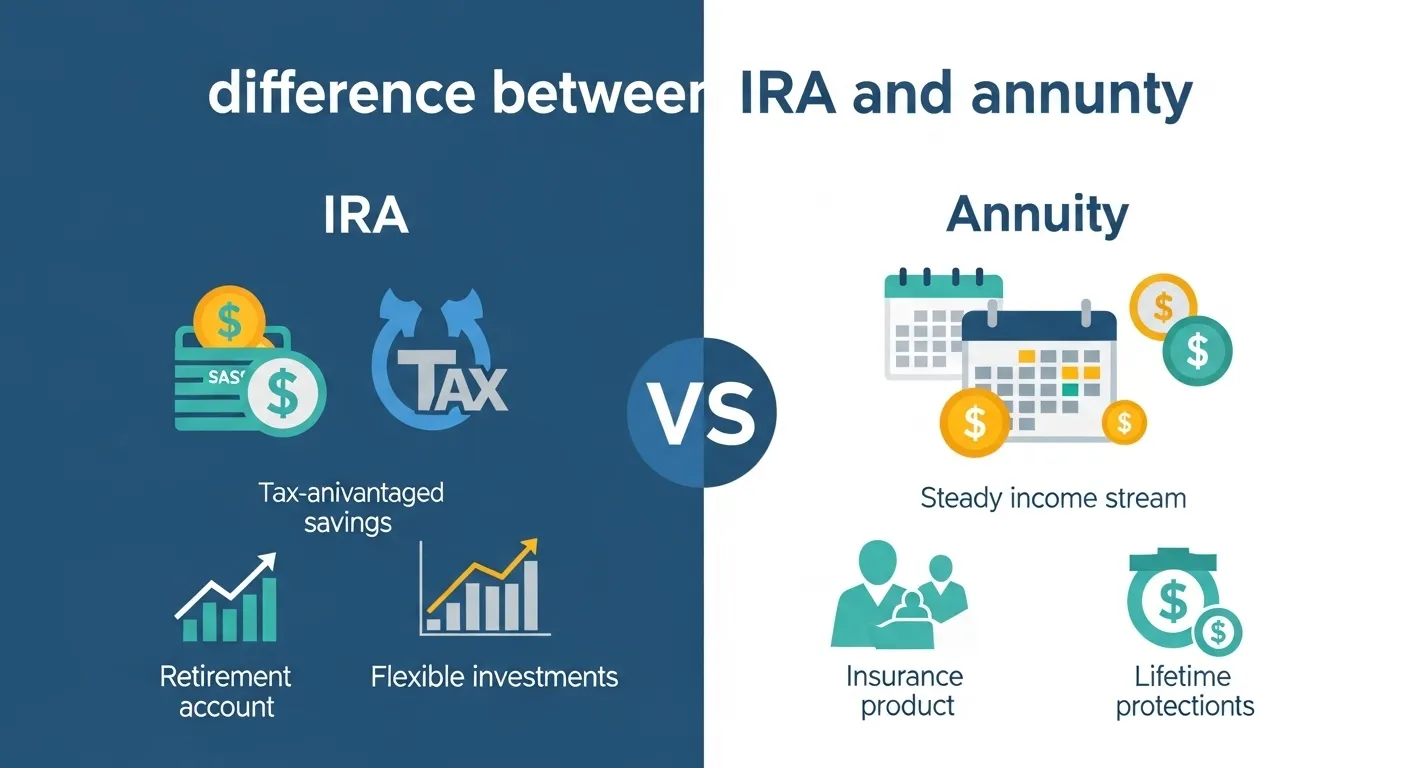
An IRA and an annuity are both retirement tools, but an IRA is a tax-advantaged savings account, while an annuity is a contract that provides guaranteed income, often for life.
Understanding the difference between IRA and annuity is essential for anyone planning a secure financial future. Imagine you’re saving for retirement—one option lets you grow your money with tax advantages, while another promises a steady income when you stop working. Both sound useful, but they serve different purposes.
The difference between IRA and annuity lies in structure and function. An Individual Retirement Account is a savings vehicle that allows individuals to invest money with tax benefits. On the other hand, an Annuity is a contract with an insurance company that provides regular payouts over time. Learning the difference between IRA and annuity helps investors make smarter decisions. By understanding the difference between IRA and annuity, you can build a balanced retirement strategy that includes both growth and income.
Pronunciation
IRA (Individual Retirement Account)
US: /ˌaɪ.ɑːrˈeɪ/
Annuity
US: /əˈnuːəti/
Key Difference Between the Both
The main difference between IRA and annuity is that an IRA is designed for saving and investing money for retirement, while an annuity is designed to provide a steady income stream during retirement.
Why Is Their Difference Necessary to Know for Learners and Experts?
Knowing the difference between IRA and annuity is important for beginners and financial experts alike. For learners, it builds a foundation in retirement planning. For experts, understanding the difference between IRA and annuity helps in designing customized financial plans.
In modern society, retirement security depends on making informed financial choices. Misunderstanding the difference between IRA and annuity can lead to either insufficient savings or lack of reliable income. Clear knowledge ensures financial stability and peace of mind in later years.
Difference Between IRA and Annuity
1. Definition
An IRA is a retirement savings account. An annuity is an income-generating contract.
Examples
IRA:
- Retirement investment account
- Tax-advantaged savings
Annuity:
- Insurance contract
- Regular payouts
2. Purpose
IRA focuses on saving and growing money. Annuity focuses on providing income.
Examples
IRA:
- Long-term growth
- Investment accumulation
Annuity:
- Monthly income
- Retirement payouts
3. Structure
IRA is an account. Annuity is a contract with an insurer.
Examples
IRA:
- Bank or brokerage account
- Flexible investments
Annuity:
- Agreement with company
- Fixed terms
4. Tax Benefits
IRA offers tax advantages on contributions or withdrawals. Annuity offers tax-deferred growth.
Examples
IRA:
- Traditional or Roth options
- Tax savings
Annuity:
- Deferred taxes
- Income taxation
5. Investment Options
IRA allows multiple investment choices. Annuity has limited options.
Examples
IRA:
- Stocks
- Bonds
Annuity:
- Fixed returns
- Limited funds
6. Liquidity
IRA offers more flexibility. Annuity may have restrictions.
Examples
IRA:
- Easier withdrawals
- Penalties for early use
Annuity:
- Surrender charges
- Limited access
7. Risk Level
IRA risk depends on investments. Annuity risk is lower in fixed plans.
Examples
IRA:
- Market risk
- Variable returns
Annuity:
- Guaranteed income
- Lower risk
8. Income Feature
IRA does not automatically provide income. Annuity guarantees income.
Examples
IRA:
- Withdraw as needed
- No fixed payments
Annuity:
- Monthly income
- Lifetime payments
9. Fees
IRA fees are usually lower. Annuity fees can be higher.
Examples
IRA:
- Low management fees
- Brokerage costs
Annuity:
- Insurance fees
- Administrative costs
10. Best Use
IRA is best for saving. Annuity is best for income.
Examples
IRA:
- Building wealth
- Long-term investment
Annuity:
- Retirement income
- Financial security
Nature and Behaviour of Both
IRA is flexible and growth-oriented, while annuity is structured and income-focused. Both complement each other in a retirement plan.
Why People Are Confused About Their Use?
People often confuse IRA and annuity because both are used for retirement. However, one focuses on saving and the other on income generation.
Table Showing Difference and Similarity
| Feature | IRA | Annuity | Similarity |
| Type | Account | Contract | Retirement tools |
| Purpose | Saving | Income | Financial planning |
| Risk | Variable | Lower | Long-term use |
| Flexibility | High | Limited | Tax benefits |
| Income | Not fixed | Guaranteed | Retirement support |
Which Is Better in What Situation?
IRA
IRA is better for individuals who want to grow their savings over time and have control over investment choices. It is ideal for long-term wealth accumulation.
Annuity
Annuity is better for those who want a predictable income during retirement. It is especially useful for individuals seeking financial stability and reduced risk.
How the Keywords Are Used in Metaphors and Similes
Examples:
- “His savings acted like an IRA—growing steadily over time.”
- “Her income was like an annuity—reliable and consistent.”
Connotative Meaning
IRA
Connotation: Growth, planning.
Example:
“He built an IRA-like strategy for his future.”
Annuity
Connotation: Stability, security.
Example:
“She preferred an annuity-like income for peace of mind.”
Idioms or Proverbs Related to the Words
There are no direct idioms, but concepts relate to saving and stability.
Example:
“Save for a rainy day.”
Works in Literature
Retirement planning is widely discussed in financial literature:
- The Intelligent Investor (Finance, Benjamin Graham, 1949)
- The Total Money Makeover (Finance, Dave Ramsey, 2003)
Movie Names Made on the Keywords
There are no major movies specifically based on IRA or annuity, but financial themes appear in:
- Wall Street (1987, USA)
- The Big Short (2015, USA)
Five Frequently Asked Questions
1. What is the main difference between IRA and annuity?
IRA is for saving, while annuity is for income.
2. Can I have both?
Yes, many people use both.
3. Which is safer?
Annuities are generally safer.
4. Are IRAs flexible?
Yes, they offer more investment choices.
5. Which is better for retirement?
A combination of both is often ideal.
How Both Are Useful for Surroundings
Both IRA and annuity help individuals achieve financial independence and reduce reliance on external support during retirement.
Final Words for the Both
IRA and annuity are powerful financial tools that serve different but complementary roles in retirement planning.
Conclusion
The difference between IRA and annuity lies in their purpose and structure. An IRA helps individuals save and grow money with tax advantages, while an annuity provides a steady income stream for financial security. Understanding the difference between IRA and annuity allows individuals to make informed retirement decisions. By learning the difference between IRA and annuity, you can create a balanced strategy that ensures both growth and stability in your financial future.

I’m Shabbir Hussain, a professional content writer who specializes in clear and authentic comparisons between similar terms. I write concise, research-based, and reader-friendly content that turns complex language into simple explanations. Through Mysynonyms.com, I help readers strengthen their vocabulary and clearly understand word differences.