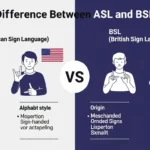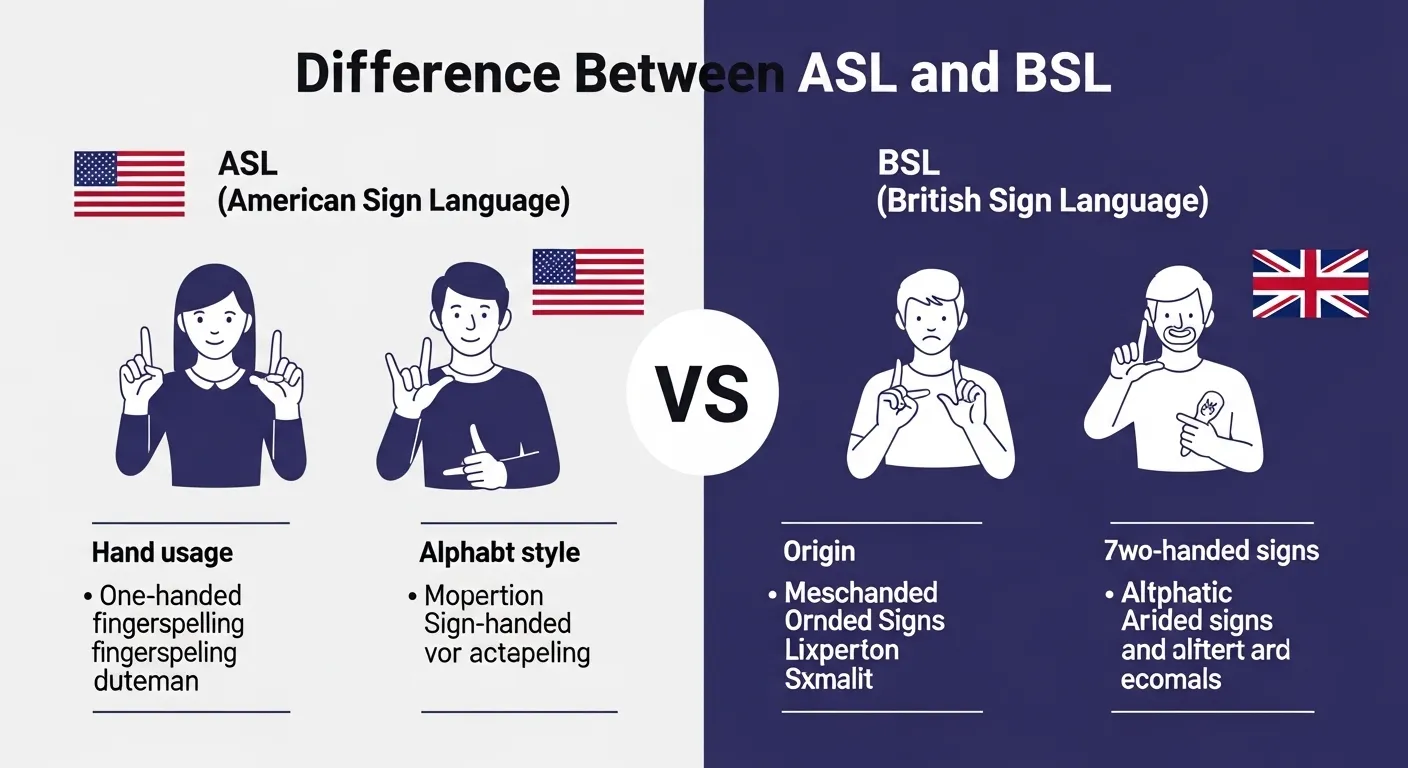
ASL and BSL are both sign languages used by Deaf communities, but they differ in origin, structure, and usage, ASL is used mainly in the United States, while BSL is used in the United Kingdom.
Understanding the difference between ASL and BSL is important for anyone interested in communication, language, or Deaf culture. Imagine travelling to another country and realising that even sign language isn’t universal, just like spoken languages, sign languages also vary across regions.
The difference between ASL and BSL lies in history, grammar, and hand usage. American Sign Language (ASL) developed from French Sign Language influences and is widely used in North America. In contrast, British Sign Language (BSL) evolved independently in the UK. Learning the difference between ASL and BSL helps learners communicate more effectively and respect cultural diversity. By understanding the difference between ASL and BSL, you can appreciate the richness and uniqueness of sign languages worldwide.
Pronunciation
ASL (American Sign Language)
Spoken as initials: /ˌeɪ.esˈel/
BSL (British Sign Language)
Spoken as initials: /ˌbiː.esˈel/
Key Difference Between the Both
The main difference between ASL and BSL is that ASL uses one hand for fingerspelling and follows American linguistic structure, while BSL uses two hands and has its own unique grammar and vocabulary.
Why Is Their Difference Necessary to Know for Learners and Experts?
Knowing the difference between ASL and BSL is essential for students, interpreters, and anyone working with Deaf communities. For learners, it prevents confusion when studying sign language. For experts, understanding the difference between ASL and BSL ensures accurate communication and cultural sensitivity.
In global communication, assuming all sign languages are the same can lead to misunderstandings. Recognizing the difference between ASL and BSL helps build respect for linguistic diversity and improves inclusivity.
Difference Between ASL and BSL
1. Origin
ASL is influenced by French Sign Language. BSL developed independently in the UK.
Examples
ASL:
- French roots
- American development
BSL:
- British origin
- Independent evolution
2. Region of Use
ASL is used in the United States and parts of Canada. BSL is used in the United Kingdom.
Examples
ASL:
- USA
- North America
BSL:
- UK
- British regions
3. Hand Usage
ASL uses one hand for fingerspelling. BSL uses two hands.
Examples
ASL:
- One-handed alphabet
- Simpler gestures
BSL:
- Two-handed alphabet
- More complex movements
4. Grammar
ASL has its own grammar structure. BSL has a different grammar system.
Examples
ASL:
- Subject-Verb-Object variations
- Unique syntax
BSL:
- Topic-comment structure
- Different sentence patterns
5. Vocabulary
ASL and BSL have completely different signs.
Examples
ASL:
- Unique signs for words
- American expressions
BSL:
- Different signs
- British expressions
6. Fingerspelling System
ASL uses a one-handed alphabet. BSL uses a two-handed alphabet.
Examples
ASL:
- Quick spelling
- One hand
BSL:
- Two-hand coordination
- Distinct shapes
7. Learning Curve
ASL may be easier for beginners due to one-hand use. BSL may require more coordination.
Examples
ASL:
- Simpler hand use
- Faster learning
BSL:
- Two-hand coordination
- Practice required
8. Cultural Influence
ASL reflects American Deaf culture. BSL reflects British Deaf culture.
Examples
ASL:
- American customs
- US community
BSL:
- British traditions
- UK community
9. Global Influence
ASL is widely used internationally. BSL is mainly limited to the UK.
Examples
ASL:
- International learners
- Global reach
BSL:
- Regional use
- Limited spread
10. Recognition
Both are officially recognized languages in their regions.
Examples
ASL:
- Recognized in US contexts
- Educational use
BSL:
- Officially recognized in UK
- Legal support
Nature and Behaviour of Both
ASL and BSL are complete, natural languages with their own grammar, vocabulary, and cultural context. They are not universal and differ just like spoken languages.
Why People Are Confused About Their Use?
People often assume that sign language is universal. However, the difference between ASL and BSL shows that sign languages vary by region, just like spoken languages.
Table Showing Difference and Similarity
| Feature | ASL | BSL | Similarity |
| Region | USA | UK | Sign languages |
| Hand Use | One hand | Two hands | Visual communication |
| Grammar | Unique | Different | Full languages |
| Origin | French influence | Independent | Cultural roots |
| Vocabulary | Different | Different | Communication tool |
Which Is Better in What Situation?
ASL
ASL is better if you are in the United States or interacting with American Deaf communities. It is also widely taught internationally.
BSL
BSL is better if you are in the United Kingdom or working with British Deaf communities. It is essential for local communication there.
How the Keywords Are Used in Metaphors and Similes
Examples:
- “Their communication was as clear as ASL.”
- “The system worked like BSL—structured and expressive.”
Connotative Meaning
ASL
Connotation: Accessibility, communication.
Example:
“He used an ASL-like approach to connect.”
BSL
Connotation: Structure, culture.
Example:
“It had a BSL-like clarity and form.”
Idioms or Proverbs Related to the Words
There are no direct idioms, but communication-related phrases apply.
Example:
“Actions speak louder than words.”
Works in Literature
Sign languages are explored in Deaf studies and linguistic research.
Movie Names Made on the Keywords
While not specific, sign language appears in films like:
- A Quiet Place (2018, USA)
- CODA (2021, USA)
Five Frequently Asked Questions
1. What is the main difference between ASL and BSL?
ASL uses one hand and is used in the US, while BSL uses two hands and is used in the UK.
2. Are ASL and BSL the same?
No, they are completely different languages.
3. Which is easier to learn?
ASL is often easier due to one-hand use.
4. Can ASL users understand BSL?
No, not without learning it.
5. Why are they different?
They developed independently.
How Both Are Useful for Surroundings
Both ASL and BSL promote communication, inclusion, and accessibility for Deaf communities.
Final Words for the Both
ASL and BSL are rich, expressive languages that reflect the cultures and communities they serve.
Conclusion
The difference between ASL and BSL lies in their origin, structure, and usage. ASL is used in the United States and uses one hand, while BSL is used in the United Kingdom and uses two hands. Understanding the difference between ASL and BSL helps improve communication and cultural awareness. By learning the difference between ASL and BSL, you can better connect with diverse communities and appreciate linguistic diversity.

I’m Shabbir Hussain, a professional content writer who specializes in clear and authentic comparisons between similar terms. I write concise, research-based, and reader-friendly content that turns complex language into simple explanations. Through Mysynonyms.com, I help readers strengthen their vocabulary and clearly understand word differences.