Werewolf and lycan both refer to humans transforming into wolves, but “werewolf” is a traditional mythological term, while “lycan” is a modern, stylized version often used in fiction.
Understanding the difference between werewolf and lycan becomes fascinating when you explore myths, folklore, and modern fantasy stories. Imagine hearing an old tale from a village elder about a cursed human turning into a wolf under the full moon. Now picture a sleek, powerful creature from a modern movie with controlled transformations and enhanced abilities. Both sound similar, yet they carry different meanings.
The difference between werewolf and lycan lies in origin, usage, and portrayal. Werewolf comes from ancient folklore and legends across Europe. On the other hand, Lycan is a term popularized in modern media, especially in films like Underworld. Learning the difference between werewolf and lycan helps readers and viewers better understand how myths evolve into modern storytelling. By understanding the difference between werewolf and lycan, you can appreciate both traditional folklore and contemporary fantasy.
Pronunciation
Werewolf
US: /ˈwɪrˌwʊlf/
Lycan
US: /ˈlaɪkæn/
Key Difference Between the Both
The main difference between werewolf and lycan is that werewolf is a traditional mythological creature tied to curses and folklore, while lycan is a modern fictional term often used to describe more controlled and powerful wolf-like beings.
Why Is Their Difference Necessary to Know for Learners and Experts?
Knowing the difference between werewolf and lycan is useful for students of literature, mythology enthusiasts, and fantasy fans. For learners, it builds an understanding of how language and storytelling evolve. For experts, understanding the difference between werewolf and lycan helps in analyzing cultural narratives and media adaptations.
In modern society, movies, books, and games often blur these terms. Understanding the difference between werewolf and lycan allows audiences to distinguish between traditional myths and modern interpretations, enriching their reading and viewing experience.
Difference Between Werewolf and Lycan
1. Origin
Werewolf originates from ancient folklore. Lycan comes from modern fiction.
Examples
Werewolf:
- European legends
- Medieval stories
Lycan:
- Modern films
- Fantasy novels
2. Meaning
Werewolf means “man-wolf.” Lycan is derived from “lycanthrope.”
Examples
Werewolf:
- Human turning into wolf
- Myth-based meaning
Lycan:
- Stylized version
- Fictional term
3. Transformation Control
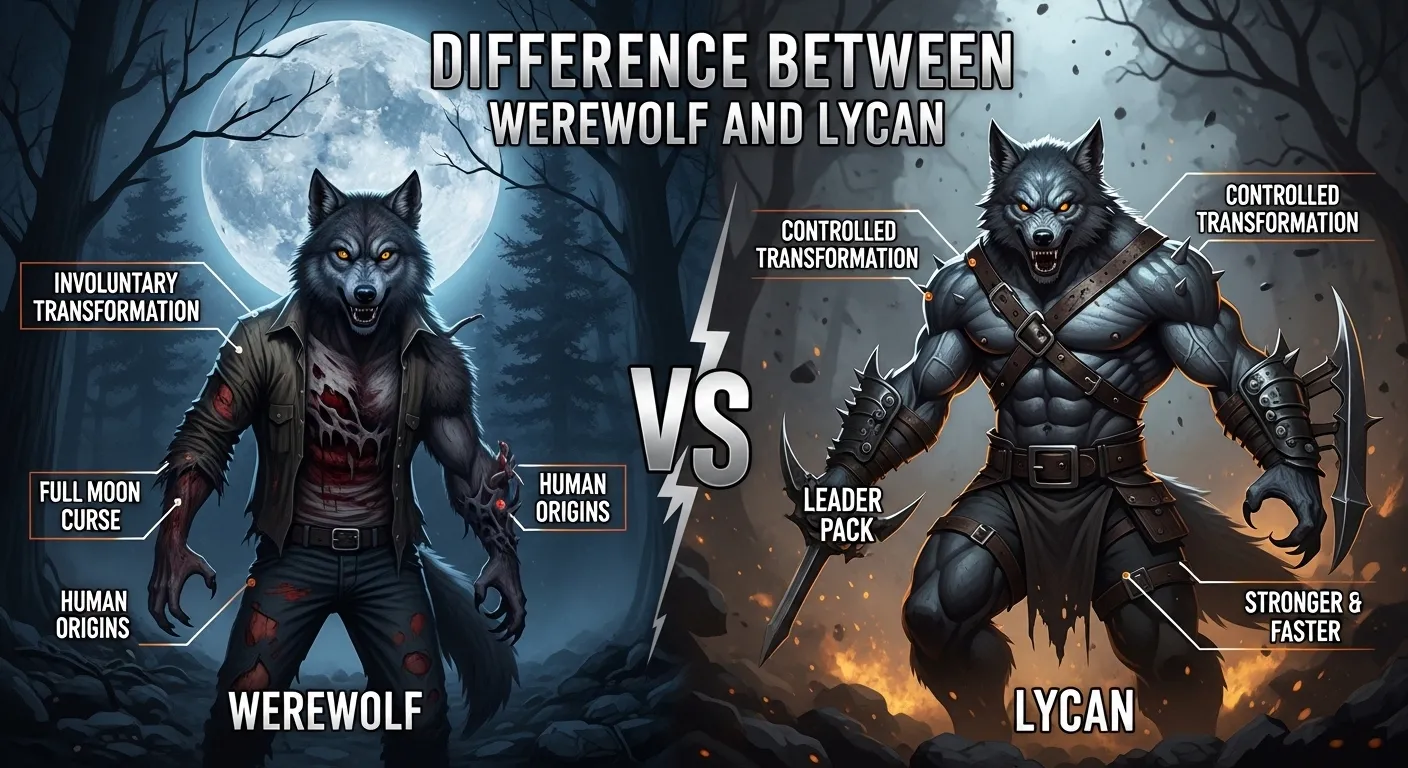
Werewolves often cannot control transformation. Lycans usually have control.
Examples
Werewolf:
- Forced by full moon
- Uncontrolled change
Lycan:
- Voluntary transformation
- Controlled power
4. Appearance
Werewolves look more like wolves. Lycans often appear more humanoid.
Examples
Werewolf:
- Wolf-like body
- Animal features
Lycan:
- Human-wolf hybrid
- Muscular build
5. Behavior
Werewolves are often aggressive. Lycans are more strategic.
Examples
Werewolf:
- Wild instincts
- Dangerous nature
Lycan:
- Intelligent actions
- Organized behavior
6. Cultural Role
Werewolves are part of folklore. Lycans are part of entertainment media.
Examples
Werewolf:
- Legends and myths
- Cultural stories
Lycan:
- Movies and games
- Fictional universes
7. Weakness
Werewolves are weak to silver. Lycans may have different weaknesses.
Examples
Werewolf:
- Silver bullets
- Magical cures
Lycan:
- Varies by story
- Fictional rules
8. Usage of Term
Werewolf is widely recognized. Lycan is genre-specific.
Examples
Werewolf:
- Common term
- Universal use
Lycan:
- Used in fantasy
- Media-specific
9. Story Setting
Werewolves appear in traditional settings. Lycans appear in modern or futuristic settings.
Examples
Werewolf:
- Villages
- Old forests
Lycan:
- Urban settings
- Sci-fi worlds
10. Popularity
Werewolves are classic figures. Lycans are modern favorites.
Examples
Werewolf:
- Timeless legends
- Historical stories
Lycan:
- Trendy concept
- Modern audience appeal
Nature and Behaviour of Both
Werewolves are typically portrayed as cursed beings driven by instinct and transformation cycles. Lycans, on the other hand, are often depicted as powerful, intelligent creatures with control over their abilities and actions.
Why People Are Confused About Their Use?
People often confuse werewolf and lycan because both involve human-to-wolf transformation. Additionally, modern media sometimes uses the terms interchangeably, increasing confusion.
Table Showing Difference and Similarity
| Feature | Werewolf | Lycan | Similarity |
| Origin | Folklore | Modern fiction | Shape-shifting |
| Control | Limited | Controlled | Human-wolf |
| Appearance | Wolf-like | Hybrid | Supernatural |
| Role | Myth | Media | Fantasy |
| Popularity | Classic | Modern | Entertainment |
Which Is Better in What Situation?
Werewolf
Werewolves are better suited for traditional storytelling, horror themes, and folklore-based narratives. They represent fear, mystery, and ancient beliefs.
Lycan
Lycans are better for modern fantasy and action stories. They offer more flexibility in character development, power, and storytelling.
How the Keywords Are Used in Metaphors and Similes
Examples:
- “He changed like a werewolf under pressure.”
- “She fought like a lycan—strong and controlled.”
Connotative Meaning
Werewolf
Connotation: Curse, transformation, danger.
Example:
“His anger turned him into a werewolf-like figure.”
Lycan
Connotation: Power, control, strength.
Example:
“She had a lycan-like presence—strong and fearless.”
Idioms or Proverbs Related to the Words
There are no direct idioms, but werewolves symbolize hidden nature.
Example:
“He showed his inner werewolf when challenged.”
Works in Literature
- Dracula (Gothic fiction, Bram Stoker, 1897)
- The Wolf Man (Horror literature/film inspiration, 1941)
Movie Names Made on the Keywords
- Underworld (2003, USA/UK)
- The Wolfman (2010, USA)
Five Frequently Asked Questions
1. What is the main difference between werewolf and lycan?
Werewolf is a mythological term, while lycan is a modern fictional term.
2. Are they the same?
They are similar but not identical.
3. Which is older?
Werewolf.
4. Which is more powerful?
Depends on the story.
5. Why is lycan popular?
Due to modern movies and games.
How Both Are Useful for Surroundings
Both werewolves and lycans enrich storytelling, entertainment, and cultural imagination.
Final Words for the Both
Werewolves and lycans represent two versions of the same idea, one rooted in tradition and the other shaped by modern creativity.
Conclusion
The difference between werewolf and lycan lies in their origin, portrayal, and usage. Werewolves come from ancient folklore and represent uncontrollable transformation, while lycans are modern fictional beings with enhanced abilities and control. Understanding the difference between werewolf and lycan allows readers and viewers to appreciate both traditional myths and contemporary storytelling. By learning the difference between werewolf and lycan, you gain deeper insight into how legends evolve over time.

I’m Shabbir Hussain, a professional content writer who specializes in clear and authentic comparisons between similar terms. I write concise, research-based, and reader-friendly content that turns complex language into simple explanations. Through Mysynonyms.com, I help readers strengthen their vocabulary and clearly understand word differences.