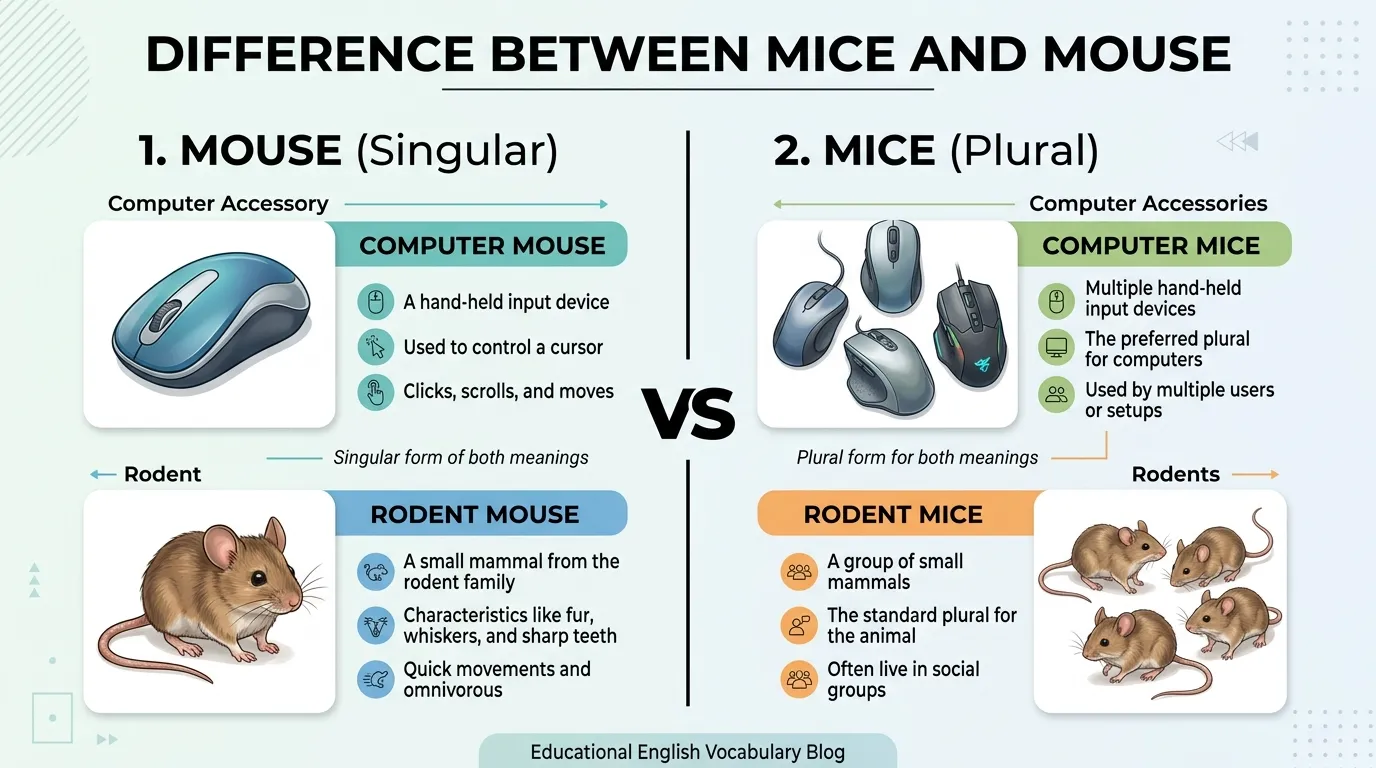
The difference between mice and mouse is simple: “mouse” is the singular form referring to one small rodent or computer device, while “mice” is the plural form referring to more than one.
Understanding the difference between mice and mouse is important for English learners, writers, students, and even computer users. At first glance, these two words may seem confusing because they look very different, even though they refer to the same basic object or animal. Unlike many English nouns that simply add “-s” to become plural, “mouse” changes completely into “mice.” This irregular pattern often creates confusion for learners.
The difference between mice and mouse is mainly grammatical. Mouse is the singular form used for one rodent or one computer pointing device. On the other hand, “mice” is the plural form used when referring to multiple rodents or multiple computer devices. Learning the difference between mice and mouse helps improve grammar, communication, and sentence accuracy.
The difference between mice and mouse also appears in technology. In computing, a computer mouse is an input device used to control a cursor, while multiple devices are called mice. By understanding the difference between mice and mouse, you can avoid common grammar mistakes and communicate more clearly in both everyday English and technical contexts.
Pronunciation
Mouse
US: /maʊs/
Mice
US: /maɪs/
Key Difference Between the Both
The main difference between mice and mouse is that “mouse” refers to one item or animal, while “mice” refers to more than one.
Why Is Their Difference Important?
Knowing the difference between mice and mouse is important because singular and plural forms affect grammar, sentence structure, and meaning. Using the wrong form can make a sentence sound incorrect or confusing.
For students and English learners, understanding the difference between mice and mouse improves writing and speaking skills. For computer users, it helps in technical communication when discussing hardware devices.
Difference Between Mice and Mouse
1. Singular vs Plural
“Mouse” is singular.
“Mice” is plural.
Examples
Mouse:
- One mouse in the room
- One computer mouse
Mice:
- Several mice in the kitchen
- Multiple computer mice
2. Grammar Category
Mouse is a singular noun.
Mice is an irregular plural noun.
Examples
Mouse:
- “The mouse is small.”
Mice:
- “The mice are hiding.”
3. Usage in Sentences
Mouse uses singular verbs.
Mice uses plural verbs.
Examples
Mouse:
- “The mouse runs fast.”
Mice:
- “The mice run fast.”
4. Animal Meaning
Mouse refers to one rodent.
Mice refers to many rodents.
Examples
Mouse:
- One pet mouse
Mice:
- A group of field mice
5. Technology Meaning
Mouse means one computer device.
Mice means multiple computer devices.
Examples
Mouse:
- Wireless mouse
Mice:
- Gaming mice
6. Word Origin
Mouse comes from Old English singular forms.
Mice evolved from ancient Germanic plural forms.
7. Common Mistakes
People sometimes incorrectly say “mouses” instead of “mice.”
Correct Usage
- Correct: “Three mice.”
- Incorrect: “Three mouses.”
8. Formal and Informal Use
Both words are acceptable in formal and informal English, depending on quantity.
9. Role in Idioms
Mouse and mice appear in different expressions.
Examples
- “Quiet as a mouse.”
- “When the cat’s away, the mice will play.”
10. Learning Difficulty
Mouse is easy because it is singular.
Mice can confuse learners because it is irregular.
Nature and Usage of Both Words
The difference between mice and mouse reflects one of the irregular plural patterns in English grammar. Unlike standard nouns such as “book/books” or “car/cars,” the word “mouse” changes internally to become plural.
This type of irregular plural is similar to:
- Man → Men
- Tooth → Teeth
- Goose → Geese
Learning the difference between mice and mouse helps learners recognize these important grammar patterns.
Why People Are Confused?
People are confused about the difference between mice and mouse because English usually forms plurals by adding “-s” or “-es.” Since “mouse” changes completely into “mice,” learners often expect “mouses” instead.
Another reason is that the words are used in both biology and technology, creating additional contexts where learners must apply correct grammar.
Comparison Table
| Feature | Mouse | Mice | Similarity |
| Number | Singular | Plural | Same basic meaning |
| Grammar | Singular noun | Irregular plural noun | English nouns |
| Verb Use | Singular verbs | Plural verbs | Used in sentences |
| Technology | One device | Multiple devices | Computer hardware |
| Animal Meaning | One rodent | Many rodents | Mammals |
Which Is Better in What Situation?
Mouse
Use “mouse” when referring to:
- One animal
- One computer device
- Singular sentence structure
Examples
- “I bought a new mouse.”
- “The mouse is under the table.”
Mice
Use “mice” when referring to:
- Multiple animals
- Multiple computer devices
- Plural sentence structure
Examples
- “The mice are eating cheese.”
- “The office ordered new wireless mice.”
Examples in Everyday English
Here are practical examples showing the difference between mice and mouse clearly:
Animal Context
- “A mouse entered the kitchen.”
- “Several mice were hiding behind the boxes.”
Technology Context
- “My mouse stopped working.”
- “The company tested different gaming mice.”
Idioms and Expressions
The words mouse and mice appear in several common English expressions.
Quiet as a Mouse
Meaning: Very quiet.
Example:
“The child was as quiet as a mouse during the movie.”
When the Cat’s Away, the Mice Will Play
Meaning: People behave freely when authority is absent.
Example:
“The students became noisy when the teacher left—when the cat’s away, the mice will play.”
Literary and Cultural Usage
Mice appear frequently in literature, children’s stories, and cartoons.
Famous examples include:
- Mickey Mouse
- Of Mice and Men
These examples show how commonly the words are used in English culture.
Frequently Asked Questions
1. What is the main difference between mice and mouse?
Mouse is singular, while mice is plural.
2. Is “mouses” correct English?
Usually no. The correct plural is “mice.”
3. Can “mice” refer to computer devices?
Yes.
4. Why is “mice” irregular?
It comes from older forms of English and Germanic languages.
5. Which word should I use for one computer device?
Mouse.
Common Grammar Tips
To remember the difference between mice and mouse, keep these tips in mind:
- One = mouse
- More than one = mice
- Mouse uses singular verbs
- Mice uses plural verbs
Conclusion
The difference between mice and mouse is mainly grammatical and numerical. “Mouse” refers to one rodent or one computer device, while “mice” refers to multiple rodents or devices. Although the words may look confusing because of their irregular spelling change, understanding the difference between mice and mouse becomes easy with practice.
By learning the difference between mice and mouse, English learners can improve grammar, avoid common mistakes, and communicate more confidently in both everyday and technical situations.

I’m Shabbir Hussain, a professional content writer who specializes in clear and authentic comparisons between similar terms. I write concise, research-based, and reader-friendly content that turns complex language into simple explanations. Through Mysynonyms.com, I help readers strengthen their vocabulary and clearly understand word differences.