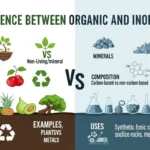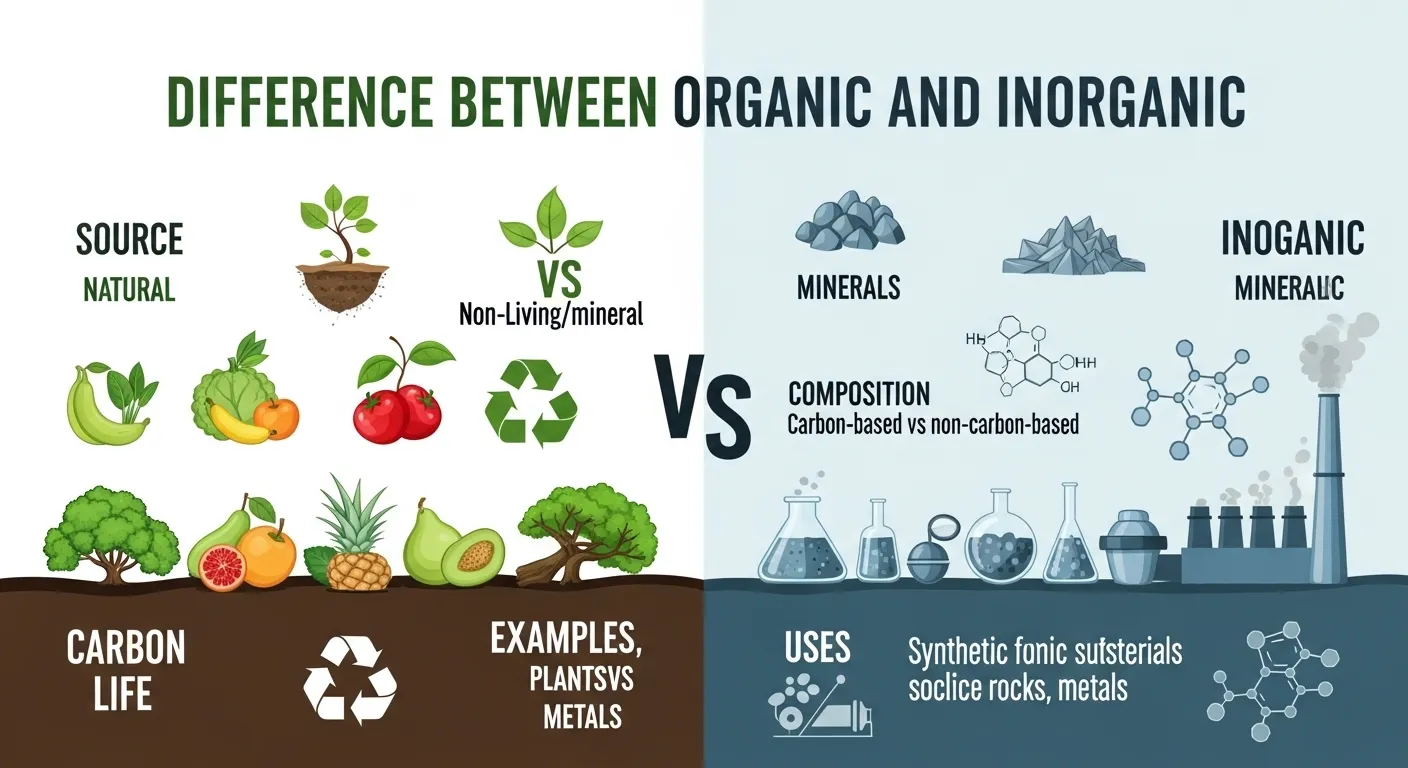
Organic and inorganic substances differ mainly in composition, organic compounds contain carbon (usually with hydrogen), while inorganic compounds generally do not.
Understanding the difference between organic and inorganic is essential in chemistry and everyday life. Imagine cooking food or using cleaning products, some materials come from living organisms, while others come from minerals and non-living sources.
The difference between organic and inorganic lies in their chemical structure and origin. Organic compound are typically carbon-based and found in living organisms, while Inorganic compound are usually derived from non-living materials like minerals. Learning the difference between organic and inorganic helps students, scientists, and consumers understand how substances behave. By understanding the difference between organic and inorganic, you can make better decisions in health, environment, and industry.
Pronunciation
Organic
US: /ɔːrˈɡænɪk/
Inorganic
US: /ˌɪnɔːrˈɡænɪk/
Key Difference Between the Both
The main difference between organic and inorganic is that organic compounds contain carbon-hydrogen bonds, while inorganic compounds generally do not.
Why Is Their Difference Necessary to Know for Learners and Experts?
Knowing the difference between organic and inorganic is important for students, researchers, and professionals. For learners, it builds a foundation in chemistry. For experts, understanding the difference between organic and inorganic helps in research, medicine, agriculture, and industry.
In society, both materials are used in food, medicines, construction, and environmental management. Misunderstanding the difference between organic and inorganic can lead to confusion in scientific and practical applications.
Difference Between Organic and Inorganic
1. Definition
Organic compounds are carbon-based. Inorganic compounds are not primarily carbon-based.
Examples
Organic:
- Sugar
- Proteins
Inorganic:
- Salt
- Water
2. Presence of Carbon
Organic compounds contain carbon. Inorganic compounds usually lack carbon.
Examples
Organic:
- Methane
- Ethanol
Inorganic:
- Sodium chloride
- Carbon dioxide
3. Origin
Organic compounds come from living organisms. Inorganic compounds come from non-living sources.
Examples
Organic:
- Plants
- Animals
Inorganic:
- Minerals
- Rocks
4. Bonding
Organic compounds have covalent bonds. Inorganic compounds may have ionic or covalent bonds.
Examples
Organic:
- Strong carbon bonds
- Complex chains
Inorganic:
- Ionic bonds
- Simple structures
5. Complexity
Organic compounds are complex. Inorganic compounds are simpler.
Examples
Organic:
- Large molecules
- Complex structures
Inorganic:
- Simple compounds
- Basic structures
6. Solubility
Organic compounds are less soluble in water. Inorganic compounds are often water-soluble.
Examples
Organic:
- Oils do not mix with water
- Fats are insoluble
Inorganic:
- Salt dissolves in water
- Acids dissolve easily
7. Melting and Boiling Points
Organic compounds have lower melting points. Inorganic compounds have higher melting points.
Examples
Organic:
- Wax melts easily
- Low boiling liquids
Inorganic:
- Metals have high melting points
- Strong solids
8. Flammability
Organic compounds are usually flammable. Inorganic compounds are mostly non-flammable.
Examples
Organic:
- Alcohol burns
- Fuel ignites
Inorganic:
- Salt does not burn
- Water extinguishes fire
9. Reaction Speed
Organic reactions are slower. Inorganic reactions are faster.
Examples
Organic:
- Complex reactions
- Multi-step processes
Inorganic:
- Quick reactions
- Simple processes
10. Applications
Organic compounds are used in food and medicine. Inorganic compounds are used in construction and industry.
Examples
Organic:
- Medicines
- Plastics
Inorganic:
- Cement
- Metals
Nature and Behaviour of Both
Organic compounds are complex, carbon-based, and often associated with living systems. Inorganic compounds are simpler, mineral-based, and widely used in industrial processes.
Why People Are Confused About Their Use?
People often confuse organic and inorganic because some inorganic compounds contain carbon (like carbon dioxide). However, the key difference is the presence of carbon-hydrogen bonds.
Table Showing Difference and Similarity
| Feature | Organic | Inorganic | Similarity |
| Carbon | Present | Usually absent | Chemical compounds |
| Origin | Living | Non-living | Used in life |
| Bonding | Covalent | Ionic/Covalent | React chemically |
| Complexity | High | Low | Matter forms |
| Use | Food, medicine | Industry | Essential |
Which Is Better in What Situation?
Organic
Organic compounds are better for biological processes, medicines, and food-related applications.
Inorganic
Inorganic compounds are better for construction, manufacturing, and industrial processes.
How the Keywords Are Used in Metaphors and Similes
Examples:
- “Their friendship felt organic—natural and growing.”
- “The system seemed inorganic—rigid and mechanical.”
Connotative Meaning
Organic
Connotation: Natural, healthy.
Example:
“It was an organic process—pure and natural.”
Inorganic
Connotation: Artificial, rigid.
Example:
“The structure felt inorganic—unnatural and stiff.”
Idioms or Proverbs Related to the Words
Back to nature
Example:
“Organic living brings you back to nature.”
Works in Literature
Organic and inorganic concepts are widely discussed in chemistry textbooks and scientific research papers.
Movie Names Made on the Keywords
There are no major movies directly based on organic and inorganic concepts.
Five Frequently Asked Questions
1. What is the main difference between organic and inorganic?
Organic compounds contain carbon-hydrogen bonds, while inorganic compounds do not.
2. Is carbon dioxide organic?
No, it is inorganic.
3. Are all organic compounds from living things?
Not always, but they are carbon-based.
4. Which is more complex?
Organic compounds.
5. Why is this difference important?
It helps understand chemistry and real-world applications.
How Both Are Useful for Surroundings
Both organic and inorganic compounds are essential for life and industry, supporting everything from food to infrastructure.
Final Words for the Both
Both compounds are fundamental categories in chemistry, each with unique properties and uses. The difference between organic and inorganic lies in their composition and origin. Understanding this distinction is essential in fields like chemistry, biology, and environmental science. By recognising their unique properties and uses, you can better grasp how both materials play vital roles in everyday life and scientific applications.
Conclusion
The difference between organic and inorganic lies in their composition, structure, and applications. Organic compounds are carbon-based and associated with living systems, while inorganic compounds are typically mineral-based and used in industrial processes. Understanding the difference between organic and inorganic helps in science, daily life, and decision making. By learning the difference between organic and inorganic, individuals gain a deeper understanding of the world around them.

I’m Shabbir Hussain, a professional content writer who specializes in clear and authentic comparisons between similar terms. I write concise, research-based, and reader-friendly content that turns complex language into simple explanations. Through Mysynonyms.com, I help readers strengthen their vocabulary and clearly understand word differences.