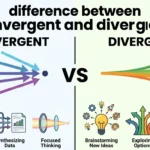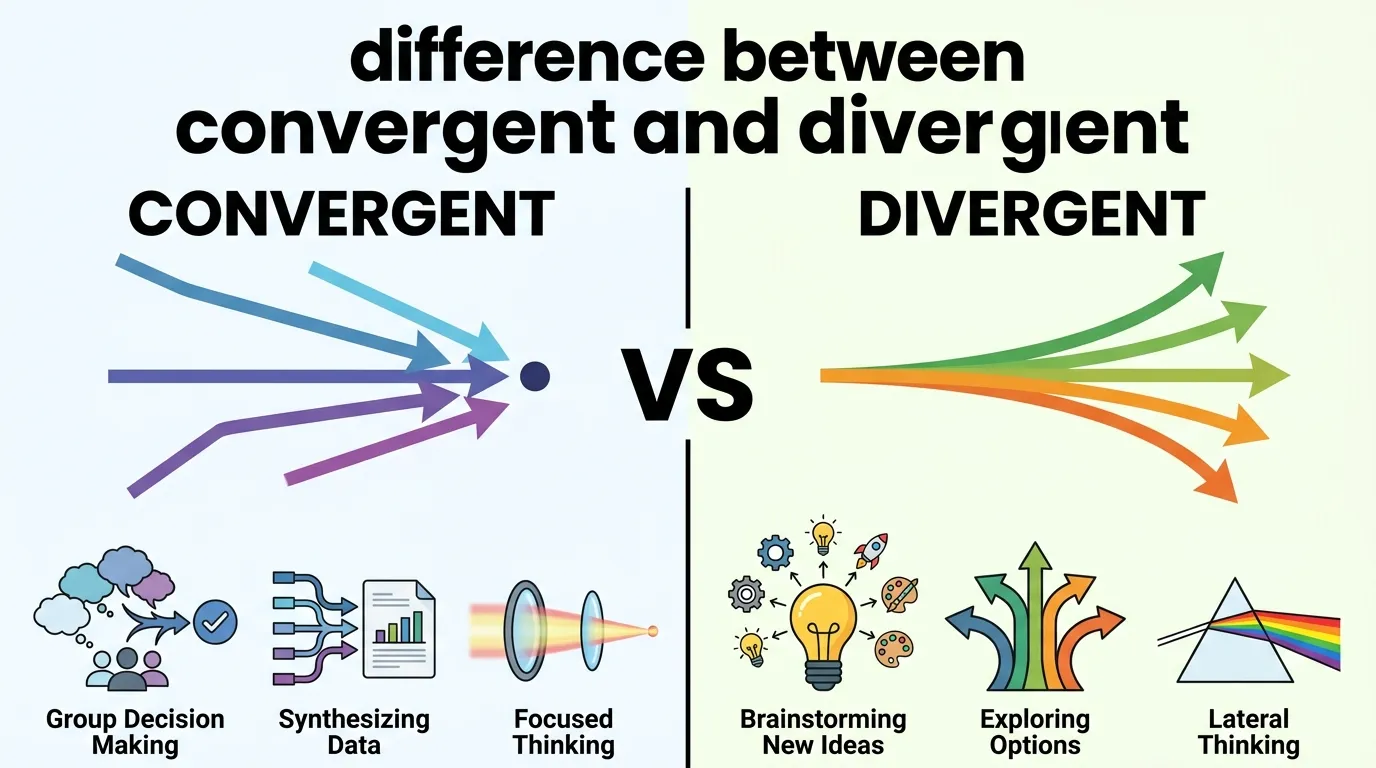
The difference between convergent and divergent lies in direction, movement, and thinking style, convergent means coming together toward a common point or solution, while divergent means moving apart in different directions or generating multiple possibilities.
Understanding the difference between convergent and divergent is important in subjects like science, mathematics, psychology, creativity, and communication. Imagine two roads: one where several paths merge into a single destination, and another where one road splits into many different directions. These two opposite movements perfectly explain the difference between convergent and divergent.
The terms are widely used in multiple fields. In thinking and problem-solving, Convergent thinking refers to narrowing ideas down to one correct answer. Meanwhile, Divergent thinking refers to generating multiple ideas or solutions. In science, convergent and divergent can describe movement of tectonic plates, evolution, lenses, or even mathematical sequences.
Learning the difference between convergent and divergent helps students, professionals, and learners understand how opposite processes work in different contexts. By understanding the difference between convergent and divergent, you can improve analytical thinking, creativity, and subject comprehension.
Pronunciation
Convergent
US: /kənˈvɝː.dʒənt/
Divergent
US: /daɪˈvɝː.dʒənt/
Key Difference Between the Both
The main difference between convergent and divergent is that convergent refers to things coming together toward one point or answer, while divergent refers to things spreading apart into multiple directions or possibilities.
Why Is Their Difference Important?
Knowing the difference between convergent and divergent is important because these concepts appear in many academic and practical fields.
In education, understanding the difference between convergent and divergent helps students develop both logical and creative thinking skills. While in science and geography, these terms explain natural processes. In business and innovation, they help teams brainstorm and solve problems effectively.
Without understanding the difference between convergent and divergent, it becomes difficult to interpret many scientific and psychological concepts correctly.
Difference Between Convergent and Divergent
1. Meaning
Convergent means moving toward a common point.
Divergent means moving away from a common point.
Examples
Convergent:
- Roads meeting together
- One correct answer
Divergent:
- Roads splitting apart
- Multiple possibilities
2. Thinking Style
Convergent thinking focuses on logic and accuracy.
Divergent thinking focuses on creativity and imagination.
Examples
Convergent:
- Solving math problems
- Selecting the best answer
Divergent:
- Brainstorming ideas
- Creative writing
3. Number of Solutions
Convergent approaches usually aim for one solution.
Divergent approaches explore many solutions.
4. Direction
Convergent movement goes inward or together.
Divergent movement goes outward or apart.
5. Use in Problem-Solving
Convergent methods analyze and narrow options.
Divergent methods expand ideas and possibilities.
Examples
Convergent:
- Final decision-making
Divergent:
- Idea generation sessions
6. Scientific Usage
In geology, convergent plates collide.
Divergent plates separate.
Examples
Convergent:
- Mountain formation
Divergent:
- Mid-ocean ridges
7. Creativity Level
Convergent thinking is structured and controlled.
Divergent thinking is open-ended and imaginative.
8. Speed of Process
Convergent approaches may be faster because they focus on one answer.
Divergent approaches may take longer because they explore many options.
9. Educational Importance
Convergent learning tests accuracy and memorization.
Divergent learning encourages innovation and exploration.
10. Communication Style
Convergent discussions seek agreement.
Divergent discussions encourage multiple viewpoints.
Nature and Characteristics of Both
The difference between convergent and divergent reflects two opposite but complementary approaches.
Convergent methods emphasize focus, structure, and precision. They are useful when there is a clear objective or correct answer.
Divergent methods emphasize exploration, flexibility, and creativity. They are useful when innovation and originality are required.
Both approaches are important and often work together in real-life situations.
Why People Are Confused?
People often confuse the difference between convergent and divergent because both are used in similar subjects and sometimes within the same process.
For example, during problem-solving:
- Divergent thinking may first generate many ideas.
- Convergent thinking may then select the best solution.
Because they work together, learners sometimes misunderstand their opposite meanings.
Comparison Table
| Feature | Convergent | Divergent | Similarity |
| Direction | Toward one point | Away from one point | Thinking processes |
| Solutions | One | Many | Used in problem-solving |
| Style | Logical | Creative | Improve understanding |
| Focus | Narrow | Broad | Educational importance |
| Nature | Structured | Flexible | Used in science and psychology |
Convergent Thinking in Real Life
Convergent thinking is useful in situations requiring:
- Accuracy
- Logic
- Final decisions
Examples
- Solving equations
- Medical diagnosis
- Multiple-choice exams
- Technical troubleshooting
In these cases, one correct answer is usually expected.
Divergent Thinking in Real Life
Divergent thinking is useful in situations requiring:
- Creativity
- Innovation
- Exploration
Examples
- Brainstorming business ideas
- Writing stories
- Designing products
- Artistic expression
In these cases, many different ideas are encouraged.
Scientific Examples
Geology
Convergent Boundaries
Tectonic plates move toward each other.
Effects:
- Earthquakes
- Volcanoes
- Mountain ranges
Divergent Boundaries
Tectonic plates move apart.
Effects:
- New crust formation
- Ocean ridges
Biology
Convergent Evolution
Different species develop similar traits independently.
Example:
- Wings of birds and bats
Divergent Evolution
Related species evolve different traits over time.
Example:
- Darwin’s finches
Advantages and Disadvantages
Advantages of Convergent Approaches
- Efficient decision-making
- Clear solutions
- Logical structure
Disadvantages
- Limits creativity
- May ignore alternative ideas
Advantages of Divergent Approaches
- Encourages innovation
- Generates many possibilities
- Supports creativity
Disadvantages
- Can become unfocused
- May take more time
Educational Importance
The difference between convergent and divergent is especially important in education.
Traditional exams often emphasize convergent thinking by requiring one correct answer. Creative assignments encourage divergent thinking by allowing multiple interpretations and ideas.
Balanced learning requires both approaches:
- Divergent thinking for creativity
- Convergent thinking for evaluation
Frequently Asked Questions
1. What is the main difference between convergent and divergent?
Convergent means coming together toward one solution, while divergent means spreading into multiple possibilities.
2. Which thinking style is more creative?
Divergent thinking.
3. Which thinking style is more logical?
Convergent thinking.
4. Can both be used together?
Yes, they often work together in problem-solving.
5. Are these terms only used in psychology?
No, they are also used in science, geology, biology, and communication.
Real-Life Importance
Understanding the difference between convergent and divergent improves:
- Decision-making
- Creativity
- Teamwork
- Learning strategies
Businesses use divergent thinking to create ideas and convergent thinking to choose the best solutions.
Conclusion
The difference between convergent and divergent lies in direction, thinking style, and problem-solving approach. Convergent methods focus on narrowing ideas toward one correct answer, while divergent methods expand ideas into multiple possibilities.
Understanding the difference between convergent and divergent helps students, professionals, and learners balance creativity with logic. By learning the difference between convergent and divergent, you can improve innovation, communication, and analytical thinking across many areas of life.

I’m Shabbir Hussain, a professional content writer who specializes in clear and authentic comparisons between similar terms. I write concise, research-based, and reader-friendly content that turns complex language into simple explanations. Through Mysynonyms.com, I help readers strengthen their vocabulary and clearly understand word differences.