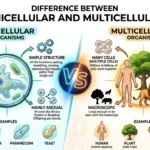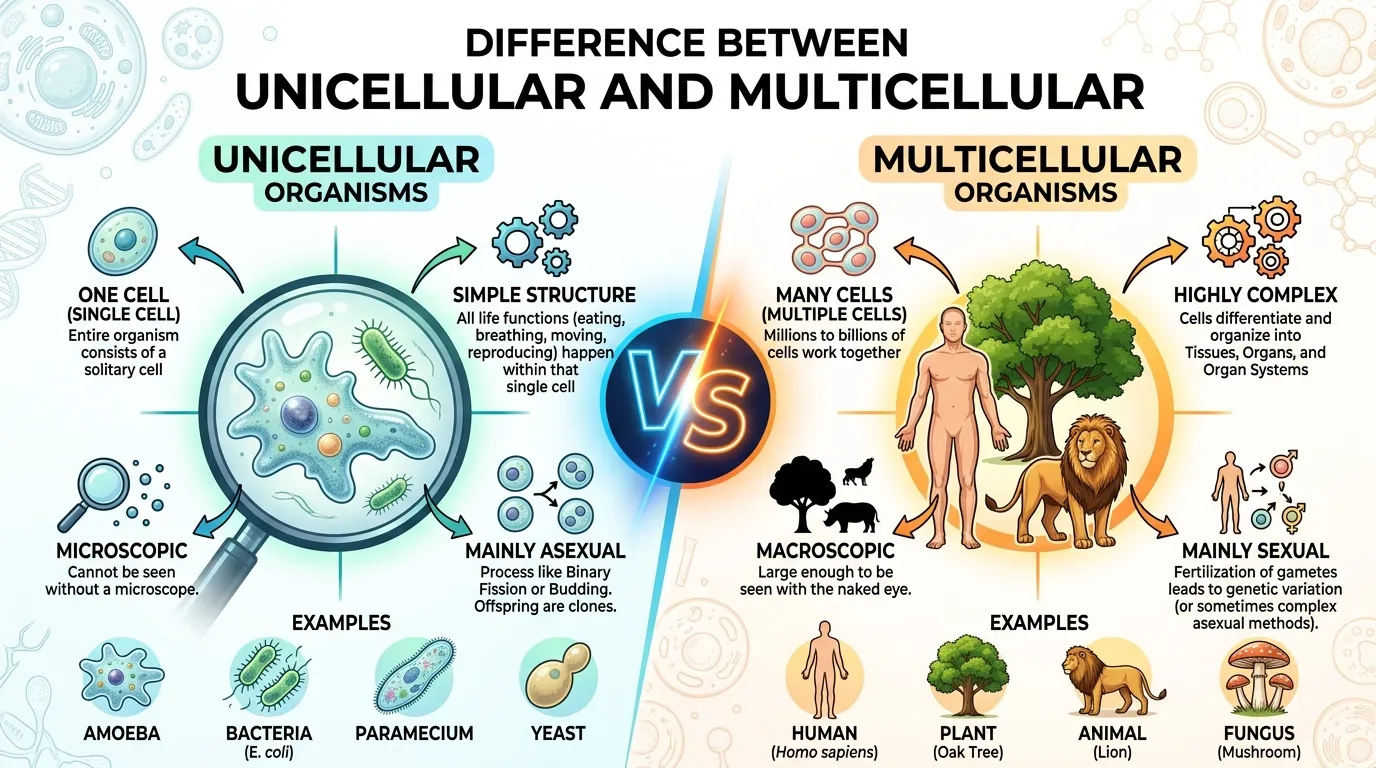
The difference between unicellular and multicellular organisms is that unicellular organisms are made of a single cell that performs all life processes, while multicellular organisms are made of many specialised cells working together.
Understanding the difference between unicellular and multicellular organisms is one of the most important concepts in biology. Imagine looking through a microscope and discovering that an entire living organism can survive as just one tiny cell. Now compare that with complex organisms like humans, trees, or animals that contain billions of cells working together. This remarkable contrast highlights the difference between unicellular and multicellular life forms.
The difference between unicellular and multicellular organisms lies mainly in cellular organization, complexity, and division of labor. Unicellular organism refers to organisms made up of only one cell, such as bacteria and amoebas. That single cell performs every essential function needed for survival, including digestion, movement, and reproduction. In contrast, Multicellular organism refers to organisms composed of many cells that specialize in different tasks.
Learning the difference between unicellular and multicellular organisms helps students understand evolution, biological organization, and how life exists in different forms. By understanding the difference between unicellular and multicellular, we gain insight into the diversity and complexity of living things on Earth.
Pronunciation
Unicellular
US: /ˌjuː.nɪˈsel.jə.lɚ/
Multicellular
US: /ˌmʌl.tiˈsel.jə.lɚ/
Key Difference Between the Both
The main difference between unicellular and multicellular organisms is that unicellular organisms consist of one cell performing all functions, while multicellular organisms consist of many specialized cells working together.
Why Is Their Difference Important?
Knowing the difference between unicellular and multicellular organisms is important because it explains how living things are organized and how biological complexity evolved over time.
For biology students, understanding the difference between unicellular and multicellular organisms helps clarify concepts such as cell specialization, tissues, organs, and systems. For scientists, this distinction is essential in microbiology, medicine, and genetics.
Without understanding the difference between unicellular and multicellular, it becomes difficult to study life sciences properly.
Difference Between Unicellular and Multicellular
1. Number of Cells
Unicellular organisms contain only one cell.
Multicellular organisms contain many cells.
Examples
Unicellular:
- Bacteria
- Amoeba
Multicellular:
- Humans
- Trees
2. Complexity
Unicellular organisms are generally simple.
Multicellular organisms are more complex.
Examples
Unicellular:
- Simple structure
- Limited organization
Multicellular:
- Complex systems
- Organized tissues
3. Cell Specialization
In unicellular organisms, one cell performs all functions.
In multicellular organisms, cells specialize for different tasks.
Examples
Unicellular:
- One cell handles digestion and movement
Multicellular:
- Nerve cells
- Muscle cells
4. Size
Unicellular organisms are usually microscopic.
Multicellular organisms are often larger and visible.
Examples
Unicellular:
- Microscopic algae
Multicellular:
- Animals
- Plants
5. Reproduction
Unicellular organisms usually reproduce asexually.
Multicellular organisms may reproduce sexually or asexually.
Examples
Unicellular:
- Binary fission
Multicellular:
- Human reproduction
- Plant reproduction
6. Lifespan
Unicellular organisms often have shorter lifespans.
Multicellular organisms generally live longer.
Examples
Unicellular:
- Rapid life cycle
Multicellular:
- Long developmental stages
7. Dependency of Cells
A unicellular organism survives independently.
Cells in multicellular organisms depend on each other.
Examples
Unicellular:
- Independent living
Multicellular:
- Organ systems cooperate
8. Growth
Unicellular organisms grow by increasing cell size.
Multicellular organisms grow by increasing cell number.
Examples
Unicellular:
- Cell enlargement
Multicellular:
- Cell division
9. Damage and Repair
Damage to a unicellular organism can kill it immediately.
Multicellular organisms can often repair damaged tissues.
Examples
Unicellular:
- Entire organism affected
Multicellular:
- Healing processes
10. Organization Level
Unicellular organisms lack tissues and organs.
Multicellular organisms have tissues, organs, and organ systems.
Examples
Unicellular:
- No organ systems
Multicellular:
- Heart
- Brain
- Leaves
Nature and Characteristics of Both
The difference between unicellular and multicellular organisms reflects different survival strategies in nature.
Unicellular organisms focus on simplicity and rapid reproduction. Because they are small and simple, they can adapt quickly to changing environments.
Multicellular organisms focus on specialization and efficiency. Different cells perform different tasks, making these organisms more advanced and capable of greater complexity.
Why People Are Confused?
People often become confused about the difference between unicellular and multicellular organisms because both are made of cells and perform the same basic life functions such as respiration, growth, and reproduction.
Another reason for confusion is that some multicellular organisms are microscopic, while some unicellular organisms form colonies that appear multicellular.
Comparison Table
| Feature | Unicellular | Multicellular | Similarity |
| Number of Cells | One | Many | Living organisms |
| Complexity | Simple | Complex | Perform life processes |
| Cell Specialization | Absent | Present | Made of cells |
| Size | Usually microscopic | Usually larger | Require energy |
| Reproduction | Mostly asexual | Sexual/asexual | Can reproduce |
Examples of Unicellular Organisms
Some common unicellular organisms include:
- Amoeba
- Paramecium
- Escherichia coli
- Yeast
These organisms perform all life functions within a single cell.
Examples of Multicellular Organisms
Some common multicellular organisms include:
- Humans
- Dogs
- Trees
- Fish
- Birds
These organisms contain specialized cells organized into tissues and organs.
Advantages and Disadvantages
Advantages of Unicellular Organisms
- Fast reproduction
- Require fewer resources
- Adapt quickly
Disadvantages
- Limited size
- Less specialization
- Vulnerable to damage
Advantages of Multicellular Organisms
- Greater complexity
- Specialized functions
- Better survival systems
Disadvantages
- Require more energy
- Slower reproduction
- Complex maintenance
Evolutionary Importance
The difference between unicellular and multicellular organisms is central to evolution. Scientists believe life first appeared as unicellular organisms billions of years ago. Over time, some cells evolved to cooperate, leading to multicellular life.
This transition allowed the development of larger organisms, specialized organs, and advanced biological systems.
Frequently Asked Questions
1. What is the main difference between unicellular and multicellular organisms?
Unicellular organisms consist of one cell, while multicellular organisms consist of many cells.
2. Are humans unicellular or multicellular?
Humans are multicellular organisms.
3. Which type is more complex?
Multicellular organisms are more complex.
4. Can unicellular organisms survive independently?
Yes, a single cell performs all necessary functions.
5. Which appeared first on Earth?
Unicellular organisms appeared first.
Real-Life Importance
Understanding the difference between unicellular and multicellular organisms helps in medicine, environmental science, and biotechnology.
For example:
- Bacteria are unicellular and important in disease research.
- Human biology depends on understanding multicellular systems.
Conclusion
The difference between unicellular and multicellular organisms lies in the number of cells, complexity, organization, and specialization. Unicellular organisms rely on a single cell to carry out all life functions, while multicellular organisms use many specialized cells working together efficiently.
Understanding the difference between unicellular and multicellular helps explain how life evolved from simple forms to highly advanced organisms. By learning the difference between unicellular and multicellular, students and readers gain a deeper understanding of biology, evolution, and the incredible diversity of life on Earth.

I’m Shabbir Hussain, a professional content writer who specializes in clear and authentic comparisons between similar terms. I write concise, research-based, and reader-friendly content that turns complex language into simple explanations. Through Mysynonyms.com, I help readers strengthen their vocabulary and clearly understand word differences.