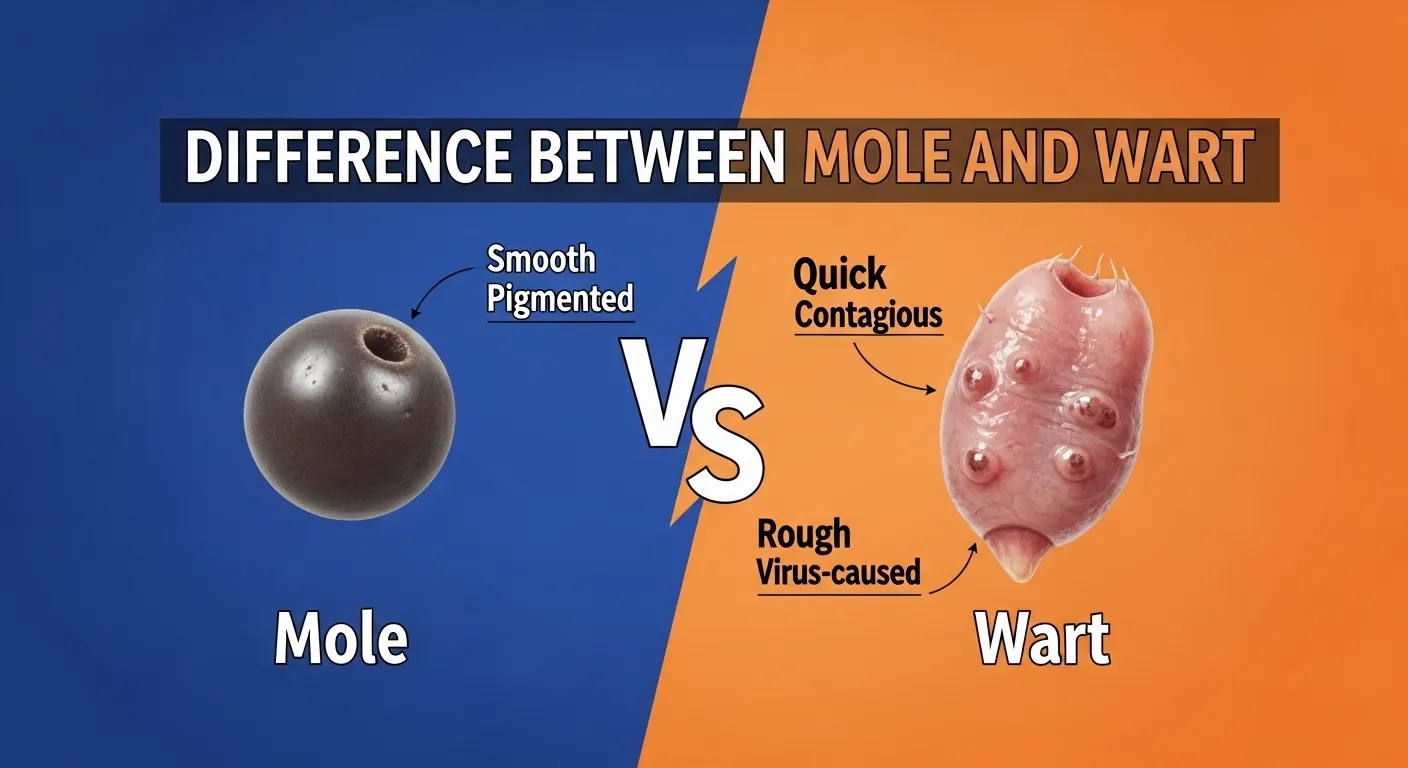
Moles and warts are both skin growths, but moles are usually harmless pigment clusters, while warts are caused by a viral infection and can spread.
Understanding the difference between mole and wart is essential for anyone who wants to take proper care of their skin. Imagine you notice a small spot on your arm—maybe it has been there for years, or maybe it suddenly appeared and feels rough to touch. These differences matter because not all skin growths behave the same way.
The difference between mole and wart lies mainly in their cause, appearance, and health implications. Mole (skin lesion) is a natural cluster of pigment cells that usually develops over time and remains stable. On the other hand, Wart is caused by the Human papillomavirus and can spread through contact.
Learning the difference between mole and wart helps you identify harmless spots and recognize when medical attention is needed. By understanding the difference between mole and wart, you can protect your skin and overall health more effectively.
Pronunciation
Mole
US: /moʊl/
Wart
US: /wɔːrt/
Key Difference Between the Both
The main difference between mole and wart is that a mole is a non-infectious skin growth made of pigment cells, while a wart is an infectious growth caused by a virus.
Why Is Their Difference Necessary to Know for Learners and Experts?
Knowing the difference between mole and wart is important for both everyday people and medical professionals. For learners, it builds awareness about skin health and early detection of potential problems. For experts, understanding the difference between mole and wart helps in accurate diagnosis and treatment planning.
In society, many people ignore skin changes or confuse harmless moles with contagious warts. This confusion can lead to unnecessary worry or delayed treatment. By clearly understanding the difference between mole and wart, individuals can take timely action, avoid spreading infections, and maintain better hygiene and health.
Difference Between Mole and Wart
1. Definition
A mole is a pigmented skin growth formed by melanocytes. A wart is a rough skin growth caused by a viral infection.
Examples
Mole:
- Brown or black spot on skin
- Present since childhood
Wart:
- Raised rough bump
- Appears suddenly
2. Cause
Moles are caused by clusters of pigment cells. Warts are caused by a viral infection.
Examples
Mole:
- Genetic factors
- Sun exposure
Wart:
- HPV infection
- Skin contact
3. Appearance
Moles are smooth and even-colored. Warts are rough and uneven.
Examples
Mole:
- Flat or slightly raised
- Uniform color
Wart:
- Grainy texture
- Irregular surface
4. Texture
Moles feel smooth or soft. Warts feel rough and hard.
Examples
Mole:
- Soft touch
- Smooth surface
Wart:
- Hard surface
- Rough feel
5. Color
Moles are usually brown, black, or skin-colored. Warts are often skin-colored or grayish.
Examples
Mole:
- Dark brown
- Black
Wart:
- Pale
- Gray
6. Growth Pattern
Moles grow slowly or remain unchanged. Warts can grow quickly.
Examples
Mole:
- Stable size
- Long-term presence
Wart:
- Rapid growth
- Spreading
7. Contagious Nature
Moles are not contagious. Warts are contagious.
Examples
Mole:
- Cannot spread
- Safe to touch
Wart:
- Spreads by contact
- Infectious
8. Pain and Sensation
Moles are usually painless. Warts may cause discomfort.
Examples
Mole:
- No pain
- No irritation
Wart:
- Pain when pressed
- Irritation
9. Medical Concern
Moles are mostly harmless but should be monitored. Warts are usually harmless but need treatment if spreading.
Examples
Mole:
- Rarely cancerous
- Needs observation
Wart:
- Treatable infection
- May need removal
10. Treatment
Moles usually do not require treatment unless suspicious. Warts often need treatment.
Examples
Mole:
- Monitoring
- Surgical removal if needed
Wart:
- Topical medication
- Freezing or removal
Nature and Behaviour of Both
Moles are stable, non-infectious, and often permanent skin features. Warts are temporary, contagious, and caused by viral activity, meaning they may appear and disappear over time.
Why People Are Confused About Their Use?
People often confuse moles and warts because both appear as small skin growths. However, their texture, cause, and behavior are quite different. Lack of awareness leads to this confusion.
Table Showing Difference and Similarity
| Feature | Mole | Wart | Similarity |
| Cause | Pigment cells | Virus | Skin growth |
| Texture | Smooth | Rough | Visible on skin |
| Contagious | No | Yes | Usually harmless |
| Growth | Slow | Fast | May need care |
| Treatment | Rarely needed | Often needed | Medical advice helpful |
Which Is Better in What Situation?
Mole
Moles are generally harmless and do not require treatment unless they change in size, shape, or color. They are normal skin features and often remain stable throughout life. Regular monitoring is enough in most cases.
Wart
Warts require attention because they are contagious and may spread to other parts of the body or to other people. Treatment is often recommended, especially if they cause discomfort or cosmetic concerns.
How the Keywords Are Used in Metaphors and Similes
Examples:
- “The secret was like a mole—hidden but always present.”
- “The problem kept coming back like a wart.”
Connotative Meaning
Mole
Connotation: Hidden mark or spy.
Example:
“He acted as a mole inside the organization.”
Wart
Connotation: Flaw or imperfection.
Example:
“The report showed every wart of the system.”
Idioms or Proverbs Related to the Words
Warts and all
Example:
“She accepted the truth, warts and all.”
Works in Literature
While moles and warts are not central themes, they appear in descriptions and symbolism:
- The Adventures of Sherlock Holmes (Detective fiction, Arthur Conan Doyle, 1892)
- Harry Potter Series (Fantasy, J. K. Rowling, 1997)
Movie Names Made on the Keywords
There are no major movies specifically based on moles or warts, but they appear in character design and storytelling:
- Harry Potter and the Philosopher’s Stone (2001, UK/USA)
- The Witches (1990, UK)
Five Frequently Asked Questions
1. What is the main difference between mole and wart?
A mole is a pigment-based skin growth, while a wart is caused by a virus.
2. Are warts dangerous?
They are usually harmless but contagious.
3. Can moles turn cancerous?
Some can, so monitoring is important.
4. Can warts go away on their own?
Yes, but treatment may speed up removal.
5. Should I see a doctor?
Yes, if there are changes or concerns.
How Both Are Useful for Surroundings
Moles help in understanding skin health and monitoring for serious conditions. Warts highlight the importance of hygiene and infection control in communities.
Final Words for the Both
Moles and warts are common skin conditions, but they differ greatly in cause, appearance, and treatment. Awareness is key to proper care.
Conclusion
The difference between mole and wart lies in their origin, nature, and behavior. Moles are harmless pigment clusters that usually remain stable, while warts are viral infections that can spread and may require treatment.
Understanding the difference between mole and wart helps individuals identify skin changes accurately and seek medical advice when necessary. By learning the difference between mole and wart, you can maintain better skin health, prevent infections, and respond to potential concerns with confidence.

I’m Shabbir Hussain, a professional content writer who specializes in clear and authentic comparisons between similar terms. I write concise, research-based, and reader-friendly content that turns complex language into simple explanations. Through Mysynonyms.com, I help readers strengthen their vocabulary and clearly understand word differences.