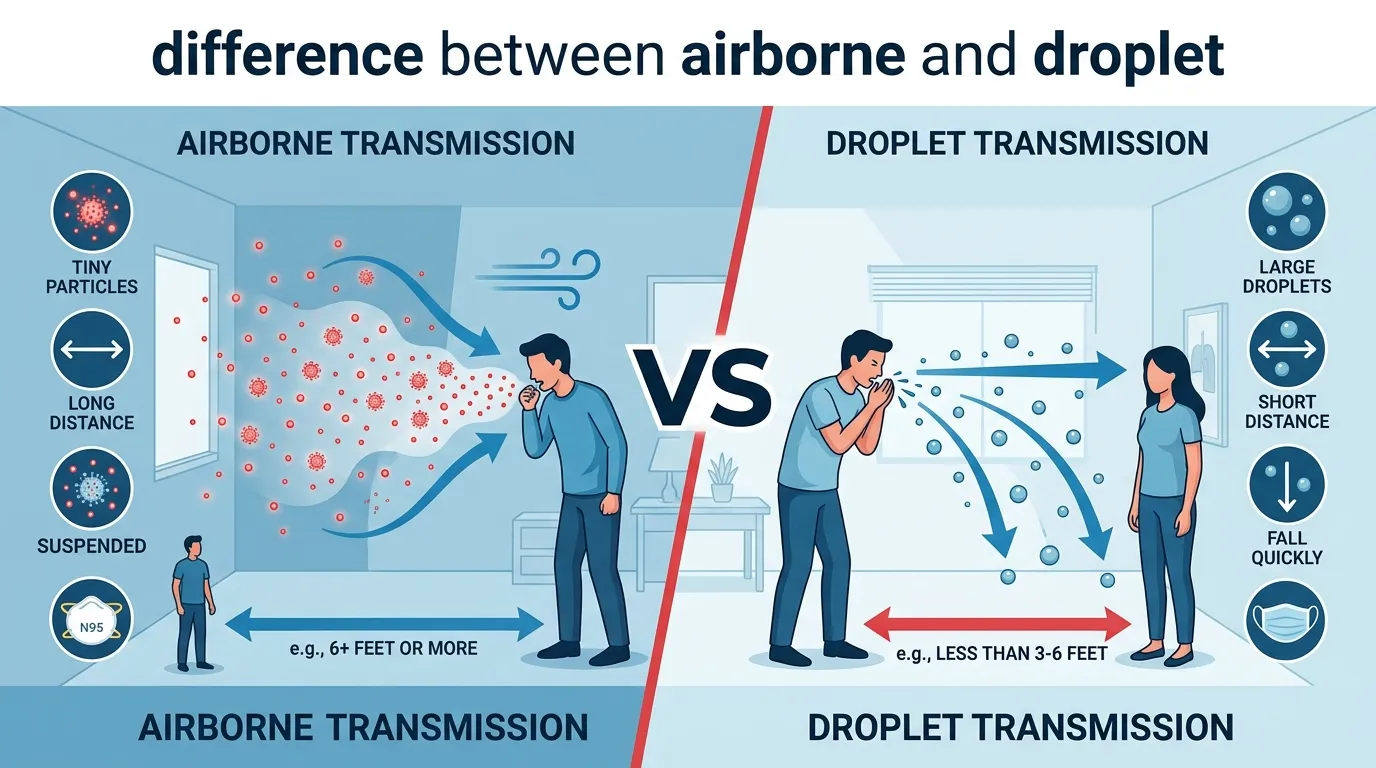
The difference between airborne and droplet transmission is that airborne particles can remain suspended in the air for long periods and travel farther distances, while droplet particles are larger, heavier, and usually fall to the ground quickly after being expelled.
Understanding the difference between airborne and droplet transmission is extremely important in public health, medicine, infection control, and personal safety. These two terms became especially familiar during outbreaks of infectious diseases, yet many people still confuse them. Although both involve the spread of germs through the air, the difference between airborne and droplet transmission mainly depends on particle size, travel distance, and how long infectious particles remain in the environment.
Airborne transmission occurs when very small particles or aerosols remain suspended in the air for extended periods. These particles can travel across rooms and infect people who inhale them later. In contrast, Droplet transmission involves larger respiratory droplets that usually travel short distances before falling onto surfaces or the ground.
Learning the difference between airborne and droplet transmission helps people understand disease prevention, protective equipment, ventilation importance, and infection control practices. By understanding the difference between airborne and droplet, individuals can make safer health decisions and better protect themselves and others.
Pronunciation
Airborne
US: /ˈer.bɔːrn/
Droplet
US: /ˈdrɑː.plət/
Key Difference Between the Both
The main difference between airborne and droplet transmission is that airborne particles stay suspended in the air for longer periods and travel farther, while droplet particles are larger and fall quickly after release.
Why Is Their Difference Important?
Knowing the difference between airborne and droplet transmission is important because prevention methods differ significantly.
Airborne transmission may require:
- Specialized ventilation
- High-filtration masks
- Air purification systems
Droplet transmission may mainly require:
- Physical distancing
- Surgical masks
- Surface hygiene
Understanding the difference between airborne and droplet helps healthcare workers, schools, businesses, and the public apply the correct safety measures.
Difference Between Airborne and Droplet
1. Particle Size
Airborne particles are extremely small.
Droplet particles are larger and heavier.
Examples
Airborne:
- Aerosols
- Microscopic suspended particles
Droplet:
- Sneezing droplets
- Coughing droplets
2. Time in Air
Airborne particles can stay in the air for long periods.
Droplets usually settle quickly.
3. Travel Distance
Airborne particles may travel across rooms or ventilation systems.
Droplets generally travel short distances.
Examples
Airborne:
- Lingering indoor aerosols
Droplet:
- Direct cough exposure nearby
4. Transmission Method
Airborne diseases spread mainly through inhalation of suspended particles.
Droplet diseases spread through close-contact respiratory droplets.
5. Ventilation Importance
Ventilation is especially critical for airborne transmission control and is less central for droplet transmission.
6. Protective Equipment
Airborne precautions often require respirators like N95 masks.
Droplet precautions may use surgical masks.
7. Environmental Persistence
Airborne particles may remain infectious for extended periods.
Droplets lose airborne presence more quickly.
8. Common Diseases
Airborne Examples
- Tuberculosis
- Measles
Droplet Examples
- Common cold
- Influenza in many situations
9. Surface Contamination
Droplets more commonly contaminate nearby surfaces because they fall quickly.
Airborne particles are more associated with inhalation risks.
10. Infection Control Measures
Airborne precautions are generally stricter because particles spread more easily through shared air.
Nature and Characteristics of Both
The difference between airborne and droplet transmission mainly relates to particle behavior in the environment.
Airborne transmission:
- Involves smaller aerosols
- Allows longer suspension time
- Can affect larger indoor areas
Droplet transmission:
- Involves larger respiratory particles
- Requires closer contact
- Usually spreads over shorter distances
Both forms can spread infectious diseases, but the risks and prevention methods differ.
Why People Are Confused?
People often confuse the difference between airborne and droplet transmission because:
- Both involve coughing or sneezing
- Both spread through respiratory particles
- Both can occur indoors
Additionally, some diseases may spread through both mechanisms under certain conditions.
Media discussions and public health terminology can also blur the distinction for non-medical audiences.
Comparison Table
| Feature | Airborne | Droplet | Similarity |
| Particle Size | Smaller | Larger | Respiratory transmission |
| Air Suspension | Long-lasting | Short-lasting | Spread infection |
| Distance | Longer | Shorter | Human-to-human spread |
| Main Risk | Inhalation | Close-contact exposure | Public health concern |
| Protection | Respirators & ventilation | Masks & distancing | Infection control |
Airborne Transmission Explained
Airborne transmission occurs when tiny particles remain suspended in the air after:
- Breathing
- Talking
- Sneezing
- Coughing
Because these particles are so small, they may:
- Travel farther
- Remain airborne longer
- Accumulate in poorly ventilated spaces
This is one of the most important aspects of the difference between airborne and droplet transmission.
Droplet Transmission Explained
Droplet transmission occurs when larger respiratory droplets are expelled during:
- Sneezing
- Coughing
- Talking
These droplets usually:
- Travel only short distances
- Fall to surfaces quickly
- Require closer contact for infection spread
Importance of Ventilation
Ventilation plays a major role in reducing airborne transmission.
Examples include:
- Open windows
- Air filtration systems
- Improved airflow
While ventilation also helps with droplets, it is especially critical for airborne particle control.
Advantages of Understanding Both
Learning the difference between airborne and droplet helps:
- Improve public health awareness
- Reduce infection spread
- Apply proper safety measures
- Understand medical guidance better
Common Prevention Methods
Airborne Prevention
- N95 respirators
- Air purification
- Ventilation improvements
- Isolation rooms
Droplet Prevention
- Surgical masks
- Physical distancing
- Covering coughs and sneezes
- Hand hygiene
Healthcare Importance
The difference between airborne and droplet transmission is essential in:
- Hospitals
- Clinics
- Nursing homes
- Public health planning
Healthcare workers use different protective protocols depending on the transmission type.
Educational Importance
Understanding the difference between airborne and droplet is important in:
- Medical education
- Biology classes
- Public health training
- Emergency preparedness
It also helps the general public understand disease prevention strategies more clearly.
Frequently Asked Questions
1. What is the main difference between airborne and droplet?
Airborne particles stay suspended in the air longer and travel farther, while droplets are larger and settle quickly.
2. Which spreads farther?
Airborne particles.
3. Are airborne diseases more contagious?
Often yes, because particles remain in the air longer.
4. Do droplets fall quickly?
Yes.
5. Why is ventilation important for airborne diseases?
Because it helps remove suspended infectious particles from indoor air.
Real-Life Importance
Understanding the difference between airborne and droplet helps people:
- Make informed health decisions
- Use proper protective equipment
- Improve indoor safety
- Follow public health recommendations
This knowledge is valuable for healthcare workers, students, families, and workplaces alike.
Conclusion
The difference between airborne and droplet transmission mainly lies in particle size, distance traveled, and time spent suspended in the air. Airborne particles are smaller, remain airborne longer, and travel farther distances, while droplet particles are larger, heavier, and usually settle quickly after release.
Although both forms spread infectious diseases, understanding the difference between airborne and droplet is essential for effective infection prevention and public health safety. By learning the difference between airborne and droplet, individuals can better protect themselves and others through proper health practices and awareness.

I’m Shabbir Hussain, a professional content writer who specializes in clear and authentic comparisons between similar terms. I write concise, research-based, and reader-friendly content that turns complex language into simple explanations. Through Mysynonyms.com, I help readers strengthen their vocabulary and clearly understand word differences.