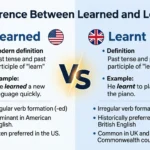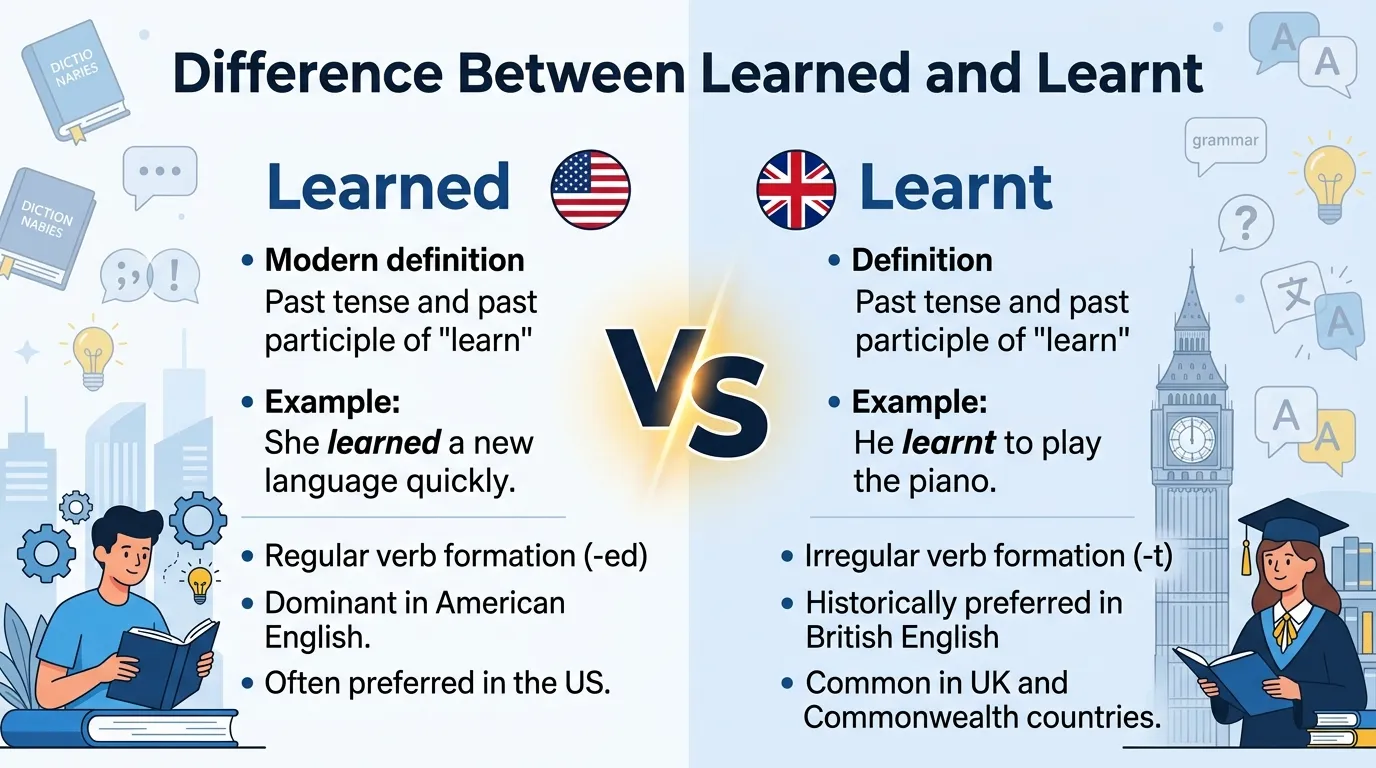
The difference between learned and learnt is mainly regional usage, “learned” is the preferred spelling in American English, while “learnt” is more commonly used in British English and other varieties of English.
Understanding the difference between learned and learnt is important for English learners, writers, students, and professionals. Many people become confused when they see both words used in books, articles, movies, or conversations. Since both forms relate to the verb “learn,” learners often wonder whether one is correct and the other is wrong. In reality, both are grammatically correct, but their usage depends largely on regional English preferences.
The difference between learned and learnt mainly appears in spelling style and geographical preference. “Learned” is widely used in American English, while “learnt” is more common in British English, Australian English, and some other international forms of English. Despite this variation, both words have the same meaning and function as the past tense and past participle of the verb “learn.”
Learning the difference between learned and learnt helps improve writing consistency and language accuracy. Whether you are preparing academic work, professional communication, or casual writing, understanding the difference between learned and learnt allows you to choose the form that best matches your audience and writing style.
Pronunciation
Learned
US: /lɝːnd/
Learnt
US & UK: /lɜːnt/
Key Difference Between the Both
The main difference between learned and learnt is that “learned” is preferred in American English, while “learnt” is more commonly used in British English and several other English dialects.
Why Is Their Difference Important?
Knowing the difference between learned and learnt is important because consistency matters in writing and communication.
For example:
- Academic institutions often prefer one style.
- Publishers follow regional language standards.
- Professional writing usually requires consistency.
Understanding the difference between learned and learnt also helps English learners recognize that language can vary across regions without changing meaning.
Difference Between Learned and Learnt
1. Regional Usage
“Learned” is common in American English.
“Learnt” is common in British English.
Examples
Learned:
- American textbooks
- US newspapers
Learnt:
- British novels
- UK publications
2. Spelling Style
Learned uses the “-ed” ending.
Learnt uses the “-t” ending.
Examples
Learned:
- Worked similarly to “played”
Learnt:
- Similar pattern to “dreamt” or “burnt”
3. Frequency of Use
“Learned” is more widely used globally.
“Learnt” is less common but still correct.
4. Formality
Both forms are acceptable in formal and informal writing.
5. Pronunciation Differences
“Learned” may sometimes be pronounced differently when used as an adjective.
Examples
Verb:
- “I learned French.”
Adjective:
- “A learned scholar.”
In adjective form, “learned” is pronounced /ˈlɝː.nɪd/.
6. Grammatical Function
Both function as:
- Past tense
- Past participle
Examples
Past Tense:
- “She learned quickly.”
- “She learnt quickly.”
Past Participle:
- “He has learned the lesson.”
- “He has learnt the lesson.”
7. Historical Development
“Learnt” comes from older English traditions.
“Learned” became more dominant in American English over time.
8. Usage in Education
American schools generally teach “learned.”
British schools often teach both forms.
9. Commonness in Media
American media mostly uses “learned.”
British media often uses “learnt.”
10. Writing Consistency
Writers should usually choose one form consistently within the same document.
Nature and Meaning of Both Words
The difference between learned and learnt does not affect meaning. Both words mean:
- Gained knowledge
- Acquired skill through study or experience
The distinction is mostly stylistic and regional rather than grammatical.
Why People Are Confused?
People often become confused about the difference between learned and learnt because English contains many verbs with two acceptable past forms.
Examples include:
- Burned / burnt
- Dreamed / dreamt
- Spoiled / spoilt
Because both forms are correct, learners sometimes assume one must be incorrect.
Another reason for confusion is exposure to different media sources. Someone reading both American and British English may encounter both spellings regularly.
Comparison Table
| Feature | Learned | Learnt | Similarity |
| Main Usage | American English | British English | Same meaning |
| Ending | -ed | -t | Past forms of “learn” |
| Formality | Formal & informal | Formal & informal | Grammatically correct |
| Frequency | More common globally | Less common | Used in writing |
| Meaning | Acquired knowledge | Acquired knowledge | Same function |
Examples in Sentences
Learned Examples
- “I learned Spanish in school.”
- “She learned how to drive.”
- “They learned valuable lessons.”
Learnt Examples
- “I learnt French in college.”
- “He learnt the truth later.”
- “We learnt new skills during training.”
Learned as an Adjective
One important part of the difference between learned and learnt is that “learned” can also function as an adjective.
Example:
- “He is a learned professor.”
In this case, “learned” means highly educated or scholarly and is pronounced differently.
“Learnt” is not normally used this way.
Historical Background
The word “learn” comes from Old English. Historically, both “learned” and “learnt” developed naturally as acceptable forms.
Over time:
- American English favored “learned.”
- British English continued using both, especially “learnt.”
This historical evolution explains the modern difference between learned and learnt.
Which Is Better in What Situation?
Learned
Best for:
- American audiences
- US academic writing
- International business writing
Common Contexts
- American textbooks
- Corporate communication
- US websites
Learnt
Best for:
- British audiences
- UK publications
- Traditional British writing
Common Contexts
- British newspapers
- UK schools
- Commonwealth English usage
Advantages of Knowing Both Forms
Understanding the difference between learned and learnt helps:
- Improve reading comprehension
- Avoid unnecessary corrections
- Adapt writing for different audiences
- Recognize regional language differences
Common Mistakes
Mistake 1: Thinking One Form Is Incorrect
Incorrect belief:
- “Learnt is wrong.”
Reality:
- Both are correct.
Mistake 2: Mixing Styles
Example:
- “I learnt math and later learned science.”
While not technically wrong, consistent style is usually preferred.
Educational Importance
The difference between learned and learnt is important in language education because it demonstrates how English varies internationally.
It also teaches students:
- Regional spelling differences
- Language evolution
- Writing consistency
Frequently Asked Questions
1. What is the main difference between learned and learnt?
“Learned” is mainly American English, while “learnt” is mainly British English.
2. Are both grammatically correct?
Yes.
3. Which form is more common worldwide?
“Learned.”
4. Can “learned” be an adjective?
Yes.
5. Should I use both in the same document?
Usually no; consistency is recommended.
Real-Life Importance
Understanding the difference between learned and learnt helps students, writers, and professionals communicate effectively with international audiences.
It is especially useful in:
- Academic writing
- Editing
- Publishing
- Language learning
Conclusion
The difference between learned and learnt mainly lies in regional preference rather than meaning. “Learned” is the preferred form in American English, while “learnt” is more commonly used in British English and other international varieties of English.
Both forms are grammatically correct and carry the same meaning. Understanding the difference between learned and learnt helps improve writing consistency, language awareness, and communication skills. By learning the difference between learned and learnt, English learners can confidently recognise and use both forms correctly in different contexts.

I’m Shabbir Hussain, a professional content writer who specializes in clear and authentic comparisons between similar terms. I write concise, research-based, and reader-friendly content that turns complex language into simple explanations. Through Mysynonyms.com, I help readers strengthen their vocabulary and clearly understand word differences.